
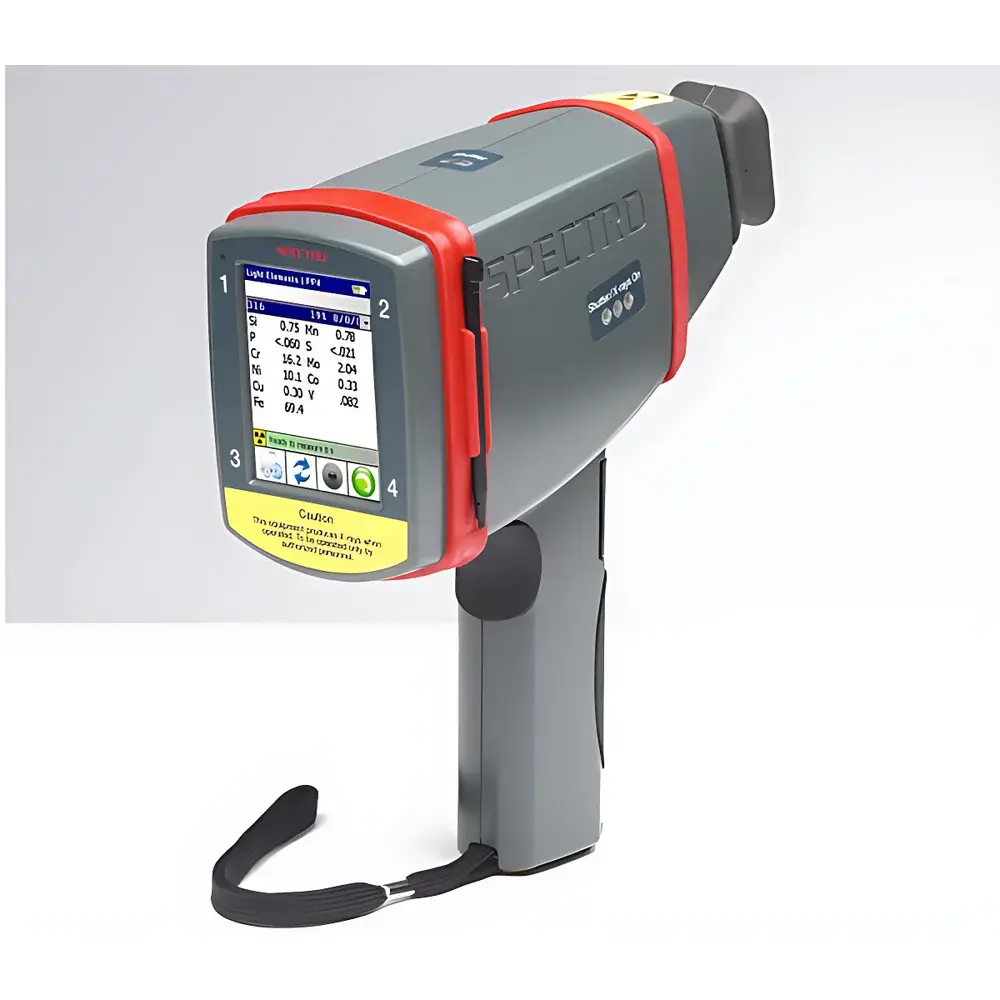
SPECTRO xSORT Handheld Energy Dispersive X-Ray Fluorescence Spectrometer
| Brand | SPECTRO |
|---|---|
| Origin | Germany |
| Type | Handheld/Portable |
| Model | xSORT |
| Element Range | Mg–U (47 elements) |
| Detection Limit | 7 ppm |
| Concentration Range | 7 ppm – 99.99% |
| Energy Resolution | 140 eV (at Mn Kα) |
| Repeatability | ≤ 0.1% RSD |
| Safety Compliance | EN 62471, IEC 61010-1, EU RoHS Directive |
| Weight | 1.64 kg (3.62 lb) |
| Dimensions (H×W×D) | 270 × 93 × 230 mm |
| Light Element Analysis | Mg, Al, Si, P in air |
| Analysis Time | 2–60 s |
Overview
The SPECTRO xSORT is a handheld energy dispersive X-ray fluorescence (EDXRF) spectrometer engineered for precision elemental analysis in demanding field environments. Based on the fundamental principle of X-ray fluorescence—where primary X-rays excite atoms in a sample, causing emission of characteristic secondary X-rays—the instrument quantifies elemental composition by detecting energy-specific photon emissions using a high-resolution silicon drift detector (SDD). Designed and manufactured in Germany to stringent DIN/ISO quality standards, the xSORT delivers laboratory-grade analytical performance without requiring sample preparation, vacuum chambers, or external helium purging—even for light elements (Mg, Al, Si, P) analyzed in ambient air. Its ergonomic, all-in-one architecture integrates radiation shielding, thermal management, and real-time spectral processing to meet European safety directives (EN 62471, IEC 61010-1) while enabling rapid deployment across geographically dispersed or logistically constrained sites.
Key Features
- High-performance SDD detector with 140 eV energy resolution at Mn Kα, ensuring sharp peak separation and accurate multi-element quantification.
- Real-time ICAL (Intelligent Calibration) system: built-in calibration reference block enables automatic spectral recalibration before each measurement—eliminating reliance on external standards and minimizing drift-related uncertainty.
- Integrated 2-megapixel CCD camera with crosshair overlay for precise targeting; visual confirmation and geotagged image capture synchronized with spectral data.
- Embedded GPS module records latitude, longitude, and altitude with each measurement—critical for environmental monitoring, mining surveys, and regulatory reporting traceability.
- Triple-layer safety architecture: hardware shutter, interlock circuitry, and user-level password protection compliant with IEC 62471 risk group classification.
- Ruggedized IP54-rated enclosure with reinforced magnesium alloy housing, drop-tested to 1 m, and operational across −10 °C to +50 °C ambient conditions.
Sample Compatibility & Compliance
The xSORT supports direct, non-destructive analysis of heterogeneous, irregular, or unprepared samples—including soils, sediments, ores, alloys, polymers, electronic components, and airborne particulates. No grinding, pressing, or acid digestion is required. It complies with international method standards including ASTM E1621 (EDXRF analysis of metals), ASTM E2587 (statistical process control for alloy verification), and ISO 17025–accredited testing workflows. For regulated applications such as RoHS/WEEE compliance screening, EPA Method 6200 (field portable XRF for soil metals), and EU CLP labeling, the instrument’s documented measurement uncertainty, audit-ready data logs, and 21 CFR Part 11–compatible software options support GLP/GMP-aligned documentation requirements.
Software & Data Management
SPECTRO’s proprietary SPECTRO XRF Software provides intuitive touchscreen operation, customizable method libraries, and automated grade identification (e.g., UNS, EN, ASTM alloy codes). All spectra, images, GPS metadata, operator ID, and timestamp are stored in encrypted SQLite databases with configurable export formats (CSV, PDF, XML). Remote firmware updates, spectral library expansion, and QC report generation—including control charting per ISO 8258—are supported via secure USB or Wi-Fi sync. Audit trails record every calibration event, parameter change, and user login—fully traceable for internal QA reviews or third-party accreditation audits.
Applications
- Metal Manufacturing & Scrap Recycling: Positive material identification (PMI), alloy sorting (e.g., stainless steels, aluminum grades), and melt shop QC with <2 s measurement cycles for 41 elements; extended 60 s mode covers Mg–U (47 elements).
- Environmental Monitoring: In-situ soil screening for As, Pb, Cd, Cr, Hg per EPA Region 10 protocols; detection limits down to 7 ppm enable rapid delineation of contamination plumes.
- Geology & Mining: Real-time ore grade estimation (Fe, Cu, Zn, Ni, REEs), lithological mapping, and core logging without lab turnaround delays.
- Consumer Product Safety: RoHS-compliant screening of Pb, Cd, Hg, Cr⁶⁺, Br (as PBB/PBDE) in plastics, coatings, and electronics assemblies.
- Cultural Heritage & Archaeology: Non-invasive pigment and metal artifact analysis—preserving integrity while resolving provenance and manufacturing techniques.
FAQ
Does the xSORT require helium purge or vacuum for light element analysis?
No. The optimized X-ray tube geometry, high-efficiency SDD, and advanced background suppression algorithms enable reliable Mg, Al, Si, and P quantification in ambient air—no auxiliary gas or evacuation systems needed.
How is measurement repeatability verified in the field?
Each analysis includes internal statistical validation (RSD ≤ 0.1% for major elements); optional daily QC checks using certified reference materials (CRMs) can be logged and trended within the software.
Can raw spectral data be exported for third-party processing?
Yes. Full-resolution .spc files—including intensity counts per channel, live time, dead time, and tube parameters—are exportable for offline deconvolution or multivariate modeling in platforms like PyMCA or AXIL.
Is the device suitable for ISO/IEC 17025 accredited laboratories?
When deployed with documented SOPs, annual performance verification (per ASTM E2891), and traceable CRMs, the xSORT meets technical requirements for field-based accredited testing—subject to scope-specific assessment by the accrediting body.
What battery life can be expected during continuous operation?
Standard lithium-ion battery supports ≥ 8 hours of typical usage (10–15 s measurements); hot-swappable dual-battery option extends operation to >14 hours without shutdown.
Related Products






