
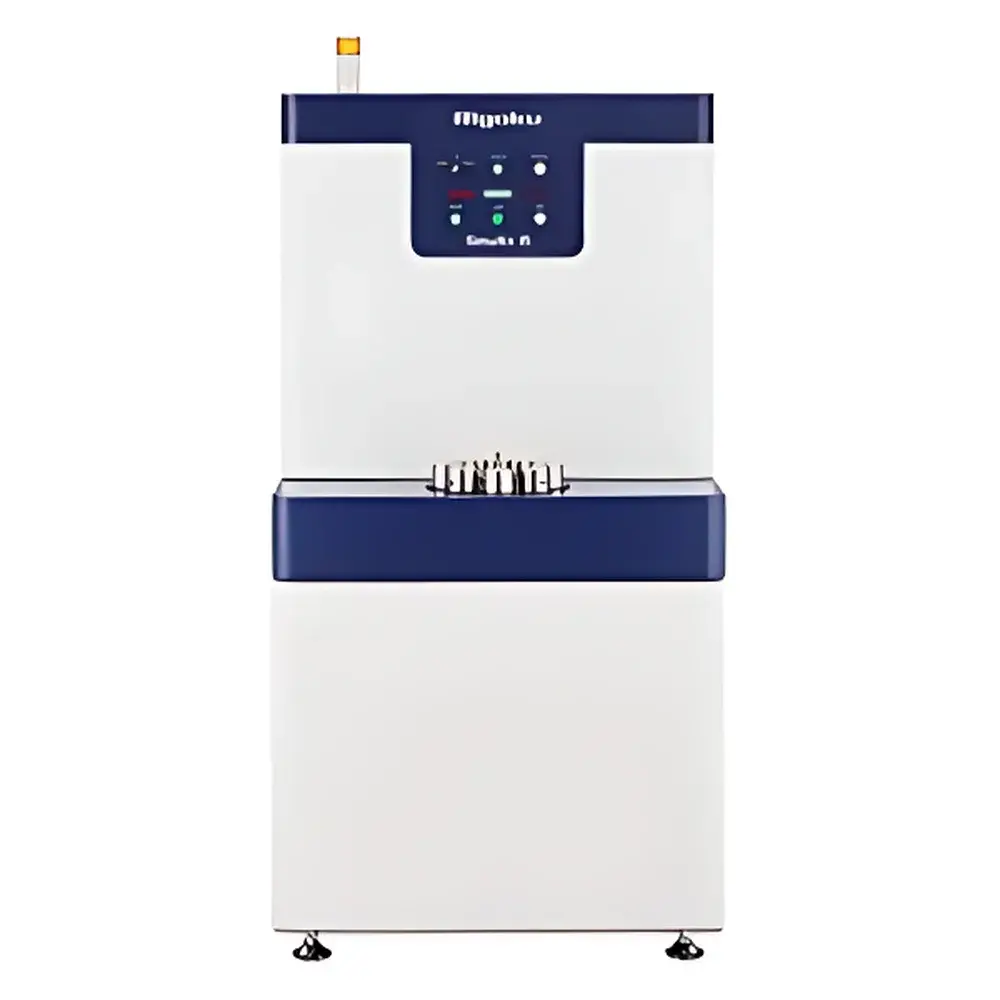
Rigaku Simultix 15 Wavelength Dispersive X-Ray Fluorescence (WDXRF) Spectrometer
| Brand | Rigaku |
|---|---|
| Origin | Japan |
| Model | Simultix 15 |
| Instrument Type | Floor-standing |
| X-ray Tube Power | 4 kW |
| Analytical Element Range | Be (4) to U (92) |
| Beryllium Window Thickness | 30 µm |
| Goniometer Angular Reproducibility | ±0.0001° |
| Detector Configuration | Simultaneous Multi-channel (Standard 30 channels, upgradable to 40) |
| Optional Features | XRD Channel, Curved Crystal Optics, Automatic Pressure Control (APC), Background Measurement (BG), Compton Scattering Ratio Calibration, Unattended Operation with 48-position ASC |
Overview
The Rigaku Simultix 15 is a floor-standing, simultaneous wavelength dispersive X-ray fluorescence (WDXRF) spectrometer engineered for high-precision, high-throughput elemental analysis in industrial quality control and research environments. Based on the well-established Bragg diffraction principle—where characteristic X-ray fluorescence lines are dispersed by analyzing crystals at precisely controlled angles—the Simultix 15 delivers quantitative and semi-quantitative results across the full elemental range from beryllium (Z = 4) to uranium (Z = 92). Its fixed-channel architecture enables real-time, parallel detection of up to 40 elements without mechanical scanning delays, making it particularly suited for production-critical applications in metallurgy, cement, mining, and raw material certification where repeatability, long-term stability, and regulatory compliance are paramount.
Key Features
- Simultaneous multi-channel detection with standard 30 fixed channels, expandable to 40—ensuring sub-second per-element dwell times and total analysis cycles under 60 seconds for routine samples.
- High-power 4 kW sealed-tube X-ray source with 30 µm Be window, optimized for both light-element excitation (e.g., Na, Mg, Al, Si) and trace heavy-metal sensitivity (e.g., Pb, As, Cd).
- Goniometer with angular reproducibility of ±0.0001°, supporting rigorous calibration traceability and long-term drift compensation required for ISO/IEC 17025-accredited laboratories.
- Integrated XRD channel enabling concurrent phase identification and crystallinity assessment alongside elemental quantification—critical for mineralogical analysis of ores, slags, and clinker.
- RX85 synthetic multilayer crystals delivering ~30% higher intensity for low-Z elements (e.g., B-Kα, Be-Kα) compared to conventional multilayers, improving signal-to-noise ratio and detection limits.
- Optional curved crystal optics for fixed channels—enhancing peak intensity and resolution over planar counterparts without sacrificing alignment stability.
- Automatic Pressure Control (APC) system maintains stable vacuum conditions (<1 Pa) in the optical path, minimizing absorption artifacts for accurate light-element (Z < 11) quantification.
Sample Compatibility & Compliance
The Simultix 15 accepts solid discs (32–40 mm diameter), fused beads, pressed pellets, and thin films—compatible with industry-standard sample preparation workflows. Its robust mechanical design supports continuous 24/7 operation in plant-floor environments. The system complies with IEC 61000-6-3 (EMC), IEC 61000-6-4 (industrial emission), and meets essential safety requirements per IEC 62471 (LED/X-ray radiation safety). Data integrity features—including audit trails, electronic signatures, and user-access levels—support adherence to FDA 21 CFR Part 11, ISO 17025, and GLP/GMP documentation standards. All calibrations are traceable to NIST SRM reference materials, and factory validation includes performance verification per ASTM E1361 and ISO 20053.
Software & Data Management
Rigaku’s proprietary ZSX software platform provides a unified interface for method development, instrument control, and report generation. The workflow follows a standardized quantitative analysis sequence: background correction → matrix effect modeling (based on fundamental parameters or empirical coefficients) → calibration curve fitting → uncertainty estimation. Advanced tools include Compton scattering ratio calibration for ore grade determination, automatic background measurement (BG) for improved peak deconvolution, and FP-based semi-quantitative screening without standards. Data export supports CSV, XML, and LIMS-compatible formats (ASTM E1382-compliant). All analytical sessions are timestamped and logged with full parameter metadata, satisfying audit requirements for regulated industries.
Applications
- Process control in iron & steel plants: rapid quantification of alloying elements (Cr, Ni, Mo, Mn), tramp elements (Sn, As, Sb), and slag components (CaO, SiO₂, Al₂O₃).
- Cement and building materials: full oxide analysis (LOI, SO₃, MgO, K₂O, Na₂O) with <0.1 wt% precision for kiln feed and final product certification.
- Mining and mineral processing: grade control of base metal concentrates (Cu, Zn, Pb), REE-bearing ores, and environmental monitoring of tailings (Cd, Hg, Se).
- Recycled material verification: sorting and compliance screening for RoHS/ELV-regulated elements (Br, Cl, Cr, Pb, Hg, Cd) in plastics and metals.
- Geological surveying: field-lab correlation using fused bead protocols aligned with USGS and CSIRO reference methods.
FAQ
What is the minimum detectable limit (MDL) for sodium (Na) in glass matrices?
MDLs are matrix- and condition-dependent; typical values under optimized vacuum and APC conditions range from 10–50 ppm for Na in silicate glasses using the RX85 crystal and 4 kW excitation.
Can the Simultix 15 perform quantitative analysis without certified reference materials?
Yes—via Fundamental Parameters (FP) mode with optional wide-range goniometer, enabling rapid semi-quantitative screening and calibration-free assay for unknown or heterogeneous samples.
Is XRD data collected simultaneously with XRF, or does it require sequential measurement?
The XRD channel operates concurrently with XRF acquisition using a dedicated detector path and independent goniometer segment—no time penalty for combined analysis.
How is spectral interference managed for overlapping peaks such as V-Kβ and Ti-Kα?
Peak deconvolution uses iterative least-squares fitting with pre-characterized line shapes and background models; optional BG measurement further refines baseline definition for complex matrices.
What maintenance intervals are recommended for the X-ray tube and vacuum system?
The sealed X-ray tube is rated for ≥20,000 hours; vacuum pumps require oil change every 6 months and filter replacement annually—both tracked via built-in service timers and alert logs.





