
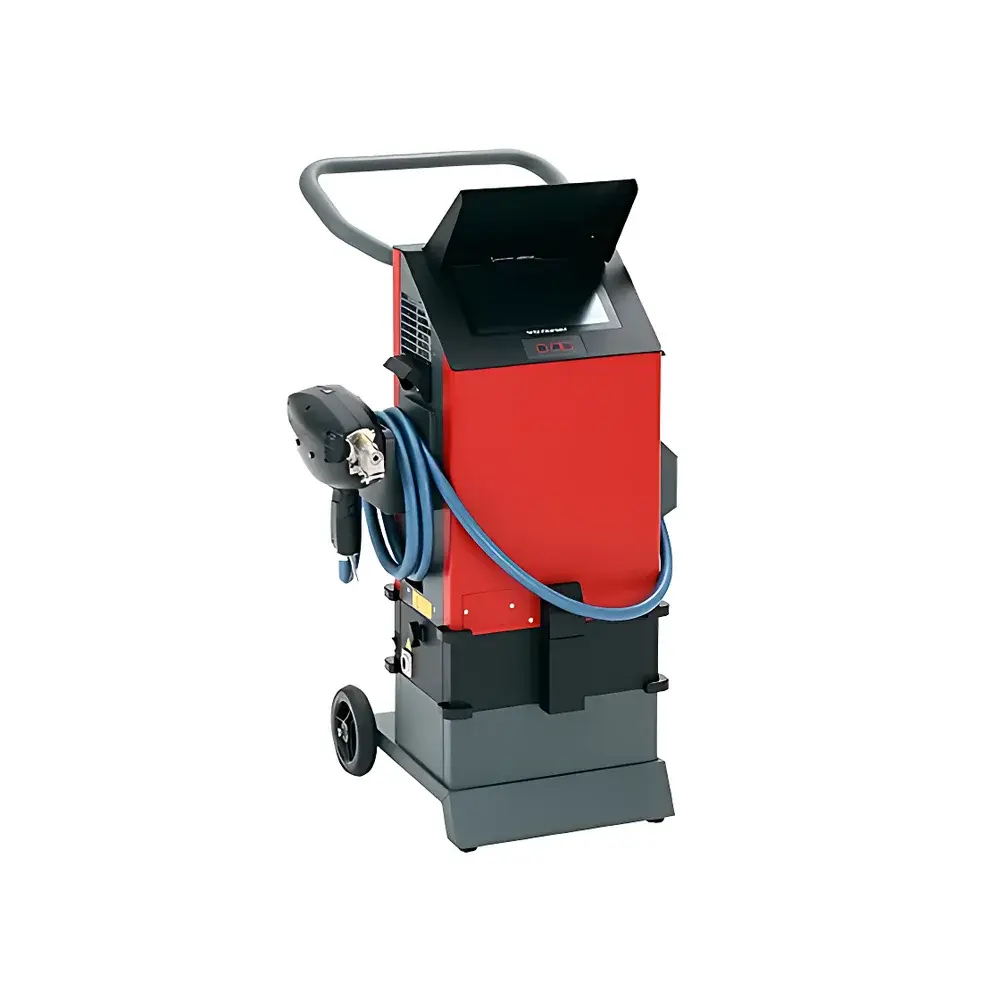
SPECTRO PORT Portable Spark Emission Spectrometer
| Brand | SPECTRO |
|---|---|
| Origin | Germany |
| Model | PORT |
| Instrument Type | Portable / Mobile |
| Excitation Source | Spark |
| Detector Type | Dual Detector (PMT + CCD) |
| Focal Length | 400 mm |
| Grating Groove Density | 3600 lines/mm |
| Wavelength Range | 178–530 nm |
| Spectral Coverage | Full-Spectrum Acquisition |
| Compliance | Designed for ISO/IEC 17025-compliant metal analysis workflows, supports ASTM E415, E1086, and EN 10315 traceability requirements |
Overview
The SPECTRO PORT is a high-performance portable spark emission spectrometer engineered for precise, on-site elemental analysis of metallic materials. Unlike X-ray fluorescence (XRF) analyzers—commonly deployed for rapid alloy sorting—the SPECTRO PORT employs optical emission spectroscopy (OES) based on controlled spark excitation, enabling quantitative determination of light elements critical to metallurgical classification: carbon (C), phosphorus (P), sulfur (S), boron (B), and nitrogen (N) in select configurations. Its core optical architecture features a 400 mm Paschen-Runge spectrometer with a high-resolution 3600 lines/mm grating, delivering spectral resolution sufficient for resolving complex inter-element overlaps in low-alloy steels, stainless grades, aluminum alloys, and nickel-based superalloys. The instrument operates across a broad wavelength range (178–530 nm), covering key analytical lines for C I (193.09 nm), P I (178.28 nm), S I (180.73 nm), and B I (249.77 nm), among others. Designed for field-deployable reliability, the SPECTRO PORT integrates thermal-stable optics and iCAL².0 intelligent calibration technology to maintain spectral alignment and intensity stability across ambient temperature fluctuations from –10 °C to +45 °C—eliminating routine recalibration under variable environmental conditions.
Key Features
- Dual-Detector Architecture: Combines photomultiplier tubes (PMTs) for high-sensitivity, low-noise detection of critical trace elements (e.g., C, P, S) with a complementary CCD array for simultaneous full-spectrum acquisition—enabling both precision quantification and spectral diagnostics.
- Thermally Adaptive Optics: Patented optical bench design minimizes thermal drift; no external heating or cooling required. iCAL².0 continuously monitors and compensates for minor wavelength shifts using internal reference lines, ensuring long-term measurement reproducibility without user intervention.
- True Field Portability: Weighing under 18 kg (including battery), the unit supports multiple deployment modes: handheld operation with ergonomic trigger handle, wheeled trolley mounting (standard and compact variants), and integrated rechargeable Li-ion battery pack rated for ≥6 hours of continuous spark analysis—ideal for shipyard decks, refinery pipe racks, construction sites, and scrap yard sorting bays.
- One-Touch Operation: Preloaded grade libraries (ASTM, DIN, EN, JIS, GB) enable automatic material identification with minimal operator input. Spark parameter optimization (energy, frequency, pre-spark duration) is fully automated per matrix, reducing dependency on expert spectroscopist oversight.
- Ruggedized Industrial Design: IP54-rated enclosure, shock-absorbing housing, and reinforced spark stand with auto-aligning electrode system ensure durability during transport and repeated use on rough surfaces, weld seams, and curved geometries.
Sample Compatibility & Compliance
The SPECTRO PORT analyzes solid metallic samples—including castings, forgings, rolled plates, bars, pipes, weld deposits, and scrap fragments—without requiring extensive surface preparation beyond standard grinding (Ra ≤ 3.2 µm). It complies with international standards governing metallic material verification: ASTM E415 (carbon steel), E1086 (stainless steels), E1479 (aluminum alloys), and EN 10315 (scrap metal specification). Data integrity meets GLP/GMP-aligned documentation requirements, with optional audit-trail-enabled software supporting FDA 21 CFR Part 11 compliance for regulated environments. All calibrations are traceable to NIST SRMs and certified reference materials (CRMs) from BAM, IRMM, and LGC.
Software & Data Management
Controlled via the SPECTRO Analytical Instruments’ WinWAS software suite, the SPECTRO PORT delivers intuitive workflow management—from method selection and spark sequence initiation to real-time spectrum visualization and report generation. Software features include multivariate statistical outlier detection, batch reporting with PDF/CSV export, customizable certificate templates (including ISO/IEC 17025 header fields), and secure network synchronization with central LIMS systems. Raw spectral data (.spc) and processed results (.xls/.xml) are stored with embedded metadata (operator ID, GPS coordinates, timestamp, environmental sensor logs), enabling full chain-of-custody tracking for quality audits.
Applications
- On-site incoming/outgoing inspection of raw materials and finished components in foundries, rolling mills, and fabrication shops.
- Positive material identification (PMI) for piping systems, pressure vessels, and structural steel in oil & gas, power generation, and pharmaceutical infrastructure.
- Scrap metal sorting and recycling facility quality control—especially for separating low-carbon vs. medium-carbon steels where C content determines scrap value.
- Weld seam verification and heat-affected zone (HAZ) analysis in field construction and maintenance operations.
- Technical due diligence during plant acquisitions or supplier qualification audits requiring independent compositional validation.
FAQ
Can the SPECTRO PORT measure carbon in stainless steel?
Yes—using the C I 193.09 nm line with optimized spark parameters and argon purge, it achieves typical repeatability of ±0.015 wt% C in 304/316 grades at production-level throughput.
Is argon gas required for operation?
Yes—argon purging is essential to suppress atmospheric nitrogen and oxygen interference in the UV region (<200 nm); an integrated argon economizer mode reduces consumption by up to 40% versus conventional OES systems.
How often does the instrument require recalibration?
Under stable operating conditions, type-standardization via iCAL².0 extends recalibration intervals to ≥100 sparks or 8 hours of continuous use; daily verification with a single check standard is recommended per ISO/IEC 17025 clause 7.7.
Does it support analysis of coated or painted metals?
No—surface coatings must be mechanically removed prior to analysis, as spark ablation cannot penetrate organic or oxide layers reliably.
What is the minimum sample size for reliable analysis?
A flat, grounded area ≥15 mm in diameter is required; curvature radius should exceed 25 mm for consistent electrode contact and plasma stability.




