
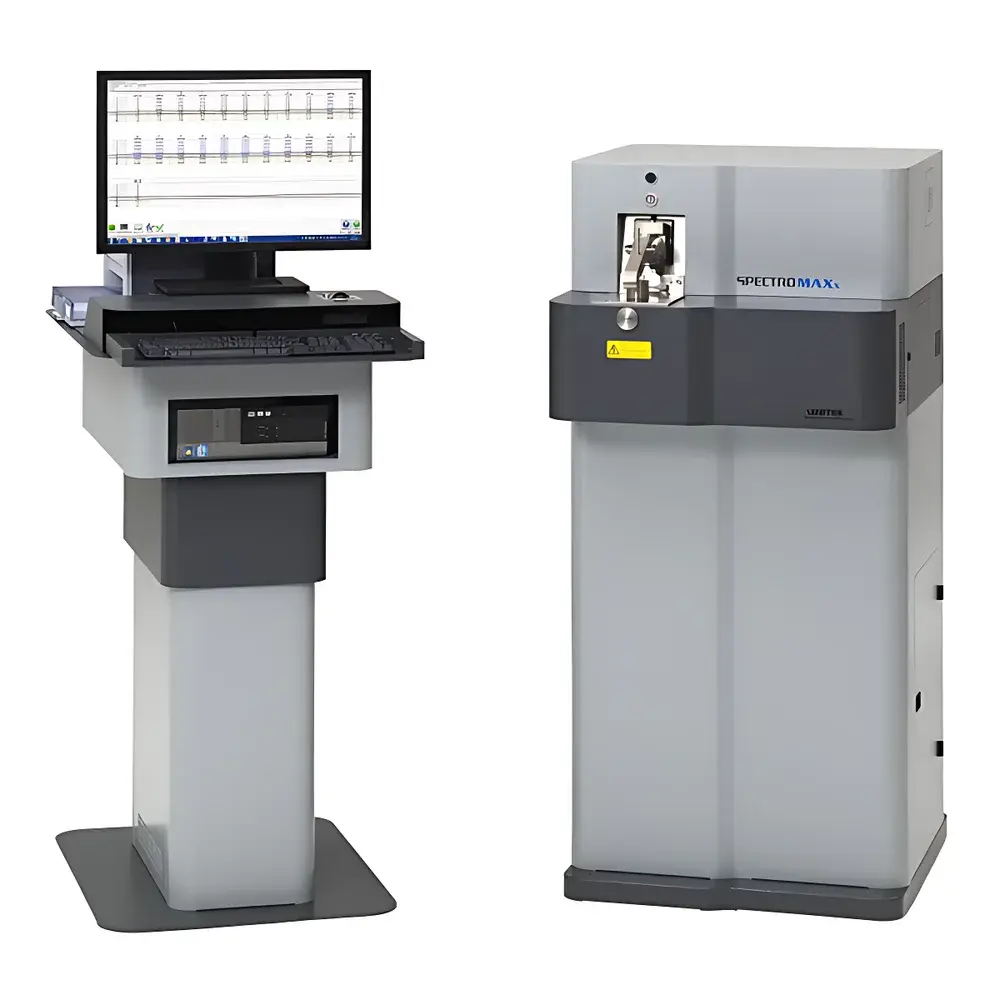
SPECTRO MAXx (LMX10) Floor-standing Spark Optical Emission Spectrometer
| Brand | SPECTRO |
|---|---|
| Origin | Germany |
| Model | SPECTRO MAXx (LMX10) |
| Instrument Type | Floor-standing |
| Excitation Method | Spark |
| Detector Type | CMOS |
| Focal Length | 750 mm |
| Grating Groove Density | 3600 lines/mm |
| Wavelength Range | 120–670 nm |
Overview
The SPECTRO MAXx (LMX10) is a high-performance floor-standing spark optical emission spectrometer (OES) engineered for precise, routine elemental analysis of metallic materials in foundries, metal production facilities, and quality control laboratories. Based on the fundamental principle of atomic emission spectroscopy, the instrument excites solid metal samples using a controlled high-energy spark discharge in an argon-purged atmosphere; emitted light is dispersed via a high-resolution Paschen–Runge optical system and detected across the full spectral range (120–670 nm) using a state-of-the-art CMOS detector array. This architecture enables simultaneous multi-element quantification—including challenging non-metals such as carbon (C), phosphorus (P), sulfur (S), and nitrogen (N)—with high sensitivity, repeatability, and long-term stability. Designed and manufactured in Germany, the MAXx (LMX10) integrates robust mechanical engineering with advanced digital plasma source control and intelligent calibration logic to deliver laboratory-grade accuracy in industrial environments.
Key Features
- Patented dual-optical-path Paschen–Runge spectrometer with 750 mm focal length and 3600 lines/mm holographic grating, ensuring high spectral resolution and minimal stray light
- Hermetically sealed optical chamber maintained at constant temperature and pressure to eliminate thermal drift and barometric influence on wavelength calibration
- Full-range CMOS detector enabling simultaneous acquisition of all spectral lines from 120 nm (vacuum UV) to 670 nm (visible), including critical C, P, S, and N lines without vacuum pumping
- Digital plasma generator with real-time current and voltage feedback for precise, reproducible spark excitation—optimized for low-noise, high-precision measurement of trace and major elements
- Open-type spark stand with motorized XYZ sample positioning, integrated grounding circuit, and modular fixture kits for rods, wires, thin sheets, and irregular geometries
- Intelligent CALibration (ICAL) technology: single-reference standard calibration across multiple base matrices (e.g., Fe, Al, Cu) in under 5 minutes—replacing traditional two-point calibrations requiring up to 50 minutes and dozens of standards
- Argon optimization system: dynamic gas flow control reduces argon consumption by up to 50%; fully automated purge-and-standby protocol shuts off argon during idle periods and re-purges the spark stand before analysis
- Tool-free optical access: front-panel lens assembly allows rapid cleaning or replacement without disassembly or realignment
Sample Compatibility & Compliance
The SPECTRO MAXx (LMX10) is validated for direct solid sampling of conductive metallic alloys—including ferrous (cast iron, steel), non-ferrous (aluminum, copper, nickel, titanium, zinc, and magnesium-based), and specialty superalloys. Sample preparation follows standardized metallurgical practices (e.g., grinding with SiC paper per ASTM E407, surface conditioning per ISO 11577). The instrument complies with international analytical standards including ASTM E1086 (analysis of stainless steels), ASTM E1999 (aluminum alloys), ISO 6871 (dental alloys), and EN 10315 (steel grade identification). Its hardware and software architecture support GLP/GMP workflows: audit trails, user access levels, electronic signatures, and data integrity features align with FDA 21 CFR Part 11 requirements when deployed with SPECTRO’s certified software suite.
Software & Data Management
Controlled via SPECTRO’s Windows-based SPECTRO Analytical Software (SAS), the MAXx (LMX10) provides intuitive method setup, real-time spectral visualization, automatic peak identification, and multivariate calibration modeling. All raw spectra are stored in vendor-neutral formats (e.g., .spc, ASCII export) and can be exported for third-party chemometric analysis. Built-in self-diagnostic routines continuously monitor lamp intensity, detector saturation, argon purity, and spark stability—generating actionable alerts and log files for preventive maintenance. Calibration data, QC checks, and instrument performance reports are archived with time-stamped metadata, supporting ISO/IEC 17025 documentation requirements. Optional integration with LIMS via OPC UA or ODBC ensures seamless data flow into enterprise QA/QC systems.
Applications
- Routine grade identification and positive material identification (PMI) in pipe fabrication, pressure vessel manufacturing, and aerospace component verification
- Low-carbon steel analysis for automotive stamping and cold-forming applications where C, N, and interstitial control is critical
- High-precision monitoring of residual elements (e.g., Sn, As, Pb) in aluminum recycling streams per EN 573-3
- Quality assurance of wear-resistant castings (e.g., high-Cr white irons) where Cr, Mo, Ni, and C/Si ratios define hardness and abrasion resistance
- Research and development of new alloy compositions, supported by full-spectrum recording and post-acquisition reprocessing capabilities
- Regulatory compliance testing for RoHS, REACH, and ELV directives requiring accurate quantification of restricted substances in metallic components
FAQ
What vacuum requirements does the SPECTRO MAXx (LMX10) have for UV spectral lines?
No vacuum pump is required—the optical chamber is sealed and purged with argon to enable stable detection down to 120 nm.
Can the instrument analyze non-conductive samples?
No. As a spark OES system, it requires electrically conductive solid metal samples. Non-conductors must be analyzed using alternative techniques such as arc/spark with conductive coating or XRF.
How frequently is recalibration needed under normal operation?
With ICAL, daily recalibration is typically unnecessary; a single reference check every 8–12 hours—or after major environmental shifts—is sufficient for most production environments.
Is remote diagnostics supported?
Yes—SPECTRO’s Remote Service Module (RSM) enables secure, encrypted technician access for real-time troubleshooting, firmware updates, and performance diagnostics.
What safety certifications does the system hold?
The MAXx (LMX10) conforms to IEC 61010-1 (electrical safety), IEC 61326-1 (EMC), and meets CE marking requirements for industrial instrumentation in the EU.




