
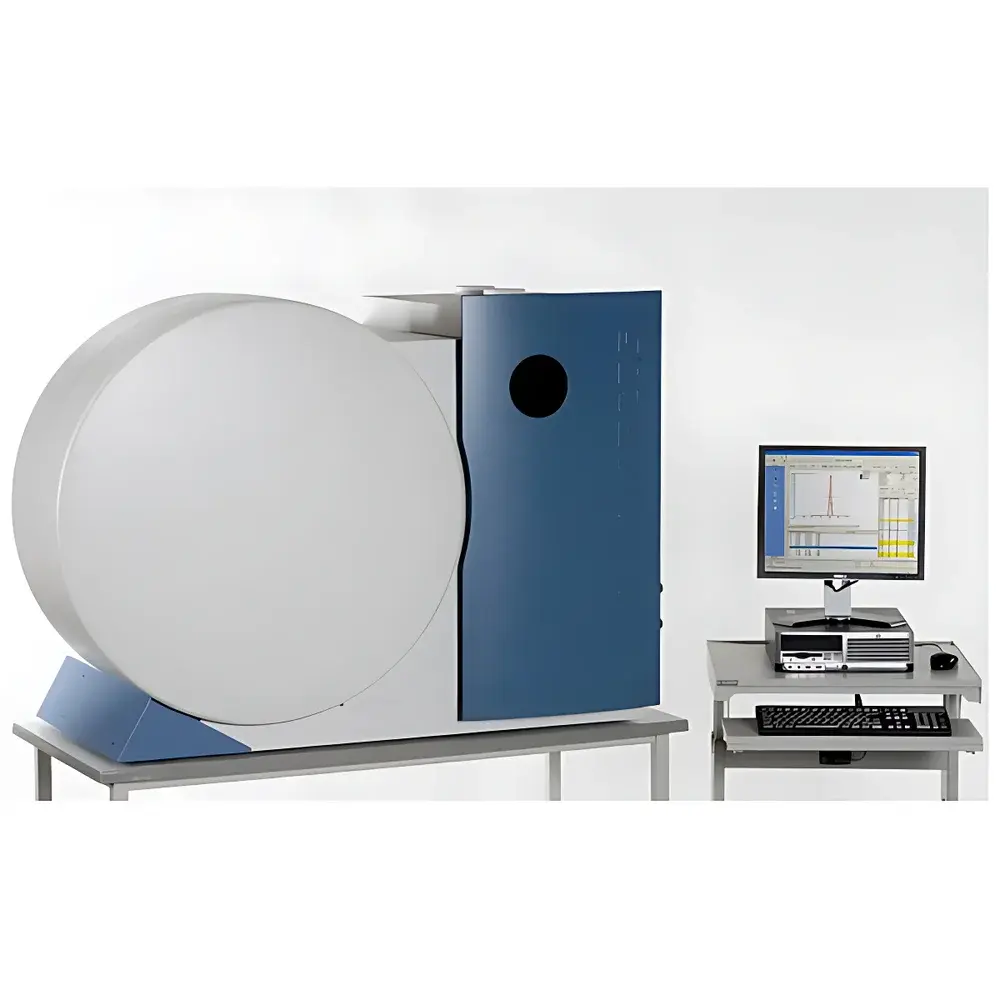
SPECTRO ARCOS Full-Spectrum Inductively Coupled Plasma Optical Emission Spectrometer
| Brand | SPECTRO |
|---|---|
| Origin | Germany |
| Model | ARCOS |
| Instrument Type | Full-Spectrum Direct-Reading ICP-OES |
| Detection Limit | Sub-ppb to ppm |
| Precision (RSD) | ≤1% |
| Long-Term Stability (Drift) | ≤0.1% |
| Wavelength Range | 130–770 nm |
| Optical Resolution | ≤0.008 nm |
Overview
The SPECTRO ARCOS Full-Spectrum Inductively Coupled Plasma Optical Emission Spectrometer is a high-performance, benchtop ICP-OES system engineered in Germany for demanding elemental analysis across research laboratories, industrial quality control, and regulatory-compliant testing environments. Based on robust inductively coupled plasma excitation and high-fidelity optical emission detection, the ARCOS employs a fixed, sealed, argon-purged echelle spectrometer with a solid-state CCD detector—enabling simultaneous acquisition of the entire UV-VIS-NIR spectral range (130–770 nm) without mechanical scanning. Its unique optical architecture eliminates the need for cryogenic cooling or continuous external argon purging for deep-UV lines (<190 nm), significantly reducing operational complexity and consumables dependency. The instrument’s plasma source delivers stable, adjustable RF power from 500 W to 2000 W, supporting both aqueous and volatile organic matrices—including gasoline and other hydrocarbon-based samples—without matrix-induced signal suppression or torch degradation.
Key Features
- True full-spectrum acquisition in ≤3 seconds per sample—enabling quantitative multi-element analysis of up to 73 elements within 30 seconds.
- Patented sealed, temperature-stabilized echelle optical path with integrated argon recirculation—ensures long-term wavelength calibration stability and eliminates external gas consumption for UV line detection.
- No liquid nitrogen or thermoelectric cooling required: the back-thinned CCD detector operates at ambient temperature with ultra-low dark current, enabled by proprietary low-noise air-cooling design.
- Automated plasma torch alignment via 3-axis stepper-motor-controlled positioning; quick-connect torch interface enables tool-free installation and automatic optical recalibration.
- Mass flow-controlled gas delivery (plasma, auxiliary, nebulizer) with real-time digital feedback—ensuring reproducible plasma conditions across batches and operators.
- High-power RF generator with adaptive impedance matching—maintains stable plasma under variable matrix loads, including high-salt, high-organic, or high-acid content samples.
Sample Compatibility & Compliance
The ARCOS accommodates a broad spectrum of sample types: acid-digested environmental solids, metallurgical alloys, petrochemical distillates, food digestates, pharmaceutical excipients, and geological leachates. Its axial/radial dual-view capability (MultiView™) allows user-selectable observation geometry optimized for sensitivity (axial) or robustness against matrix interferences (radial). The system meets key international standards for analytical validation, including ISO/IEC 17025 method verification requirements, ASTM D1944 (petroleum metals), EPA Methods 200.7 and 6020B (water and wastewater), and USP for elemental impurities in pharmaceuticals. All instrument parameters, measurement logs, and calibration history are timestamped and audit-trail enabled—supporting compliance with FDA 21 CFR Part 11 and GLP/GMP documentation protocols.
Software & Data Management
Controlled by SPECTRO’s Sparkvue™ software suite, the ARCOS provides intuitive workflow-driven operation—from method setup and calibration to automated QC checks and report generation. The software supports multi-level user permissions, electronic signatures, and secure data export in ASTM E1382-compliant formats. Quantitative analysis leverages internal standardization, matrix-matched calibration, and optional multivariate correction algorithms (e.g., inter-element correction, background modeling). Raw spectral data is stored in vendor-neutral HDF5 format, ensuring long-term archival integrity and third-party spectral library interoperability. All system events—including lamp status, gas pressure deviations, and detector temperature fluctuations—are logged in real time for root-cause analysis during method troubleshooting or regulatory audits.
Applications
The ARCOS is routinely deployed in applications requiring trace-level multi-element quantification with high throughput and minimal operator intervention. These include: monitoring heavy metal contaminants (As, Cd, Pb, Hg) in drinking water per WHO guidelines; quantifying alloying elements (Cr, Ni, Mo, Co) in aerospace-grade superalloys; determining halogens (Cl, Br, I) in polymer additives and flame retardants—a capability unmatched by most ICP-OES platforms; screening catalyst poisons (V, Na, Fe) in refinery feedstocks; and validating elemental impurity profiles in active pharmaceutical ingredients (APIs) per ICH Q3D. Its ability to analyze volatile organics without solvent dilution or oxygen addition makes it especially valuable for fuel analysis labs subject to ASTM D5185 and D7260.
FAQ
Does the ARCOS require liquid nitrogen or external chiller units?
No—the detector uses an advanced air-cooling system with patented thermal management, eliminating cryogens and auxiliary chillers.
Can it measure chlorine, bromine, and iodine reliably?
Yes—its extended UV sensitivity down to 130 nm enables direct detection of Cl I 134.724 nm, Br I 153.029 nm, and I I 178.278 nm with sub-ppb detection limits.
Is the system compliant with FDA 21 CFR Part 11?
Yes—Sparkvue™ software includes full electronic signature support, audit trail logging, and role-based access control aligned with Part 11 requirements.
What sample introduction options are supported?
Standard configuration includes glass concentric nebulizer and cyclonic spray chamber; optional accessories include microflow nebulizers, ultrasonic nebulizers, laser ablation modules, and hydride generation systems.
How often does the optical system require recalibration?
The sealed, thermostatically controlled echelle optics maintain wavelength calibration for ≥6 months under routine use; automated daily wavelength verification is recommended but not mandatory.





