
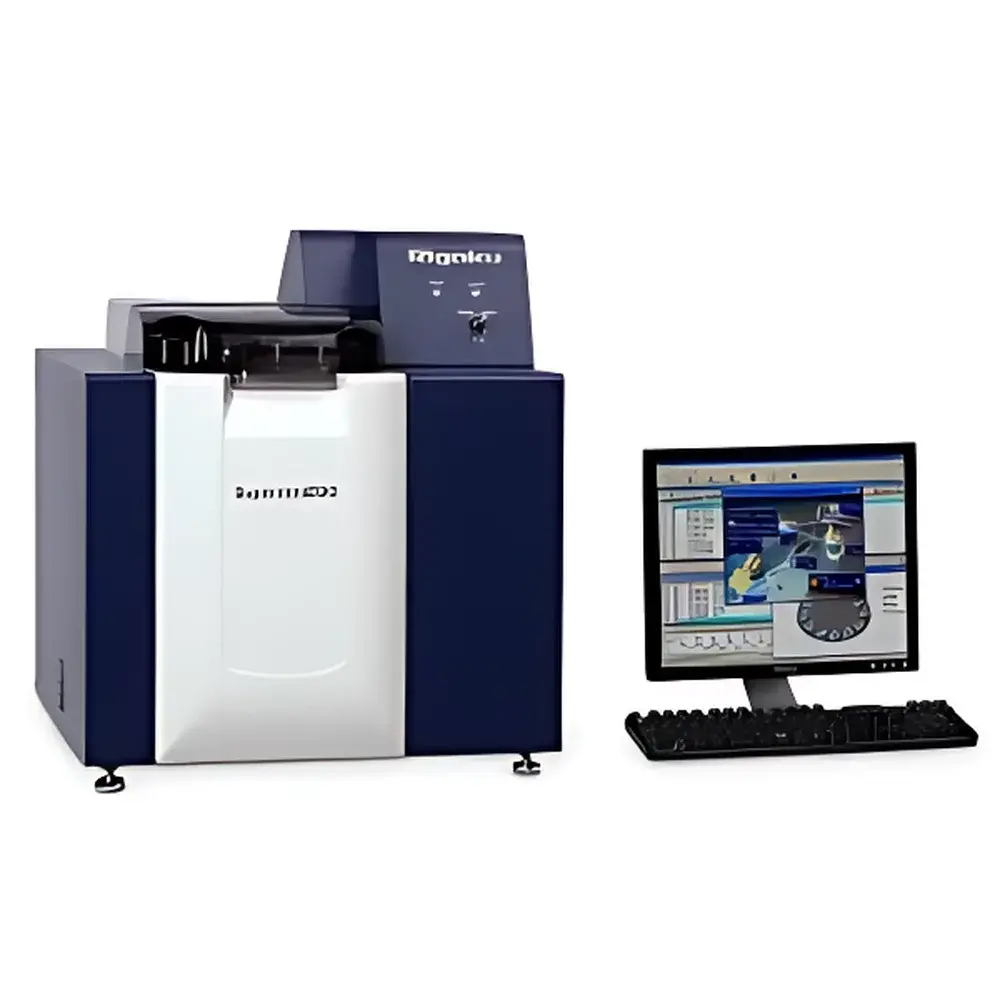
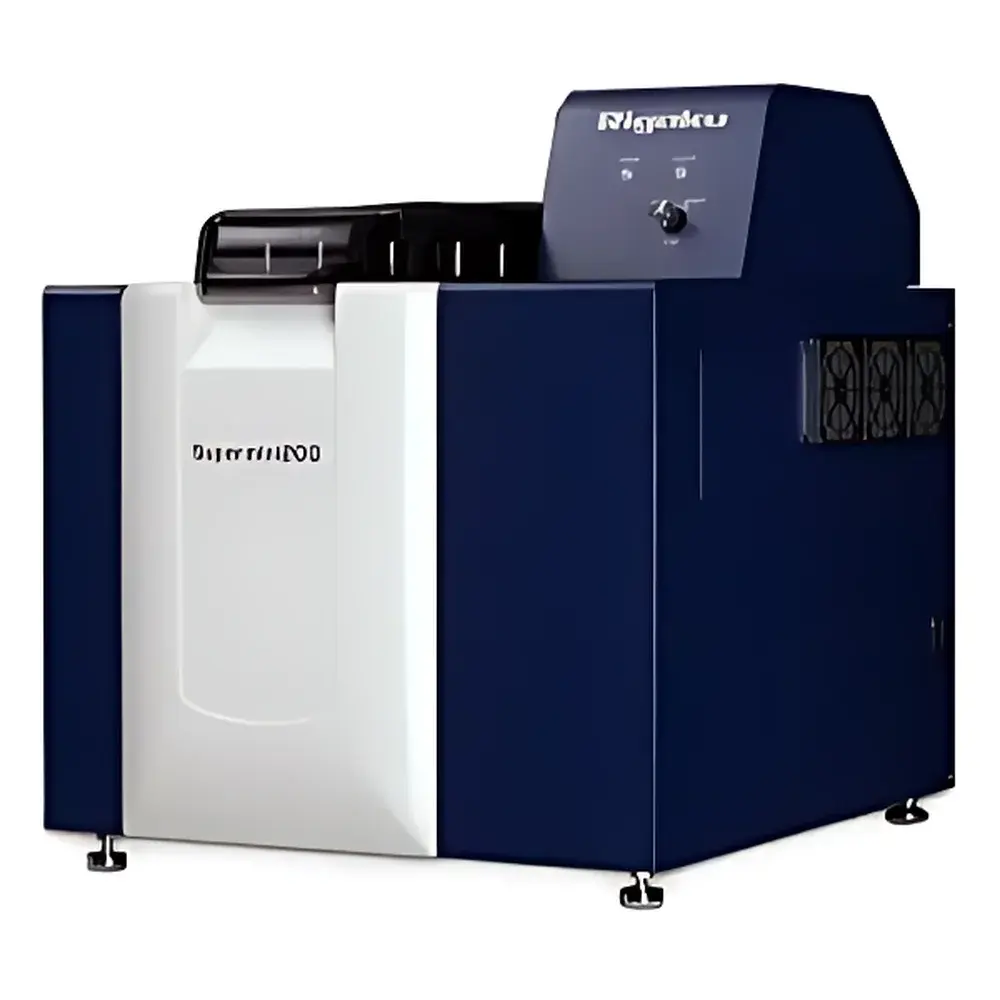
Rigaku Supermini 200 Wavelength Dispersive X-Ray Fluorescence Spectrometer
| Brand | Rigaku |
|---|---|
| Origin | Japan |
| Model | Supermini 200 |
| Instrument Type | Benchtop |
| X-ray Tube Power | 200 W |
| Elemental Range | Oxygen (O, Z=8) to Uranium (U, Z=92) |
| Instrument Class | Scanning-type WDXRF |
| Compliance | CE certified |
| Cooling | Air-cooled tube |
| Gas Consumption | Low-flow P-10 gas (Ar/CH₄) |
| Sample Handling | 12-position automatic sampler |
| Operating Environment | Vacuum or He-purged |
Overview
The Rigaku Supermini 200 is a benchtop wavelength dispersive X-ray fluorescence (WDXRF) spectrometer engineered for high-sensitivity elemental analysis across industrial, environmental, and regulatory compliance laboratories. Unlike energy dispersive XRF (EDXRF), WDXRF relies on Bragg diffraction from analyzing crystals to isolate characteristic X-ray wavelengths with exceptional spectral resolution—enabling precise peak separation even for adjacent elements (e.g., V/Cr, Mn/Fe, Pb/Bi). The Supermini 200 integrates a 200 W sealed-tube X-ray source, delivering photon flux comparable to floor-standing high-power WDXRF systems while retaining the mechanical stability, footprint efficiency, and operational simplicity of a benchtop platform. Its optical architecture employs fixed-channel goniometry with sequential crystal selection, optimized for reproducible intensity measurement and long-term calibration stability. Designed for routine use in QA/QC, raw material certification, and restricted substance screening (e.g., RoHS, ELV, WEEE), the system operates without liquid nitrogen cryocooling or external chilled water circuits—reducing infrastructure dependencies and total cost of ownership.
Key Features
- 200 W air-cooled X-ray tube: Enables sub-ppm detection limits for heavy elements (e.g., Pb, Cd, Hg, Cr) in metals, ceramics, and polymers—without requiring recirculating chillers or LN₂.
- Benchtop form factor: Fully self-contained design meets ISO 17025-compliant laboratory space constraints; installed on standard lab benches with minimal site preparation.
- Low P-10 gas consumption: Optimized detector gas flow reduces operating costs and supports uninterrupted multi-shift operation.
- 12-position automated sample changer: Supports unattended analysis of solids, pressed pellets, fused beads, liquids, and powders under vacuum or helium atmosphere.
- Crystal-based wavelength dispersion: Uses LiF(200), PET, and TAP analyzing crystals to cover the full elemental range from oxygen (O, 0.61 keV) to uranium (U, 98.4 keV) with <0.005° 2θ angular resolution.
- CE-marked and RoHS-compliant construction: Meets EU Machinery Directive 2006/42/EC and Electromagnetic Compatibility Directive 2014/30/EU requirements.
Sample Compatibility & Compliance
The Supermini 200 accommodates heterogeneous sample forms—including alloys, ores, cement clinker, soil digests, polymer extracts, and thin-film coatings—without matrix-matched standards in many cases due to its high peak-to-background ratio and fundamental parameter (FP) quantification engine. For regulated applications, it supports method validation per ASTM E1621 (standard test method for elemental analysis by WDXRF), ISO 21043 (XRF for cement and concrete), and IEC 62321-5 (RoHS screening of electrotechnical products). Data integrity complies with ALCOA+ principles: audit trails, electronic signatures, and user-access controls are embedded within the RIGAKU SQX software environment, facilitating GLP and GMP-aligned workflows. All measurements adhere to ISO/IEC 17025:2017 clause 7.2.2 (method validation) when configured with certified reference materials (CRMs) traceable to NIST or BAM.
Software & Data Management
Controlled by RIGAKU’s SQX software suite, the Supermini 200 provides a workflow-driven interface with ribbon-style navigation bars—eliminating modal dialogues and reducing operator training time. Quantitative analysis leverages both empirical calibration curves and FP modeling, with optional matrix correction algorithms (e.g., alpha coefficients, absorption-enhancement corrections). Raw spectra, background-subtracted intensities, and uncertainty estimates (k=2) are stored in vendor-neutral ASCII formats (.csv, .txt) and comply with ASTM E1357 data exchange standards. Audit logs record all method edits, calibration updates, and result approvals with timestamps and user IDs—fully satisfying FDA 21 CFR Part 11 requirements for electronic records and signatures when deployed on validated Windows OS platforms.
Applications
- Metal production: Grade identification, inclusion analysis, and tramp element monitoring in stainless steels, aluminum alloys, and superalloys.
- Cement & building materials: Quantification of SiO₂, Al₂O₃, Fe₂O₃, CaO, MgO, SO₃, and alkalis per ASTM C114 and EN 196-2.
- Environmental testing: Screening of As, Se, Cd, Pb, and Hg in soils, sediments, and fly ash per EPA Method 6200.
- Electronics manufacturing: Compliance verification against RoHS Annex II thresholds for homogeneous materials.
- Geological exploration: Rapid assay of major oxides and trace REEs in drill core powders using fused bead preparation.
FAQ
Does the Supermini 200 require liquid nitrogen or external cooling water?
No. It uses an air-cooled 200 W X-ray tube and thermoelectrically stabilized Si(Li) detector—eliminating cryogenic or chilled-water infrastructure.
Can it analyze light elements such as sodium or fluorine?
Yes. With helium purge and optimized vacuum path, it achieves reliable detection of Na (Z=11), Mg (Z=12), Al (Z=13), and F (Z=9) in solid matrices.
Is method transfer possible between Supermini 200 and larger RIGAKU ZSX series instruments?
Yes. SQX software ensures full compatibility of calibration files, spectral libraries, and quantification models across the ZSX platform.
What maintenance intervals are recommended for routine operation?
X-ray tube lifetime exceeds 20,000 hours; annual preventive maintenance includes crystal alignment verification, detector resolution check, and gas system leak testing.
How is data security ensured during remote instrument access?
Remote desktop sessions are encrypted via TLS 1.2+, and network access follows NIST SP 800-46 guidelines—role-based permissions prevent unauthorized method modification or result deletion.
Related Products




