
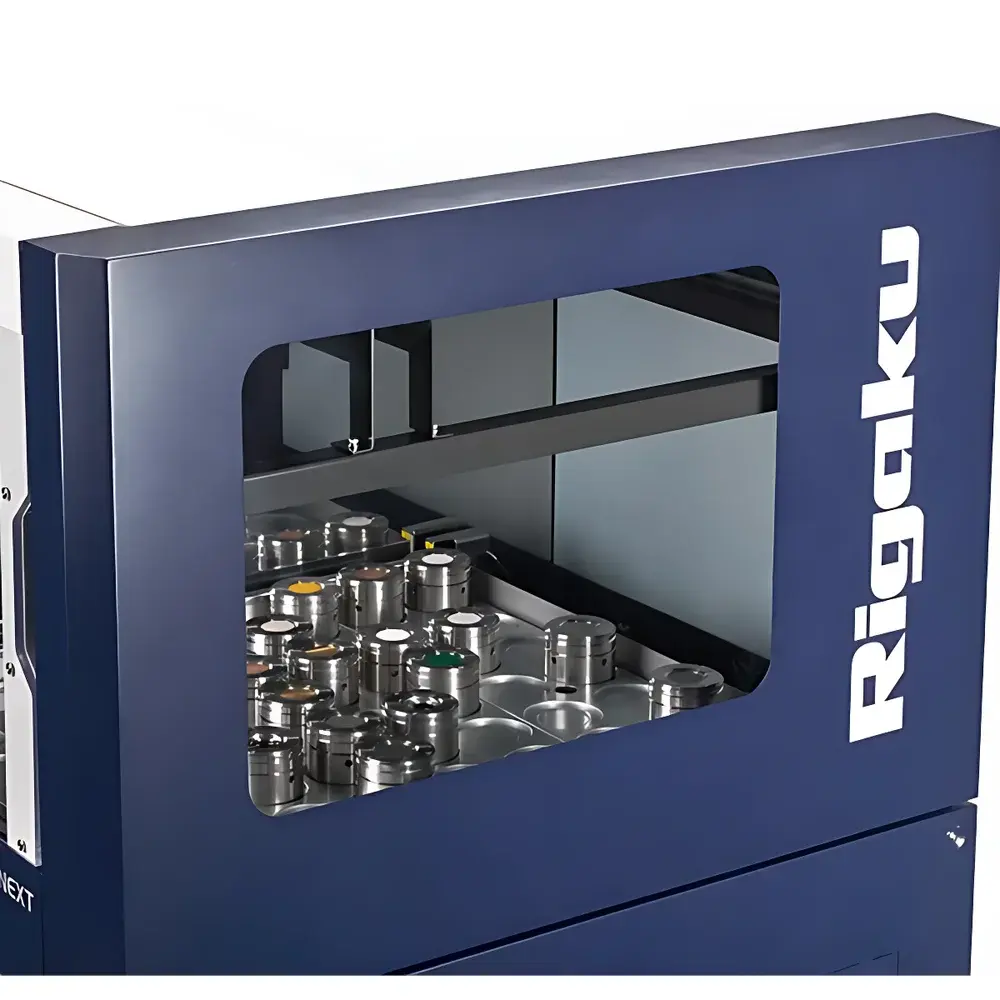
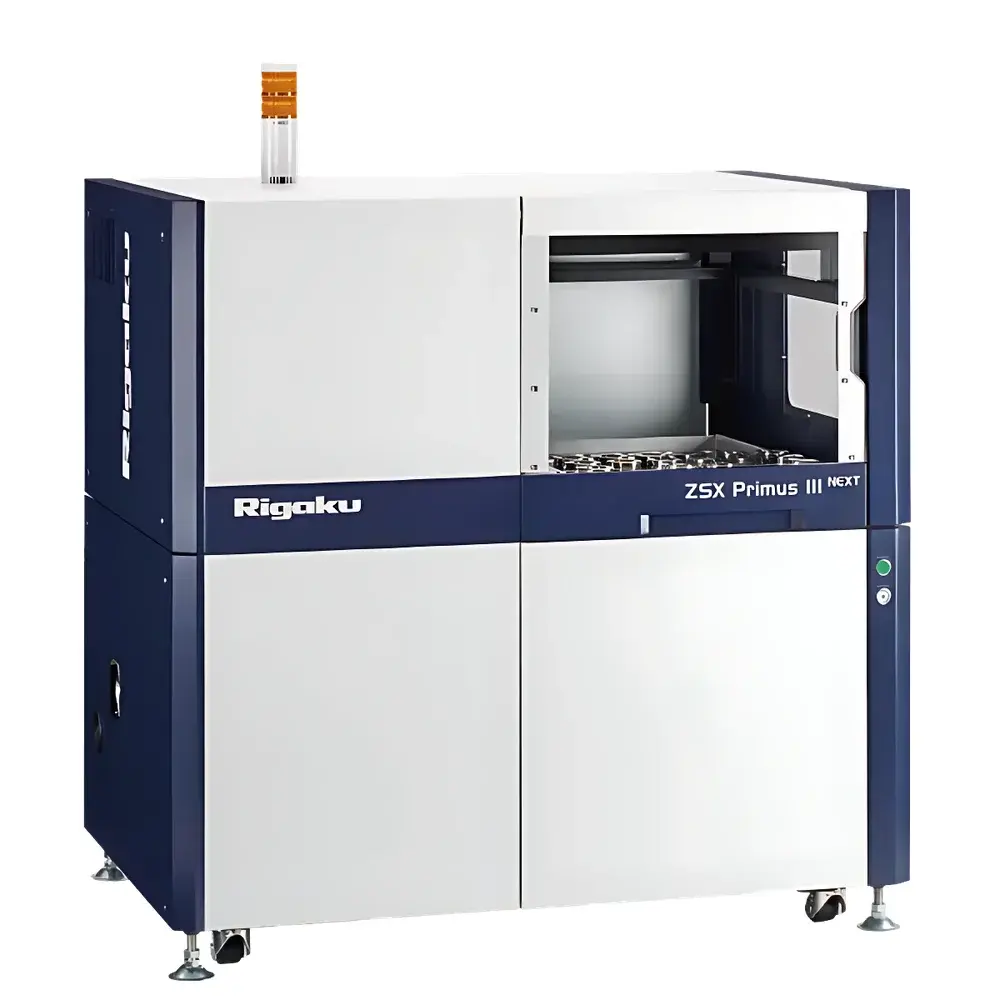
Rigaku ZSX Primus IIInext Wavelength Dispersive X-Ray Fluorescence Spectrometer
| Brand | Rigaku |
|---|---|
| Origin | Japan |
| Manufacturer Type | Authorized Distributor |
| Origin Category | Imported |
| Model | ZSX Primus IIInext |
| Instrument Type | Floor-standing |
| Instrument Kind | Scanning-type |
| X-ray Tube Power | 4 kW |
| Elemental Range | Be (4) to U (92) |
| Scan Speed | 2400°/min |
| Detector Linear Count Rate | SC: 1800 kcps |
| FPC | 3000 kcps |
| Beryllium Window Thickness | 30 µm |
| Goniometer Angular Reproducibility | ±0.0001° |
Overview
The Rigaku ZSX Primus IIInext is a high-performance, floor-standing wavelength dispersive X-ray fluorescence (WDXRF) spectrometer engineered for precision elemental analysis in demanding industrial and quality control environments. Utilizing Bragg diffraction of characteristic X-rays through analyzing crystals—principally LiF, PET, TAP, and Ge—the system delivers exceptional spectral resolution and quantitative accuracy across the full elemental range from beryllium (Be, Z=4) to uranium (U, Z=92). Its scanning-type architecture integrates a high-power 4 kW sealed-tube X-ray source with optimized beam optics and a robust goniometer system featuring angular reproducibility of ±0.0001°, ensuring long-term measurement stability and traceable calibration integrity. Designed as the evolutionary successor to the ZSX Primus III+, the IIInext incorporates enhanced thermal management, tube-above-geometry configuration to minimize sample chamber contamination, and hardware-level compatibility with Rigaku’s unified WDXRF platform—enabling seamless method transfer and cross-instrument data harmonization.
Key Features
- High-power 4 kW X-ray tube with optimized thermal dissipation for stable, long-duration operation under continuous industrial use
- Tube-above optical configuration reduces particulate deposition on optics and detector windows, extending maintenance intervals and instrument uptime
- Goniometer with ±0.0001° angular reproducibility supports high-precision peak positioning and rigorous inter-laboratory comparability
- Multi-detector architecture: simultaneous use of sealed proportional counter (SC, 1800 kcps linear range) and flow-proportional counter (FPC, 3000 kcps linear range) for optimal sensitivity across light and heavy elements
- 30 µm beryllium window enables efficient detection of low-Z elements down to beryllium while maintaining vacuum integrity and mechanical durability
- Scanning speed up to 2400°/min enables rapid multi-element acquisition without compromising peak resolution or background fidelity
- Integrated D-MCA (Digital Multi-Channel Analyzer) for real-time pulse processing, dead-time correction, and high-count-rate spectral deconvolution
Sample Compatibility & Compliance
The ZSX Primus IIInext accommodates solid discs (up to 51 mm diameter), fused beads, pressed pellets, and thin films—supporting standardized preparation protocols per ASTM E1621, ISO 21043, and JIS H 1621. Its vacuum and helium purge options allow routine analysis of light elements (Be–F) with minimal atmospheric absorption. The system complies with IEC 61000-6-3 (EMC), IEC 61000-6-4 (industrial emissions), and IEC 62471 (photobiological safety). Software workflows support audit trails, electronic signatures, and user-access controls aligned with FDA 21 CFR Part 11 requirements when deployed in regulated GMP/GLP environments.
Software & Data Management
ZSX Guidance software provides an intuitive, workflow-driven interface for method development, calibration, and routine analysis—designed to reduce operator dependency on spectroscopic expertise. It includes automated peak identification, matrix correction algorithms (e.g., fundamental parameters and empirical alpha coefficients), and built-in uncertainty estimation per ISO/IEC 17025 guidelines. All analytical results are accompanied by raw spectra, measurement statistics (count rates, peak-to-background ratios, standard deviations), and instrument metadata (tube voltage/current, crystal selection, detector gain, goniometer position). Method files (.zsm) and calibration databases are fully portable across ZSX Primus III+, IV, and IVi platforms, enabling centralized application management across multi-site laboratories.
Applications
The ZSX Primus IIInext serves as a primary elemental analyzer in industries requiring certified, repeatable bulk composition data. In mining and metallurgy, it quantifies ore grade (Fe, Cu, Ni, Zn, Pb), slag composition, and alloy certification (Al, Ti, Cr, Mo). In cement and building materials, it monitors CaO, SiO₂, Al₂O₃, Fe₂O₃, SO₃, and alkalis for clinker quality control. Glass manufacturers rely on its ppm-level precision for Na₂O, K₂O, MgO, and transition metal dopants. Petrochemical labs apply it to catalyst analysis (V, Ni, Fe in FCC catalysts) and sulfur speciation in fuels. Environmental applications include soil screening (As, Cd, Pb, Hg) and fly ash characterization per EPA Method 6010D and ISO 12846.
FAQ
What is the minimum detectable limit (MDL) for light elements such as sodium or magnesium?
MDLs are matrix- and condition-dependent; typical values under optimized vacuum conditions are ~10–50 ppm for Na and Mg in silicate matrices using FPC detection and 300 s counting time.
Can the ZSX Primus IIInext perform thin-film or coating thickness analysis?
Yes—when equipped with appropriate monochromators and calibration standards, it supports non-destructive thickness and composition analysis of layered structures per ISO 3497 and ASTM F1520.
Is remote diagnostics and software update support available?
Rigaku provides secure remote access via Rigaku Remote Support (RRS), enabling firmware updates, log file analysis, and real-time troubleshooting under customer-approved authorization protocols.
How does the system ensure long-term calibration stability?
Through daily automatic intensity monitoring of reference channels, periodic drift correction using internal standards, and goniometer encoder recalibration routines embedded in the ZSX Guidance maintenance scheduler.
Are certified reference materials (CRMs) required for calibration?
While CRMs are recommended for initial method validation and regulatory compliance, the system supports both empirical and fundamental parameter (FP) calibration approaches—allowing flexibility for in-house standards where certified materials are unavailable.




