
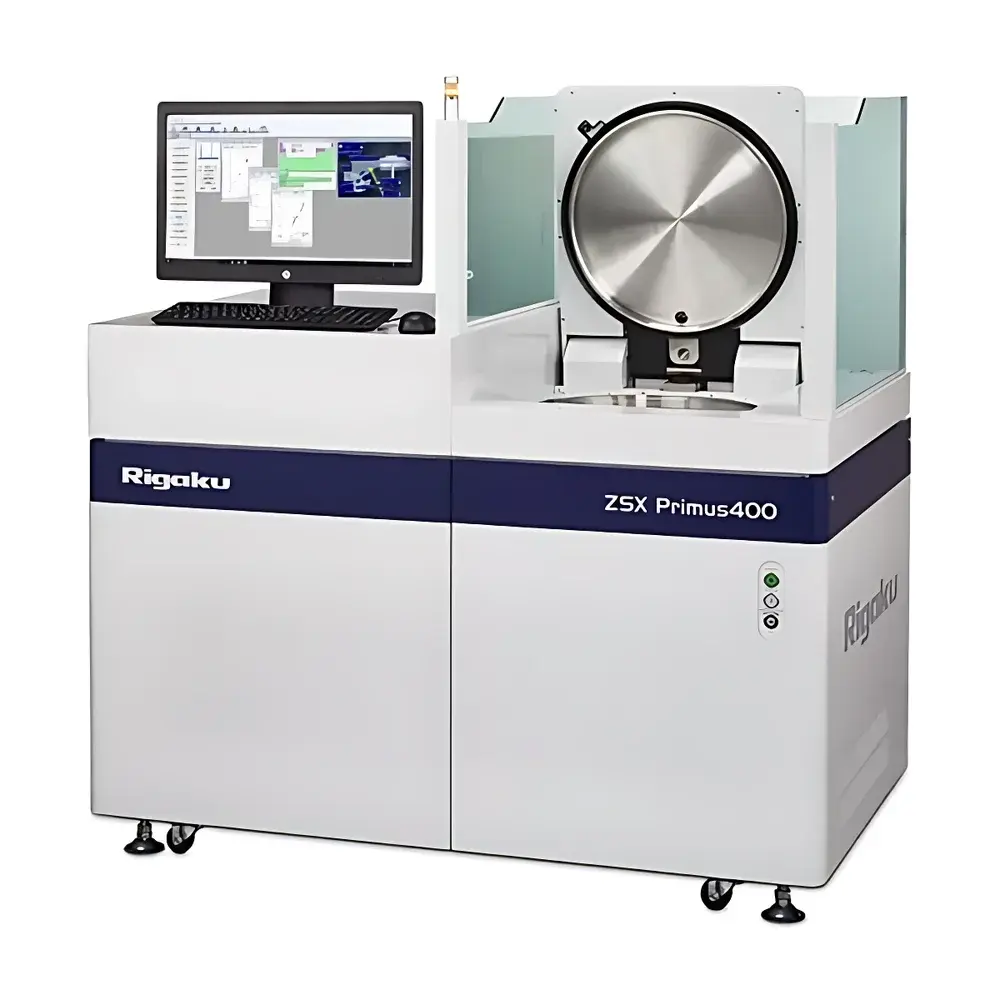
Rigaku ZSX Primus 400 Sequential Wavelength Dispersive X-Ray Fluorescence Spectrometer
| Brand | Rigaku |
|---|---|
| Origin | Japan |
| Model | ZSX Primus 400 |
| Instrument Type | Floor-standing |
| X-ray Tube Power | 4 kW |
| Elemental Range | Be (4) to U (92) |
| Maximum Sample Diameter | 400 mm |
| Maximum Sample Thickness | 50 mm |
| Maximum Sample Mass | 30 kg |
| Measurement Spot Size | 0.5–30 mm (5-step motorized selection) |
| Compliance | SEMI, CE |
Overview
The Rigaku ZSX Primus 400 is a high-performance sequential wavelength dispersive X-ray fluorescence (WDXRF) spectrometer engineered for precise, quantitative elemental analysis of large, heavy, and geometrically complex samples. Unlike energy-dispersive (EDXRF) systems, WDXRF relies on Bragg diffraction from precisely aligned analyzing crystals to isolate characteristic X-ray lines—enabling superior spectral resolution, minimal peak overlap, and detection limits in the low-ppm range for most elements from beryllium (Z = 4) to uranium (Z = 92). The ZSX Primus 400 integrates a 4 kW high-power X-ray tube with vacuum- or helium-purged optical paths, optimized crystal optics, and precision goniometry to deliver high-intensity, low-background spectra essential for trace-level analysis and thin-film metrology. Its robust floor-standing architecture accommodates industrial-scale specimens—up to 400 mm in diameter, 50 mm thick, and weighing up to 30 kg—making it uniquely suited for quality control of sputtering targets, semiconductor wafers, coated substrates, and multi-layered functional films.
Key Features
- Large-sample capability: Accepts specimens up to 400 mm Ø × 50 mm thickness × 30 kg mass—ideal for full-diameter wafer analysis, bulk metallurgical samples, and ceramic or glass substrates.
- Motorized, five-step variable collimation system: Selects analytical spot diameters from 0.5 mm to 30 mm without manual intervention, enabling both micro-area analysis and macro-homogeneity mapping.
- Optional integrated CCD camera with coaxial illumination: Provides real-time visual confirmation of measurement location directly within the acquisition software interface, critical for alignment-sensitive thin-film and patterned sample analysis.
- Dedicated sample adapter platform: Modular, tool-free mounting fixtures support flat plates, curved surfaces, irregular geometries, and stacked multilayer structures—ensuring reproducible positioning and beam-sample geometry.
- Advanced diffraction interference suppression (optional): Uses secondary monochromators and background-reduction optics to eliminate spurious signals from single-crystal substrates (e.g., Si, sapphire), ensuring accurate quantification of ultra-thin dielectric layers.
- Compact footprint: Occupies only 50% of the floor space required by prior-generation WDXRF platforms—optimized for constrained cleanroom or production lab environments.
Sample Compatibility & Compliance
The ZSX Primus 400 supports solid, powdered, liquid, and thin-film samples across diverse material classes—including metals, oxides, nitrides, silicates, polymers, and compound semiconductors. It complies with SEMI S2/S8 safety standards for semiconductor manufacturing equipment and carries CE marking for conformity with EU electromagnetic compatibility (EMC) and low-voltage directives. All analytical protocols are fully compatible with GLP/GMP documentation workflows; optional audit-trail-enabled software supports 21 CFR Part 11 compliance for regulated pharmaceutical and medical device applications. Routine calibration and verification procedures align with ISO 8258 (control charts), ISO 11843 (detection capability), and ASTM E1621 (standard practice for WDXRF analysis of ceramics and glasses).
Software & Data Management
Rigaku’s proprietary SuperQ software provides full instrument control, spectrum acquisition, qualitative/quantitative analysis, and spatial mapping functions. The platform supports matrix-matched standardization, fundamental parameter (FP) modeling, and empirical calibration with internal standard correction. Mapping mode enables automated multi-point raster scanning with synchronized camera imaging, generating 2D elemental distribution heatmaps with positional metadata. All raw spectra, processing parameters, and results are stored in vendor-neutral .rxf and .csv formats. Data export modules integrate seamlessly with LIMS and MES systems via OPC UA and ODBC interfaces. Software versioning and configuration management follow IEC 62304-compliant development practices.
Applications
- Semiconductor process control: Quantitative depth profiling and stoichiometry verification of high-k dielectrics (HfSiOx, Ta2O5), ferroelectrics (PZT, BST), metal gates (TiN, TaN, Ru), and barrier layers (TiW, Co).
- Thin-film metrology: Simultaneous determination of composition and thickness for sub-nanometer to micrometer films—including SiO2, BPSG, PSG, Si3N4, AlN, ZnO, and piezoelectric stacks in SAW/BAW devices.
- Materials R&D: Analysis of dopant distributions (B, P, As) in polysilicon, interstitial gas content (Ar, Kr, Ne) in encapsulated MEMS cavities, and phase composition in PCM materials (GST, GeTe).
- Industrial QA/QC: Bulk composition verification of sputter targets (Ni, Cu, Mo, ITO), solder bump alloys (SnAgCuNi), and refractory metal components used in aerospace and nuclear applications.
FAQ
What is the minimum detectable limit (MDL) for light elements such as oxygen or carbon?
MDLs are matrix- and condition-dependent; under vacuum and with optimized crystal selection, typical MDLs range from 10–50 ppm for O and C in oxide matrices using LiF(200) or PET crystals.
Can the ZSX Primus 400 perform non-destructive analysis of coated or layered samples?
Yes—the instrument supports both bulk and stratified analysis modes, including FP-based layer decomposition for up to five discrete layers with known or iteratively solved thicknesses.
Is helium purge required for analyzing elements below sodium (Na)?
Helium purging is recommended for optimal sensitivity to elements from Be to F; vacuum operation suffices for Na and heavier elements.
How does the system handle spectral interferences from overlapping diffraction orders?
The optional higher-order suppression module uses pulse-height discrimination and secondary crystal filtering to resolve first- and second-order peaks, particularly critical for transition metal L-lines and rare-earth element analysis.
What sample preparation methods are recommended for powder or liquid analysis?
Powders should be pressed into pellets using binder-free hydraulic pressing; liquids require containment in X-ray-transparent polymer cups (e.g., Mylar or Polyimide) with appropriate backing foils to minimize absorption effects.





