
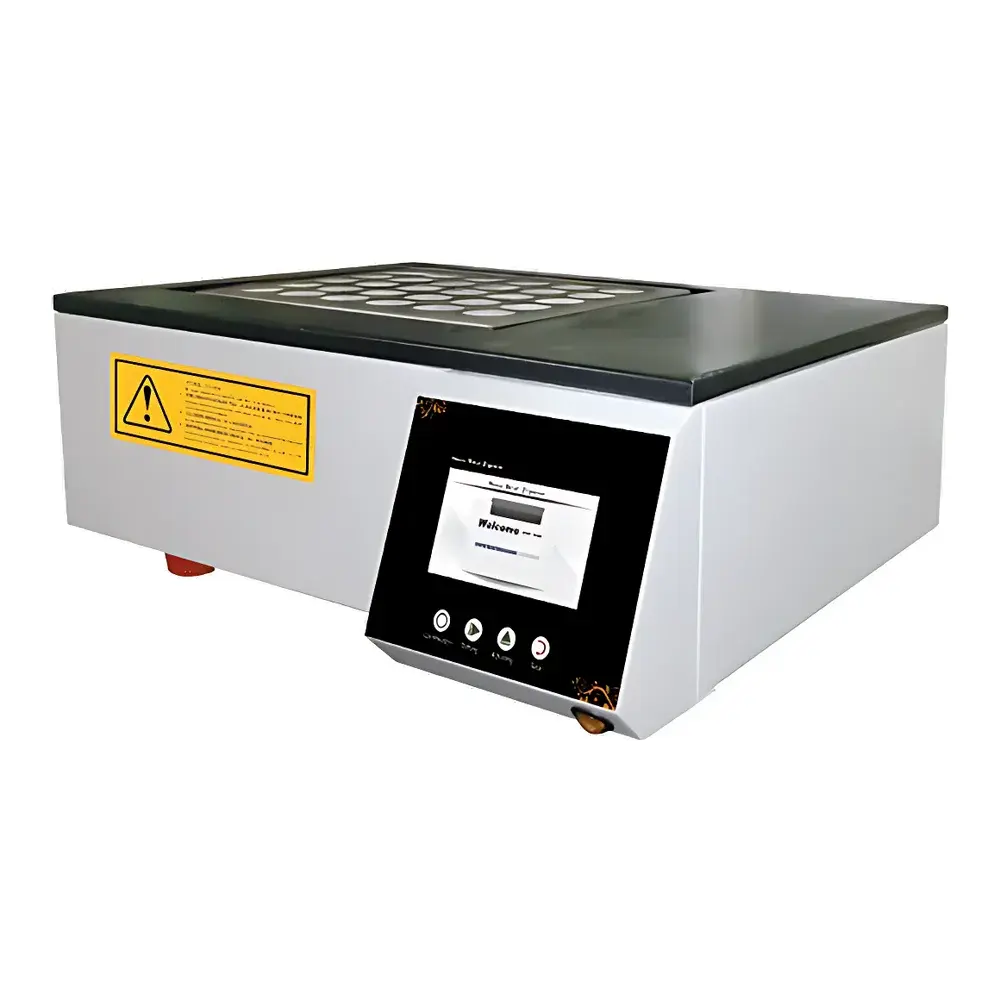
Hanon SH230N Graphite Block Digestion System
| Brand | Hanon |
|---|---|
| Origin | Shandong, China |
| Model | SH230N |
| Instrument Type | Graphite Block Digestion System |
| Automation Level | Fully Automatic |
| Digestion Positions | 30 |
| Temperature Range | Ambient +5°C to 450°C |
| Temperature Control Accuracy | ±0.1°C |
| Heating Principle | Infrared Heating + High-Purity Graphite Thermal Conduction |
| Reagent Channels | 30 per batch |
| Insulation Material | Eco-Friendly Ceramic Fiber + Optimized Air-Channel Design |
| Digestion Vessels | Optional Borosilicate Glass (50 mL calibrated / 100 mL max) or PTFE (70 mL max) |
| Power Supply | 220 V AC ±10%, 50 Hz |
| Rated Power | 3.6 kW |
| Dimensions (L×W×H) | 515 × 421 × 211 mm |
| Net Weight | 22 kg |
Overview
The Hanon SH230N Graphite Block Digestion System is a fully automated, high-throughput sample preparation instrument engineered for trace metal analysis workflows. It employs a dual-mode heating architecture—combining focused infrared radiation with uniform thermal conduction through high-purity, antioxidant-treated graphite blocks—to achieve rapid, reproducible, and spatially homogeneous heating across all 30 digestion positions. Unlike conventional hotplate or ceramic heater-based systems, the SH230N’s integrated thermal design minimizes radial and axial temperature gradients (<1.5°C inter-hole deviation at 400°C), ensuring consistent acid decomposition kinetics across parallel samples. This precision is critical for regulatory-compliant digestion prior to quantification by atomic absorption spectroscopy (AAS), atomic fluorescence spectroscopy (AFS), or inductively coupled plasma atomic emission spectroscopy (ICP-AES). The system operates within a rigorously controlled thermal envelope (ambient +5°C to 450°C), enabling method flexibility for diverse matrices—including soils, biological tissues, foodstuffs, pharmaceutical excipients, and geological samples—while maintaining full compliance with ISO 11047, EPA Method 3050B/3051A, and GB/T 5009.12–2017.
Key Features
- Fully automated operation with embedded real-time temperature control firmware, supporting programmable multi-step ramp-hold protocols and automatic power cutoff upon completion.
- 30-position digestion block fabricated from high-density, oxidation-resistant graphite, thermally optimized to sustain uniformity under prolonged high-temperature exposure (≥400°C).
- Triple-layer thermal management: infrared emitter array + graphite conduction + dual-stage insulation (ceramic fiber core + engineered air-channel cavity), reducing external surface temperature to <50°C during operation.
- Chemically inert housing featuring electrosprayed polytetrafluoroethylene (PTFE) coating on stainless steel surfaces—resistant to HNO₃, HCl, HF, H₂O₂, and aqua regia vapors and splashes.
- Integrated safety architecture including over-temperature, over-current, and over-voltage protection; sloped drain channel design prevents acid ingress into electrical compartments.
- Modular vessel compatibility: supports both borosilicate glass tubes (50 mL calibrated, 100 mL capacity) and PTFE digestion vessels (70 mL capacity), enabling method-specific acid selection (e.g., HF for silicate dissolution).
Sample Compatibility & Compliance
The SH230N accommodates solid, semi-solid, and liquid samples ranging from 0.1 g to 2.0 g (dry weight basis) or up to 10 mL of aqueous digestates. Its thermal stability and corrosion resistance make it suitable for digestion of complex, high-fat, or high-silica matrices—such as animal feed, cereal grains, activated sludge, fly ash, and plant tissue—without compromising digestion completeness or blank integrity. All operational parameters are logged with timestamped audit trails, satisfying GLP and GMP documentation requirements. The system adheres to IEC 61010-1 (Safety Requirements for Electrical Equipment for Measurement, Control, and Laboratory Use) and supports validation protocols aligned with USP , ASTM D3682, and ISO/IEC 17025 clause 5.4.1 for method transfer and equipment qualification.
Software & Data Management
The SH230N runs on an embedded Linux-based controller with a 4.3-inch capacitive touchscreen interface. Users define digestion methods via intuitive graphical menus—setting ramp rates (0.1–20°C/min), hold durations (1–240 min), target temperatures, and safety limits. All method parameters, real-time temperature curves, and fault logs are exportable in CSV format via USB 2.0. While the base firmware does not include network connectivity or LIMS integration, its deterministic timing engine and non-volatile memory ensure repeatable execution independent of external software dependencies—critical for regulated environments where FDA 21 CFR Part 11 compliance is achieved via procedural controls rather than electronic signatures.
Applications
This system is routinely deployed in environmental testing laboratories for EPA SW-846 compliant soil and sediment digestion; in food safety labs for heavy metal screening per EU Commission Regulation (EC) No 1881/2006; in pharmaceutical QC for elemental impurities testing (ICH Q3D); and in academic research for geochemical sample preparation prior to multi-element ICP-MS analysis. Its 30-sample throughput and sub-±0.1°C thermal precision reduce inter-batch variability, directly improving measurement uncertainty budgets for certified reference material (CRM) analysis and proficiency testing participation.
FAQ
What digestion vessel materials are supported, and how do they affect method selection?
The SH230N accepts both borosilicate glass (for HNO₃/HCl/H₂O₂-based digestions) and PTFE (for HF-containing protocols required for silicate mineral dissolution). Vessel choice must align with analytical method specifications and CRM certification requirements.
Is the SH230N compatible with robotic autosamplers or third-party LIMS?
No native Ethernet or RS-232 interface is provided; integration requires external PLC-level signal triggering or manual CSV import/export. For fully automated labs, it is typically staged upstream of AAS/ICP instruments with discrete batch handoff.
How is temperature uniformity validated across the 30 positions?
Hanon provides factory calibration certificates documenting inter-hole deviation measured using NIST-traceable Pt100 probes at three setpoints (150°C, 300°C, 450°C). Users may perform periodic verification using the same probe configuration per ISO/IEC 17025 clause 6.4.3.
Does the system support gradient heating profiles for difficult matrices?
Yes—up to five sequential ramp-and-hold steps can be programmed, allowing controlled release of volatile species (e.g., As, Hg) before final high-temperature ashing, minimizing analyte loss.
What maintenance is required to sustain long-term thermal accuracy?
Annual inspection of graphite block surface integrity and IR emitter output calibration is recommended. PTFE-coated surfaces require only isopropanol wipe-down; no routine lubrication or consumable replacement is needed beyond standard lab-grade digestion vessels.



