
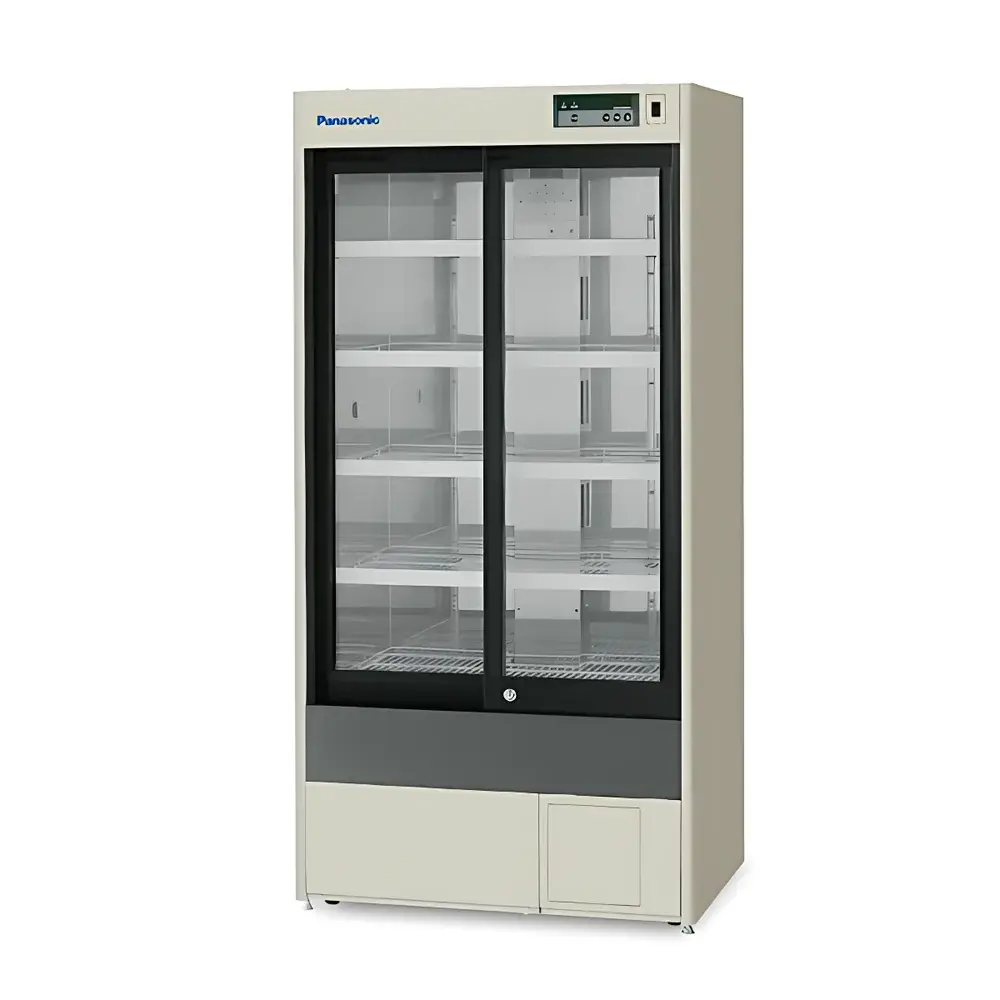
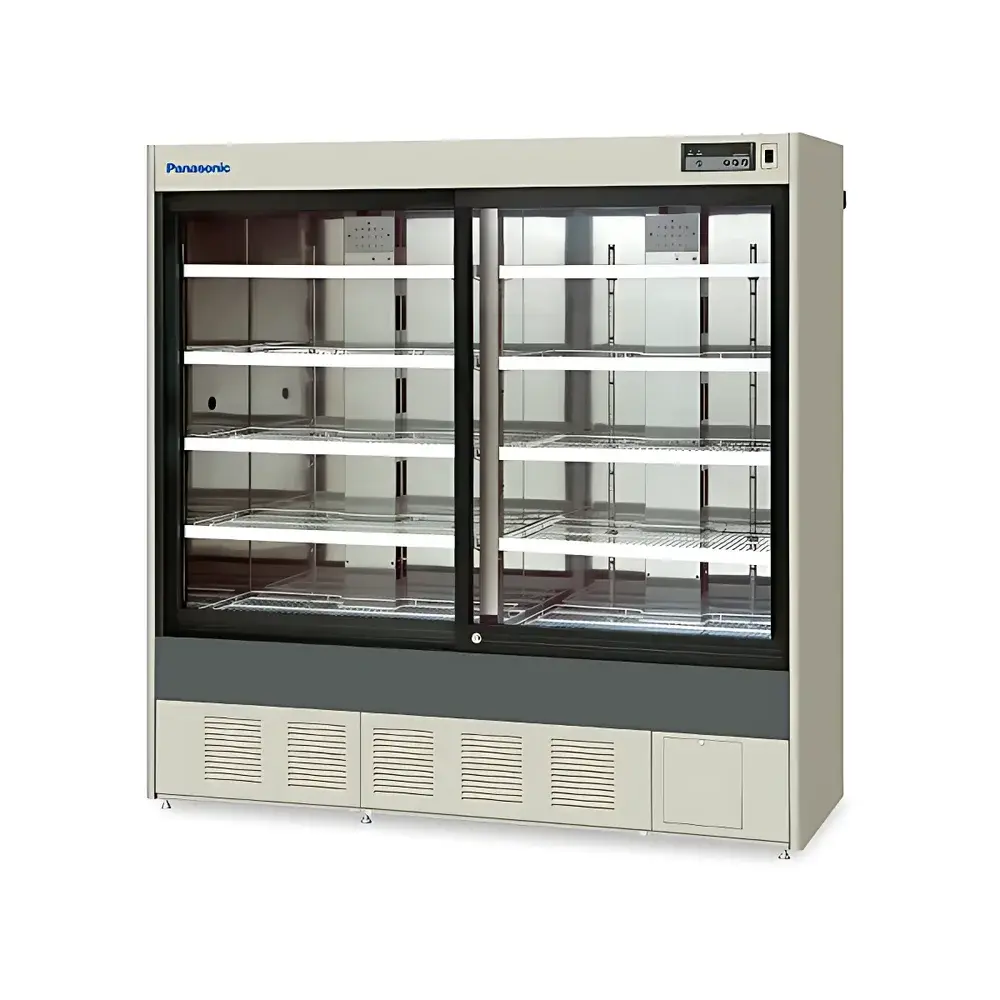
Panasonic MPR-514 & MPR-1014 Pharmaceutical Refrigerated Storage Cabinets
| Brand | Panasonic (formerly Sanyo) |
|---|---|
| Origin | Japan |
| Model | MPR-514, MPR-1014 |
| Temperature Range | 2°C to 14°C (ambient: −5°C to 35°C) |
| External Dimensions (W×D×H) | 900 × 600 × 1790 mm (MPR-514) / 1800 × 600 × 1790 mm (MPR-1014) |
| Internal Dimensions (W×D×H) | 800 × 465 × 1300 mm (MPR-514) / 1700 × 465 × 1300 mm (MPR-1014) |
| Net Volume | 489 L (MPR-514) / 1033 L (MPR-1014) |
| Net Weight | 141 kg / 243 kg |
| Power Consumption | 215 W / 320 W (220 V, 50 Hz) |
| Insulation | In-situ rigid polyurethane foam |
| Exterior | Pre-coated steel |
| Interior | Stainless steel |
| Shelving | 5 × enameled wire shelves (50 kg capacity each) / 10 × enameled wire shelves (50 kg each) |
| Door | Dual-pane low-emissivity glass doors with safety film |
| Cooling System | Forced-air circulation with hermetic compressor (200 W / 250 W) |
| Defrost System | Intelligent frost-detection-based automatic defrost cycle with dual-purpose heating elements (defrost + anti-freeze protection) |
| Refrigerant | HFC blend |
| Temperature Control | Dual Pt100 sensors with microprocessor-based PID regulation |
| Alarms | Visual & audible high/low temperature, door ajar, power failure, remote alarm contact output |
| Optional | Data logging module with RS-485 interface compliant with FDA 21 CFR Part 11 audit trail requirements |
Overview
The Panasonic MPR-514 and MPR-1014 Pharmaceutical Refrigerated Storage Cabinets are precision-engineered environmental control systems designed for the stable, compliant, and traceable storage of temperature-sensitive pharmaceuticals, biological reagents, reference standards, clinical samples, and GMP-grade intermediates. Operating within a tightly regulated range of 2°C to 14°C—validated under ambient conditions from −5°C to +35°C—these cabinets employ active forced-air circulation, dual-sensor feedback control, and intelligent defrost management to maintain spatial temperature uniformity (±0.5°C) and temporal stability (±0.3°C over 24 h), critical for adherence to ICH Q5C, USP , and WHO Technical Report Series No. 961 guidelines on storage condition qualification.
Key Features
- Precision Dual-Sensor Temperature Management: Two independently calibrated Pt100 resistance thermometers—one at the top and one at the bottom—feed real-time data to a microprocessor-based PID controller, enabling dynamic correction of thermal gradients during frequent access or ambient fluctuations.
- Intelligent Frost-Detection Defrost Cycle: Unlike timed or fixed-interval defrost systems, this cabinet monitors evaporator frost accumulation in real time. Defrost activation occurs only when required, minimizing thermal disturbance to stored materials; the integrated heating elements also serve as emergency anti-freeze safeguards during extreme ambient cold.
- Forced-Air Uniformity Engineering: A high-efficiency axial fan system, coupled with optimized internal duct geometry and stainless-steel baffle plates, ensures laminar airflow distribution across all shelf levels—verified per ISO 14644-1 Class 8 cleanroom-compatible airflow patterns and essential for IQ/OQ validation protocols.
- Robust Thermal Insulation Architecture: 80 mm thick in-situ foamed rigid polyurethane insulation (λ ≈ 0.022 W/m·K) combined with low-emissivity dual-pane glass doors delivers exceptional thermal resistance (U-value ≤ 0.35 W/m²·K), reducing energy consumption while maintaining setpoint fidelity across variable lab environments.
- Compliance-Ready Safety & Alarm Infrastructure: Redundant visual (LED) and audible (85 dB) alarms for high/low temperature deviation (>±2°C), door-open duration (>30 s), power interruption, and sensor fault. All alarm events are timestamped and logged in non-volatile memory; optional RS-485 module supports remote monitoring and 21 CFR Part 11–compliant electronic records.
Sample Compatibility & Compliance
The MPR series accommodates vials, bottles, trays, and cryoboxes up to 50 kg per shelf without compromising air exchange or thermal homogeneity. Internal stainless-steel construction (AISI 304) resists corrosion from repeated alcohol wipe disinfection and meets ISO 15190:2020 requirements for laboratory safety. The cabinet’s design conforms to IEC 61010-1 (Safety Requirements for Electrical Equipment for Measurement, Control, and Laboratory Use) and EN 60335-2-89 (Particular Requirements for Refrigerating Appliances). Temperature mapping studies per ASTM E2297-21 and EU GMP Annex 15 are supported by factory-provided validation documentation packages—including DQ/IQ templates, sensor calibration certificates (NIST-traceable), and thermal recovery test reports.
Software & Data Management
An optional Data Acquisition Module (DAM) provides continuous 2-channel temperature logging (sample interval: 1–60 min) with local SD card storage (≥1 year @ 10-min intervals) and Ethernet/RS-485 connectivity. Data export is compatible with CSV and PDF formats; audit trail functionality includes user login history, parameter change logs, and alarm event metadata—all structured to satisfy FDA 21 CFR Part 11 and EU Annex 11 requirements for electronic records integrity and accountability. Third-party integration with LabVantage, Thermo Fisher SampleManager, or custom LIMS is supported via Modbus TCP or OPC UA protocols.
Applications
- Stabilized storage of monoclonal antibodies, vaccines, and mRNA intermediates requiring strict 2–8°C chain-of-custody control
- Long-term retention of QC reference standards under GLP-compliant conditions (OECD 1998)
- Secure holding of controlled substances with physical access restriction (key-lock doors) and tamper-evident logging
- Buffer and media preparation staging zones in cGMP manufacturing suites
- Biobank sample pre-sorting and short-term holding prior to cryopreservation
FAQ
What is the validated temperature uniformity across the chamber volume?
The MPR-514 and MPR-1014 achieve ±0.5°C spatial uniformity (at 5×5×5 grid points per shelf level) and ±0.3°C temporal stability over 24 hours, as verified per ISO/IEC 17025-accredited mapping protocols.
Can the cabinet operate reliably in an unconditioned warehouse environment?
Yes—rated for ambient operation between −5°C and +35°C, with full performance retention down to −10°C ambient when equipped with optional winter kit (heater-assisted compressor crankcase).
Is the data logging module compliant with 21 CFR Part 11?
The optional DAM includes role-based user authentication, electronic signatures, immutable audit trails, and encrypted data storage—fully aligned with Part 11 Subpart B requirements for closed systems.
How frequently does the system require calibration verification?
Panasonic recommends annual sensor recalibration using NIST-traceable references; the dual-sensor architecture allows field verification without downtime via cross-check mode.
What maintenance is required for long-term reliability?
Routine tasks include monthly condenser coil vacuuming, biannual door gasket inspection, and annual refrigerant pressure verification—documented in the included Maintenance Logbook per ISO 55001 asset management principles.



