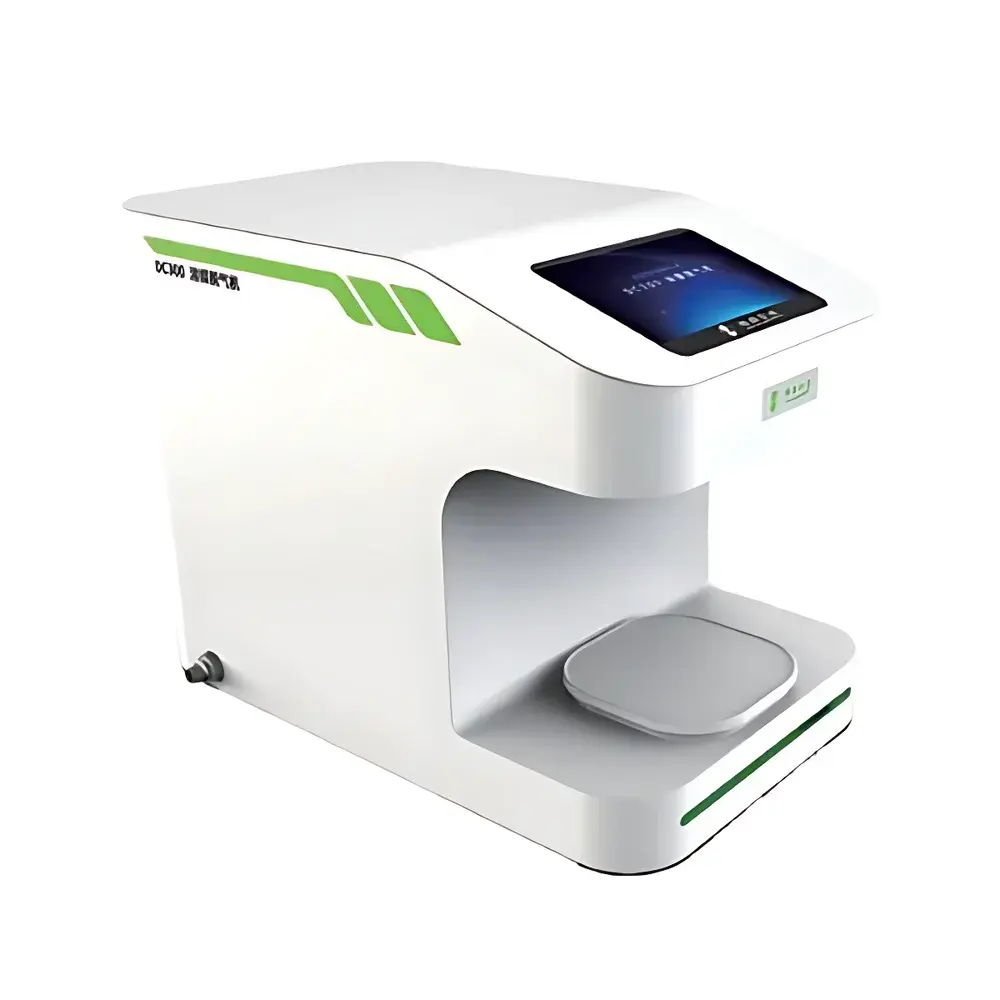
Haosoo DC300 Offline Solvent Degassing System
| Brand | Haosoo |
|---|---|
| Origin | Shandong, China |
| Model | DC300 |
| Instrument Type | Offline Degasser |
| Heating Temperature Range | Ambient to 45 °C |
| Flow Rate | 1 L/min |
| Oxygen Residual | ≤2.8 mg/L |
| Dispensing Accuracy | ≤±1% |
| Integrated Precision Weighing Module | Yes |
| Solvent Compatibility | Aqueous media (pH 1–14), surfactant-containing solutions, purified water |
| External Pure Water Feed Interface | Yes |
| Operating Modes | Single-vessel, Multi-vessel, Fixed-volume dispensing |
Overview
The Haosoo DC300 Offline Solvent Degassing System is an engineered solution designed specifically for pharmaceutical dissolution testing laboratories requiring consistent, low-oxygen solvent preparation under GLP-compliant workflows. Unlike inline degassers integrated into dissolution apparatuses, the DC300 operates as a standalone, offline unit—enabling centralized, batch-wise degassing of large-volume solvent stocks prior to distribution across multiple USP Apparatus I (basket) or II (paddle) systems. Its core operation relies on vacuum-assisted degassing combined with controlled thermal conditioning (up to 45 °C), leveraging Henry’s law principles to reduce dissolved oxygen concentration to ≤2.8 mg/L—a threshold validated to minimize oxidative degradation of labile APIs during dissolution method development and routine QC testing. The system integrates gravimetric dispensing via a high-precision load cell, eliminating volumetric errors associated with pump-based or cylinder-readout methods, and supports seamless integration with external pure water generation systems for end-to-end unattended operation.
Key Features
- Vacuum + mild thermal degassing architecture optimized for pH 1–14 aqueous media—including buffers, organic-aqueous mixtures, and surfactant formulations (e.g., SDS, polysorbates) commonly used in biorelevant dissolution media.
- Integrated precision weighing module (±0.1 g resolution) enabling weight-based solvent dispensing with ≤±1% volumetric accuracy—critical for regulatory traceability and method reproducibility per USP & Ph. Eur. guidelines.
- Three operational modes: single-vessel dispensing (for calibration or reference standards), multi-vessel parallel filling (for 6–12 dissolution vessels), and fixed-volume mode (programmable target mass per vessel).
- In-line heating capability (ambient to 45 °C) applied during degassing—not post-degassing—enhancing gas removal kinetics without promoting solvent evaporation or thermal decomposition of sensitive excipients.
- Dedicated interface for direct connection to commercial pure water systems (e.g., Milli-Q®, ELGA PURELAB®), supporting automated feed, degas, weigh, and dispense sequences without manual intervention.
- Stainless steel 316L fluid path and sealed vacuum chamber compliant with ISO 8573-1 Class 3 particulate and oil-free air requirements; no internal lubricants contacting solvent stream.
Sample Compatibility & Compliance
The DC300 accommodates all standard dissolution media specified in USP , Ph. Eur. 2.9.3, and JP 17, including simulated gastric/intestinal fluids (FaSSGF, FeSSIF), phosphate buffers, citrate buffers, and surfactant-doped media. Its inert wetted materials (316L SS, PTFE, FKM seals) ensure chemical compatibility across the full pH 1–14 range and resist leaching under prolonged exposure. The system supports audit-ready documentation: all dispensing events are timestamped and logged with mass, temperature, vacuum level, and cycle duration. Data export complies with ALCOA+ principles and may be configured for FDA 21 CFR Part 11–compliant electronic records when paired with validated LIMS or ELN platforms.
Software & Data Management
The DC300 features an embedded industrial-grade controller with a 7-inch capacitive touchscreen HMI. All parameters—including target mass per vessel, heating setpoint, vacuum hold time, and degas cycle count—are configurable and stored in non-volatile memory with user-level access control (operator, supervisor, administrator). Full-cycle logs (CSV export via USB port) include raw weight data, thermal profile, vacuum decay curves, and pass/fail status against user-defined oxygen residual thresholds. Optional OPC UA connectivity enables integration into MES or SCADA environments for centralized monitoring and SPC charting of degassing performance over time.
Applications
- Preparation of deaerated dissolution media for USP Apparatus I/II validation and routine release testing.
- Method development studies requiring strict control over dissolved oxygen as a critical process parameter (CPP).
- Stability-indicating dissolution protocols for oxidation-prone compounds (e.g., catechols, thiols, nitroaromatics).
- Supporting quality-by-design (QbD) initiatives by providing documented, repeatable solvent conditioning inputs to dissolution models.
- High-throughput labs performing >50 dissolution runs/day, where offline degassing eliminates bottlenecks in apparatus warm-up and media equilibration phases.
FAQ
Is the DC300 suitable for organic solvents such as ethanol or isopropanol?
No—the DC300 is validated exclusively for aqueous and aqueous-organic mixtures with ≤20% v/v organic content. Flammable or highly volatile solvents require explosion-proof degassing systems not covered by this design.
Can the system verify final dissolved oxygen concentration in real time?
No—oxygen measurement requires external inline DO probes (e.g., METTLER TOLEDO InPro 6950) or laboratory-grade Winkler titration. The DC300 achieves ≤2.8 mg/L via process validation under defined vacuum/temperature/time conditions.
Does the DC300 meet GMP documentation requirements for audit trails?
Yes—when operated in supervisor mode with password-protected settings, all critical actions (method changes, calibration, dispensing) are immutably logged with user ID, timestamp, and parameter values, satisfying Annex 11 and EU GMP Chapter 4 expectations.
What maintenance is required for long-term reliability?
Quarterly vacuum pump oil replacement and annual verification of load cell linearity and temperature sensor NIST-traceable calibration are recommended. No consumables beyond pump oil are required.