
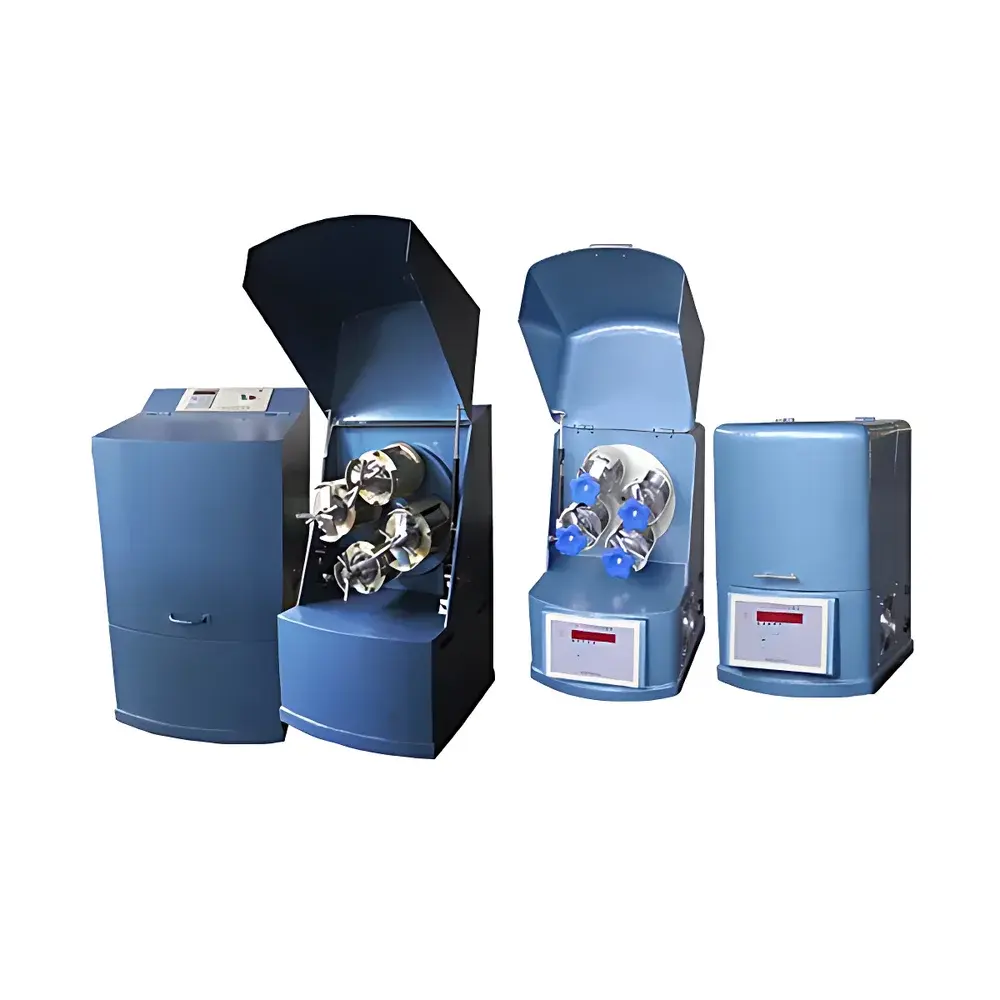
Truelab QM-WX4 Horizontal Planetary Ball Mill
| Brand | Truelab |
|---|---|
| Origin | Jiangsu, China |
| Manufacturer Type | Authorized Distributor |
| Country of Origin | China |
| Model | QM-WX4 |
| Instrument Type | Planetary Ball Mill |
| Sample Suitability | Hard & Brittle Materials |
| Feed Size | ≤10 mm (soil), ≤3 mm (other materials) |
| Final Particle Size | ≤0.1 µm |
| Batch Grinding Capacity | 4 L (total, 4 × 1 L jars) |
| Rotation Ratio (Revolution | Rotation): 1 : 2 |
| Rotational Speed (Jar Rotation) | 0–530 rpm (for 4 L jars) |
| Speed Control | Stepless Electronic Speed Regulation with Programmable Timer, Auto Forward/Reverse Cycling, and Auto Shut-off |
| Continuous Operation Time (Full Load) | Up to 48 h |
| Jar Configuration | Four horizontally mounted grinding jars, symmetrically arranged on a vertical drive plate |
| Optional Accessories | Vacuum-sealed grinding jars (50–500 mL capacity) |
Overview
The Truelab QM-WX4 Horizontal Planetary Ball Mill is an engineered solution for high-energy mechanical alloying, nanomaterial synthesis, homogenization, and ultrafine comminution of hard, brittle, or temperature-sensitive samples. Unlike conventional vertical planetary mills, the QM-WX4 employs a horizontal jar orientation—four grinding jars are symmetrically mounted in a horizontal plane on a vertically rotating drive plate. As the plate revolves (revolution), each jar rotates in the opposite direction (rotation) at a fixed 1:2 speed ratio. This dual-axis motion, combined with gravitational influence on the freely suspended grinding media, generates chaotic yet highly energetic collision trajectories. The absence of a fixed “bottom” surface ensures uniform wear distribution across the entire inner jar surface—including top, bottom, and sidewalls—enhancing both grinding efficiency and sample reproducibility. Designed for laboratory-scale R&D and pilot production, the system delivers consistent sub-100 nm particle size distributions under controlled inert or vacuum environments when equipped with sealed jars.
Key Features
- Horizontal jar configuration enabling multi-surface grinding action and eliminating sedimentation bias in density-sensitive samples
- Simultaneous operation of four independent grinding jars (total capacity: 4 L), supporting parallel sample processing for statistical robustness
- Stepless electronic speed control (0–530 rpm jar rotation) with programmable time cycles, bidirectional rotation sequencing, and automatic power cutoff
- Robust cast-aluminum frame with vibration-damping mounts and low-noise gearmotor assembly (sound pressure level <65 dB(A) at 1 m)
- Compatibility with vacuum-rated stainless steel, agate, tungsten carbide, and zirconia grinding jars (50–500 mL options available)
- Thermal management design supporting extended duty cycles—rated for continuous operation up to 48 hours under full load
Sample Compatibility & Compliance
The QM-WX4 is validated for processing hard and abrasive materials including oxides, metals, alloys, ceramics, minerals, and geological specimens. It accommodates feed sizes up to 10 mm for soil matrices and 3 mm for consolidated solids. Final particle size distribution is routinely verified by laser diffraction (ISO 13320) or electron microscopy (ASTM E1245), achieving d90 ≤ 0.1 µm in optimized protocols. The mill supports GLP-compliant workflows through traceable parameter logging (when paired with optional digital controller). Vacuum-jar operation enables oxygen- and moisture-sensitive syntheses (e.g., mechanochemical reduction, solid-state battery cathode development) in accordance with ISO 8502-9 cleanliness requirements. No CE or UL certification is provided; users must perform local electrical safety verification per IEC 61010-1.
Software & Data Management
The base QM-WX4 operates via front-panel digital interface with real-time RPM display, elapsed time tracking, and cycle completion alerts. An optional RS-485 communication module enables integration with LabArchives, ELN platforms, or custom SCADA systems for audit-trail generation. Parameter sets—including speed profiles, forward/reverse dwell times, and total runtime—are stored as user-defined methods with alphanumeric naming. All operational logs (start/stop timestamps, speed deviations >±2%, thermal fault events) are timestamped and exportable as CSV for 21 CFR Part 11–aligned review (signature-capable software required externally). Firmware updates are performed via USB port using manufacturer-provided binaries.
Applications
- Mechanochemical synthesis of MOFs, perovskites, and high-entropy alloys
- Top-down nanomaterial production (e.g., graphene oxide exfoliation, metal nanoparticle generation)
- Homogenization of heterogeneous catalysts and composite precursors
- Mineralogical sample preparation for XRD, SEM-EDS, and ICP-MS analysis
- Pharmaceutical amorphization and co-crystal screening under inert atmosphere
- Recycling research: liberation of critical metals from spent Li-ion battery cathodes
FAQ
What jar materials are compatible with the QM-WX4?
Stainless steel (304/316), agate, tungsten carbide, silicon nitride, and zirconia jars are supported. Material selection must align with sample chemistry to prevent cross-contamination or catalytic side reactions.
Can the mill operate under inert gas or vacuum conditions?
Yes—vacuum-rated jars with double O-ring seals and pressure-relief valves are available as accessories. Standard operation requires external vacuum pump (≤10 mbar) or glovebox integration.
Is calibration documentation provided with the unit?
Factory speed verification is included (certificate of conformance); NIST-traceable rotational calibration is available as an add-on service.
What maintenance intervals are recommended?
Gearbox lubrication every 2,000 operating hours; inspection of jar clamping mechanisms and drive belt tension every 500 hours.
Does the QM-WX4 meet any international safety standards?
The unit complies with general mechanical safety principles per ISO 12100 but lacks third-party certification (e.g., CE, UL). End-users are responsible for site-specific risk assessment and electrical compliance verification.



