
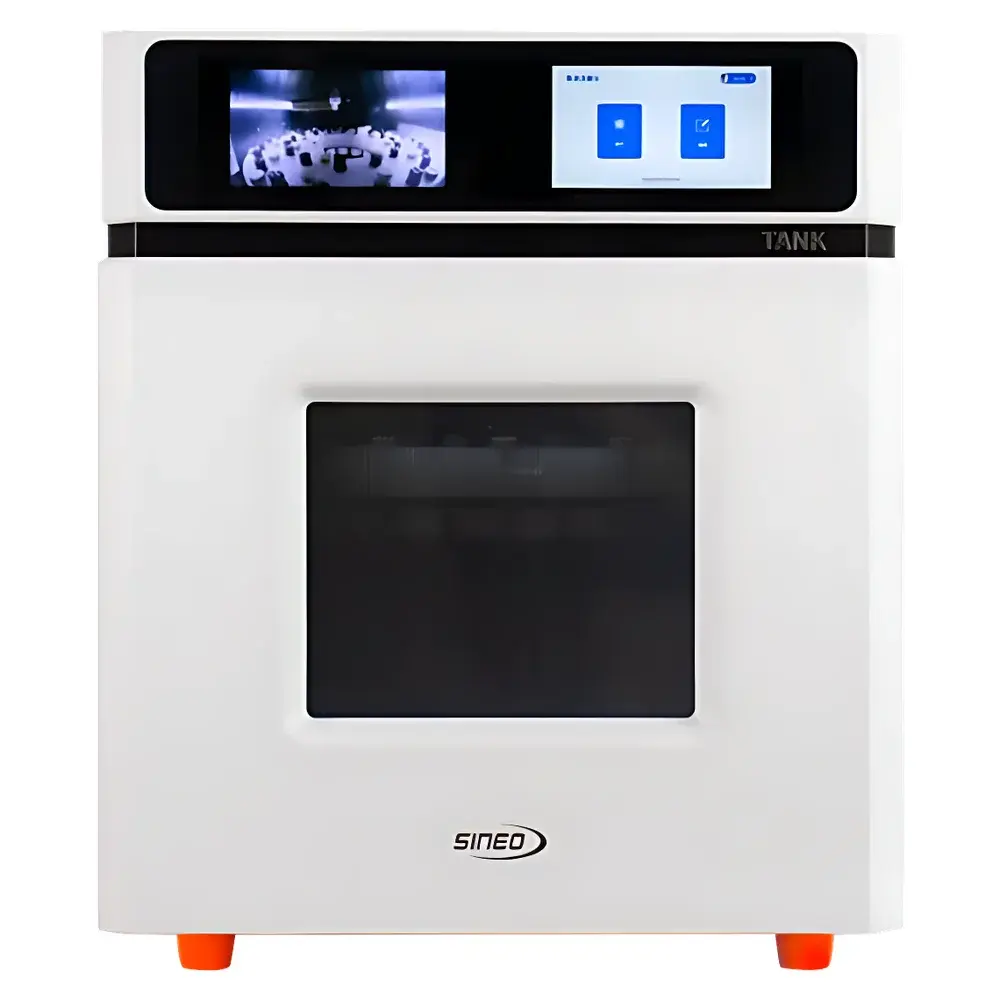
Sineo TANK Advanced Microwave Digestion System
| Brand | Sineo |
|---|---|
| Origin | Shandong, China |
| Model | TANK |
| Cavity Class | Industrial-grade |
| Sample Capacity | 12–40 positions |
| Microwave Source | 2450 MHz, dual magnetron, non-pulsed frequency-variable control |
| Max Temperature | 300 °C |
| Temp Measurement Accuracy | ±0.1 °C |
| Temp Control Stability | ±1 °C |
| Max Pressure | 15 MPa |
| Cavity Material | 316L stainless steel with multi-layer PTFE coating |
| Outer Vessel Material | Aerospace-grade composite fiber with PTFE coating (burst pressure: 70 MPa |
| max temp | 600 °C) |
| Cooling Time to Ambient | <15 min |
| Dimensions (W×D×H) | 570 × 650 × 680 mm |
| Net Weight | 65 kg |
| Power Supply | 220–240 VAC, 50/60 Hz, 16 A |
| Operating Environment | 0–40 °C, 15–80% RH |
Overview
The Sineo TANK Advanced Microwave Digestion System is an industrial-grade, high-throughput sample preparation platform engineered for precise, reproducible, and fully traceable closed-vessel microwave-assisted acid digestion. It operates on the principle of dielectric heating—where microwave energy (2450 MHz) couples directly with polar molecules (e.g., HNO₃, HCl, HF) and ionic species in the sample matrix—inducing rapid, volumetric heating under controlled pressure and temperature conditions. This enables complete decomposition of complex organic and inorganic matrices—including soils, biological tissues, polymers, geological samples, and pharmaceutical excipients—into transparent, acid-soluble solutions suitable for subsequent elemental analysis by ICP-OES, ICP-MS, AAS, or IC. Designed for compliance-critical laboratories, the TANK system integrates hardware-level safety architecture with software-enforced data integrity protocols aligned with international regulatory expectations.
Key Features
- Industrial 316L stainless steel cavity with multi-layer PTFE coating—resistant to aggressive acids (HF, aqua regia) and validated for >5-year service life under routine QC/QA use.
- Dual magnetron, non-pulsed frequency-variable microwave generation with real-time power feedback ensures uniform field distribution across the entire cavity volume—minimizing hot/cold spots and improving inter-vial temperature homogeneity (±1 °C).
- Full-vessel temperature monitoring via non-contact mid-infrared pyrometry—measuring surface temperature of each TFM-lined inner vessel in real time; optional multi-core fused-silica fiber optic system available for direct solution-phase measurement with >5× extended service life versus single-core alternatives.
- Multi-tier pressure management: elastic self-sealing venting for standard vessels and rupture-disc-based overpressure release for ultra-high-pressure configurations—both mechanisms maintain dynamic seal integrity during normal operation and initiate fail-safe gas venting (CO₂, NOₓ) only upon exceeding preset thresholds.
- Integrated HD video monitoring system with wide-angle lens and LED illumination—enables remote visual verification of rotor positioning, vessel integrity, and reaction behavior without opening the safety interlocked door.
- Android-based control interface with 8 GB onboard storage, preloaded method library, and embedded calibration routines for temperature, pressure, and microwave output—supporting ASTM D5630, ISO 11885, USP <231>, and EPA Methods 3015A, 3051A, 3052.
Sample Compatibility & Compliance
The TANK system accommodates a modular range of rotor configurations—12-, 18-, 24-, and 40-position high-throughput rotors—each constructed with aerospace composite outer vessels rated to 70 MPa burst pressure and 600 °C thermal stability. All inner vessels are manufactured from ultra-pure, low-metal-leaching polytetrafluoroethylene (TFM™), certified per ASTM D4894 and compliant with USP Class VI biocompatibility requirements. The system meets EN 61000-6-3 (EMC emission) and EN 61000-6-2 (immunity) standards. Its mechanical and electronic safety architecture—including anti-microwave leakage choke grooves, auto-locking blast-resistant door with pressure-triggered interlock, and redundant thermal cutoffs—is designed to satisfy IEC 61010-1:2010 requirements for laboratory equipment. Full audit trail functionality, electronic signatures, and role-based user access align with FDA 21 CFR Part 11 and EU Annex 11 expectations for regulated environments.
Software & Data Management
The embedded Android OS delivers a validated, secure environment supporting ALCOA+ (Attributable, Legible, Contemporaneous, Original, Accurate, Complete, Consistent, Enduring, Available) data governance principles. Each run generates a tamper-evident digital record containing timestamped temperature/pressure/power profiles per vessel, method parameters, operator ID, and instrument calibration status. Data export options include CSV, PDF report generation, and encrypted cloud synchronization via TLS 1.2–secured API endpoints. Cloud storage supports version-controlled method sharing across multi-site laboratories while maintaining local data sovereignty. Over-the-air firmware updates preserve system compliance without requiring onsite service visits. Built-in validation tools allow labs to perform periodic performance qualification (PQ) using NIST-traceable reference materials and documented SOPs.
Applications
The TANK system is routinely deployed in environmental testing laboratories (EPA-compliant soil/sediment digestion), clinical and forensic toxicology (tissue and hair digestion for heavy metal screening), geochemical research (rock and ore dissolution prior to REE quantification), food safety QA (digestion of dairy, infant formula, and spices for As, Cd, Pb, Hg analysis), and battery material R&D (LiCoO₂, NMC cathodes, graphite anodes). Its ability to sustain 300 °C at 15 MPa enables complete oxidation of recalcitrant carbon matrices—reducing residual carbon content to <0.5%—while minimizing volatile element loss through intelligent ramp-hold-cool sequencing. Method libraries include optimized protocols for halogenated flame retardants, PCBs, and PFAS precursors requiring oxidative hydrolysis prior to LC-MS/MS analysis.
FAQ
Does the TANK system support GLP/GMP-compliant audit trails?
Yes—the system logs all user actions, parameter changes, calibration events, and run outcomes with immutable timestamps and digital signatures, meeting FDA 21 CFR Part 11 and EU GMP Annex 11 requirements.
Can it digest samples containing hydrofluoric acid (HF)?
Yes—TFM inner vessels and PTFE-coated 316L cavity surfaces provide full compatibility with HF-based digestion mixtures up to 40% concentration at temperatures ≤220 °C.
Is remote monitoring and control possible?
Yes—via secure web browser interface or dedicated mobile application; live temperature/pressure dashboards, alarm notifications, and method push capabilities are supported.
What validation documentation is provided?
Each unit ships with Factory Acceptance Test (FAT) report, IQ/OQ templates aligned with ISO/IEC 17025, and a Certificate of Conformance referencing EN 61010-1, IEC 61326-1, and electromagnetic compatibility directives.
How is cooling performance verified?
The integrated corrosion-resistant centrifugal blower dynamically adjusts airflow to achieve cavity cooldown from 300 °C to ambient in ≤15 minutes—verified per ASTM E2234 and included in routine PQ checklists.



