
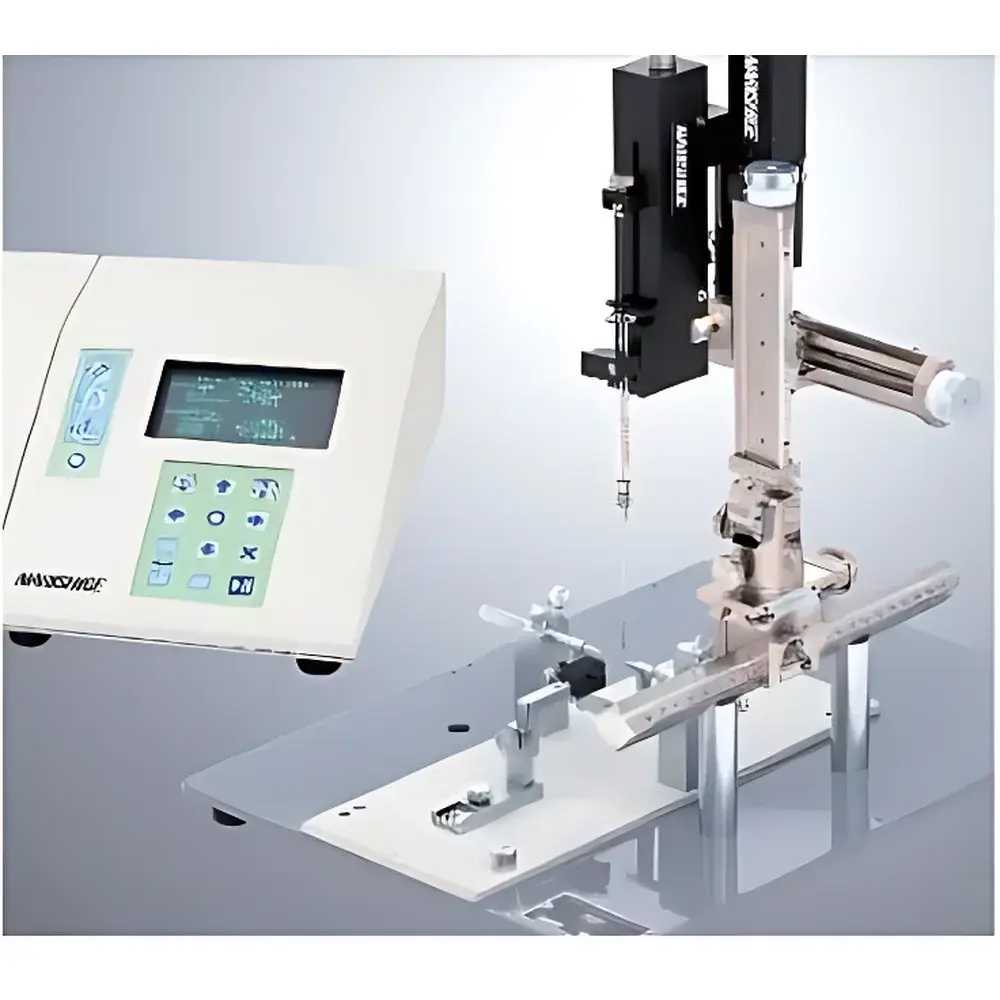
Narishige SMM Series Stereotaxic Instrument
| Brand | Narishige |
|---|---|
| Origin | Japan |
| Model | SMM-100 / SMM-100C / SMM-200 / SMM-200C / SR-5M1-HT / SR-9M-HT / SM-15R/L / SM-25A/SM-25C / SGM-3/SGM-4 / MAG-1/MAG-2/MAG-A / GM-3/GM-4 |
| Application Scope | Mouse, Rat, Neonatal Rat, Marmoset |
| Compliance | Designed for GLP-compliant acute and chronic in vivo neuroscience studies |
Overview
The Narishige SMM Series Stereotaxic Instrument is a precision-engineered platform for reproducible, high-fidelity stereotactic positioning of small laboratory animals during neuroscientific investigations. Built upon decades of refinement from the legacy SR-series, this instrument implements the principles of stereotactic coordinate geometry—referencing anatomical landmarks (bregma, lambda, external auditory meatus) to define three-dimensional Cartesian coordinates (anterior–posterior, medial–lateral, dorsal–ventral) relative to the brain’s intrinsic geometry. Its modular architecture supports both acute terminal procedures (e.g., electrophysiological recording, microinjection, optogenetic fiber implantation) and longitudinal chronic experiments—including awake-behavioral imaging, repeated cranial window access, and multi-session electrophysiology—without requiring re-surgery or compromising animal welfare. The system maintains mechanical stability under optical microscopy (including two-photon and stereo configurations), enabling integration with in vivo imaging, laser ablation, and closed-loop stimulation setups.
Key Features
- One-hand operable non-penetrating ear bars (EB-6) for rapid, atraumatic external auditory canal engagement with tactile confirmation of secure fixation.
- Compact, low-profile nose/mouth clamp optimized for murine dentition—designed to minimize oral tissue compression while ensuring consistent skull alignment across sessions.
- AP (anterior–posterior) frame rail compatible with multiple Narishige micromanipulators: SMM-100/SMM-200 (manual coarse/fine 3-axis control), SM-15R/L (left/right symmetric positioning), and SM-25A/SM-25C (ultra-thin multi-electrode carriers with independent Z-axis fine adjustment).
- SR-9M-HT variant includes a detachable chamber frame permitting repeated, anesthesia-free head fixation at identical stereotactic coordinates—validated for visual and auditory behavioral paradigms.
- Rotatable horizontal plane stage (via ergonomic handle) enables precise angular alignment of electrodes or optical fibers in sagittal, coronal, or oblique planes without repositioning the animal.
- Interchangeable head holders (SGM-3/SGM-4) implement three-point fixation (nose, mouth, ears) with pivot/swivel/rotation degrees of freedom—ideal for ophthalmic observation and cranial window imaging where unobstructed lateral access is required.
Sample Compatibility & Compliance
The SMM platform accommodates a defined range of species and developmental stages: adult and neonatal mice (C57BL/6, BALB/c), Sprague-Dawley and Wistar rats, and common marmoset (Callithrix jacchus). All components comply with ISO 13485–aligned manufacturing protocols for medical-grade laboratory equipment. The SR-9M-HT and MAG-series accessories are validated for repeated use in chronic preparations under IACUC- and AAALAC-accredited facilities. When used with GM-3/GM-4 anesthesia masks—integrated via standardized nose-bar adapters—the system supports stable isoflurane delivery while maintaining full 3-point head immobilization. No component introduces magnetic interference, ensuring compatibility with fMRI-compatible experimental rigs and electrophysiology amplifiers requiring low-noise grounding.
Software & Data Management
While the SMM Series operates as a hardware-centric mechanical platform (no embedded firmware or onboard software), its design fully supports integration into regulated digital workflows. Coordinate data generated during surgery—recorded manually or via third-party digital calipers (e.g., Mitutoyo Absolute Digimatic)—can be logged into ELN systems compliant with 21 CFR Part 11 requirements when paired with audit-trail-enabled electronic notebooks (e.g., LabArchives, Benchling). Optional digital readouts (not included) may interface via RS-232 or USB to MATLAB-, Python-, or LabVIEW-based acquisition suites for real-time coordinate logging and experiment metadata tagging. All mechanical adjustments retain traceable repeatability (±5 µm typical positional hysteresis over 100 cycles), supporting GLP documentation standards for method validation reports.
Applications
- In vivo extracellular single-unit and multi-unit electrophysiology using silicon probes or tungsten electrodes.
- Chronic two-photon calcium imaging through cranial windows in awake, head-fixed mice.
- Targeted intracerebral microinjection of viral vectors, tracers, or pharmacological agents with sub-millimeter accuracy.
- Optogenetic fiber photometry and closed-loop light delivery in behaving rodents.
- Acute slice preparation support: skull-stabilized vibratome sectioning with preserved dorsoventral orientation.
- Auditory cortex mapping via precisely angled electrode penetrations aligned to tonotopic gradients.
FAQ
Is the SMM Series compatible with two-photon microscopy setups?
Yes—the MAG-1 and MAG-2 head holders are specifically engineered for minimal profile and maximal optical clearance, allowing direct placement beneath upright two-photon microscope objectives without obstruction.
Can the same animal be repositioned identically across multiple experimental sessions?
Yes—SR-9M-HT with chamber-frame configuration enables repeatable, anesthesia-free head fixation at verified AP/ML/DV coordinates, supported by published validation data in chronic imaging and behavioral electrophysiology literature.
What level of mechanical resolution does the SMM-100 micromanipulator provide?
The SMM-100 features graduated coarse/fine dual-stage controls: coarse movement at 1 mm/rev, fine adjustment at 10 µm/rev on X/Y/Z axes, with backlash compensation achieved via calibrated knob tensioning.
Are replacement parts and service documentation available internationally?
Narishige provides global technical support through authorized distributors; all mechanical components (ear bars, clamps, rails, manipulator arms) are field-replaceable using standard hex keys, and CAD drawings are available under NDA for institutional maintenance teams.
Does the system meet requirements for FDA-regulated preclinical studies?
While not a medical device, the SMM Series conforms to ISO 14971 risk management principles and is routinely cited in IND-enabling toxicology and biodistribution studies where anatomical targeting accuracy and procedural reproducibility are critical success factors.
Related Products




