
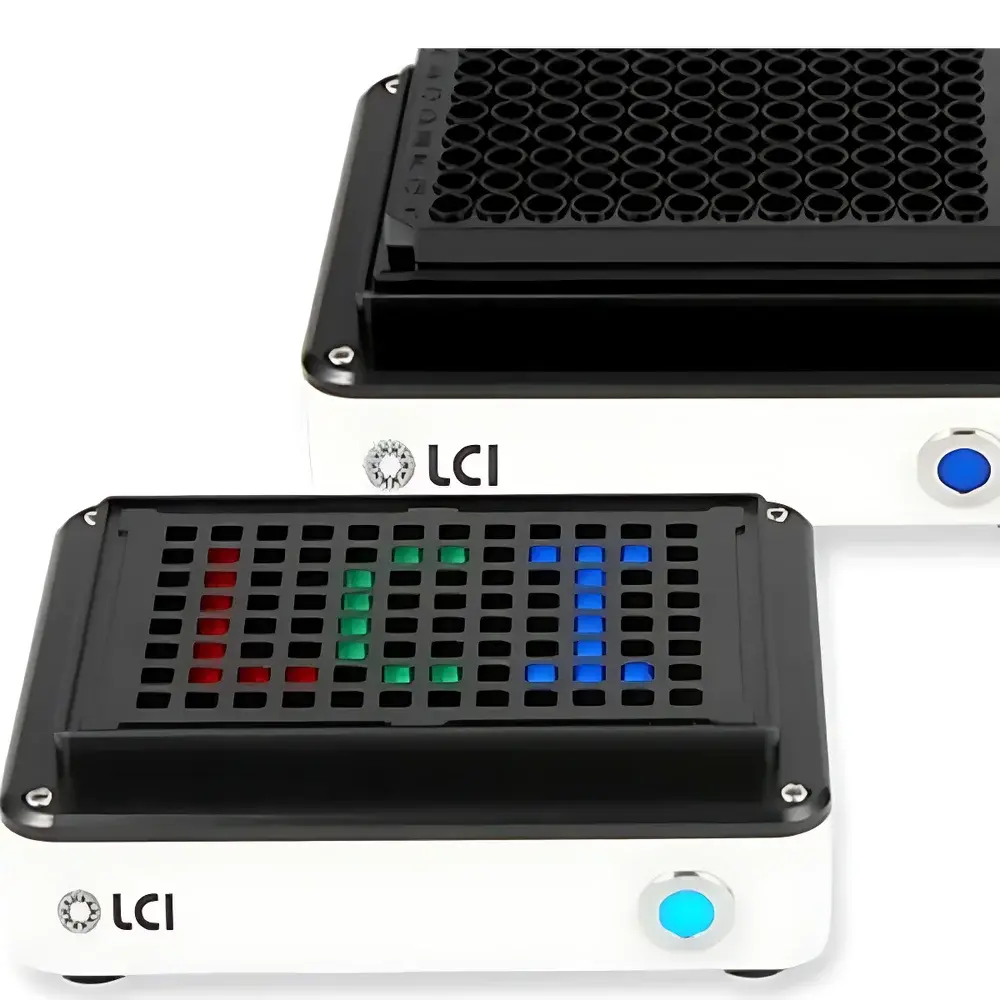
LCI W3 LED Illumination System for Multi-Well Plates
| Brand | LCI / Live Cell Instrument |
|---|---|
| Origin | Germany |
| Manufacturer Type | Authorized Distributor |
| Import Status | Imported |
| Model | W3 |
| Component Category | Optical Component |
| LED Channels | 96 |
| Wavelength Options | RGB (625 nm, 525 nm, 475 nm) or Single-Wavelength (475 nm, 525 nm, 590 nm, 625 nm, 660 nm, 730 nm, customizable) |
| Brightness Uniformity | ±5% (pre-calibrated) |
| Communication | USB, ≤10 ms latency |
| Timing Accuracy | ≤100 ms drift over 24 h |
| IP Rating | IP55 |
| Input Power | 100–240 VAC, 50/60 Hz, 0.8 A |
| Dimensions (W×D×H) | 154 × 120 × 50 mm |
| Weight | LED Module 0.85 kg, Control Unit 0.21 kg |
| Thermal Management | Integrated temperature sensing + linear PWM-controlled fan |
| Environmental Design | Conformal-coated PCBs, humidity-resistant construction for incubator use |
| Accessories | Adjustable spacer plate, anti-scatter lid |
Overview
The LCI W3 LED Illumination System is a precision-engineered optical stimulation platform designed exclusively for multi-well plate-based optogenetic experiments in live-cell imaging and functional biology. Built upon a modular, 96-channel LED architecture, the W3 delivers independently addressable, spectrally defined light pulses to individual wells—enabling high-throughput, spatiotemporally resolved photostimulation of genetically encoded opsins (e.g., ChR2, NpHR, ReaChR, Chrimson). Its core operational principle relies on digitally controlled constant-current LED drivers synchronized via low-latency USB communication, ensuring sub-10 ms command execution and 95% RH conditions.
Key Features
- 96 independent LED channels—each fully programmable for intensity (0–100%), pulse width (1 ms–24 h), frequency (DC to 100 Hz), and duty cycle—supporting combinatorial wavelength protocols across wells.
- Spectral flexibility: factory-configured RGB triad (625 nm red, 525 nm green, 475 nm blue) or user-selectable single-wavelength modules (475 nm, 525 nm, 590 nm, 625 nm, 660 nm, 730 nm), with optional narrow-band (<20 nm FWHM) variants available per application requirements.
- Pre-deployment photometric calibration: integrated brightness correction algorithm compensates for binning variance and aging drift, guaranteeing inter-channel irradiance uniformity within ±5% across the full 96-well footprint (measured at 10 mm working distance).
- Active thermal regulation: real-time LED junction temperature monitoring coupled with linear PWM-controlled silent fan ensures stable radiant flux and prevents thermal-induced wavelength shift or accelerated lumen depreciation.
- Incubator-optimized mechanical design: compact footprint (154 × 120 × 50 mm), lightweight modular assembly (LED head: 0.85 kg; controller: 0.21 kg), and detachable anti-scatter lid minimize stray light contamination during microscopy-coupled assays.
Sample Compatibility & Compliance
The W3 is validated for use with standard ANSI/SBS-compliant 6-, 12-, 24-, 48-, 96-, and 384-well plates—including black-walled, clear-bottom, and μClear® formats—without optical crosstalk between adjacent wells. Its IP55-rated housing and conformal-coated PCBs comply with IEC 60529 for protection against dust ingress and low-pressure water jets, making it suitable for routine deployment in Class II biosafety cabinets and humidified cell culture incubators operating per ISO 14644-1 (Grade 8) environmental specifications. All electronic subsystems meet CE marking requirements under EMC Directive 2014/30/EU and Low Voltage Directive 2014/35/EU. While not certified as medical device hardware, the system supports GLP-aligned experimental workflows when paired with audit-trail-enabled acquisition software (e.g., via third-party LabVIEW or Python APIs).
Software & Data Management
Control is executed via LCI’s native Windows-based W3 Control Suite—a deterministic, non-blocking GUI supporting protocol scripting (XML-based), real-time intensity monitoring, and hardware-synchronized timestamp logging. The software implements a zero-buffered USB interface to eliminate command queuing delays and enables direct integration with common acquisition platforms including MetaMorph, Micro-Manager, and NIS-Elements through TTL-triggered I/O expansion ports. All illumination parameters—including absolute irradiance values (mW/cm², traceable to NIST-calibrated photodiode reference), exposure history per well, and thermal logs—are exported in CSV/JSON format for downstream statistical analysis or LIMS ingestion. Firmware updates preserve backward compatibility and support field reconfiguration of wavelength sets without hardware modification.
Applications
- Optogenetic interrogation of neuronal circuits in iPSC-derived cortical spheroids cultured in 96-well microelectrode arrays (MEAs).
- High-content screening of light-gated ion channel kinetics using Fluo-4 AM calcium imaging in HEK293T cells expressing ChRmine.
- Photopharmacological dose-response profiling of photoswitchable compounds (e.g., azobenzene derivatives) in primary macrophage migration assays.
- Chronobiology studies involving repeated 480 nm blue-light pulses to entrain PER2::LUC bioluminescence rhythms in U2OS reporter lines.
- Photosensitizer activation (e.g., Rose Bengal, Pc 4) in photodynamic therapy (PDT) cytotoxicity assays under controlled spectral and dosimetric conditions.
FAQ
Is the W3 compatible with non-standard well plate geometries (e.g., custom microfluidic chips)?
Yes—the adjustable spacer plate allows precise vertical positioning (range: 5–25 mm) to accommodate variable sample-to-LED distances; optical alignment can be verified using the included collimation target slide.
Can multiple W3 units be synchronized for larger-format assays?
Up to four W3 controllers can be daisy-chained via USB hub with master-slave timing synchronization (±2 ms inter-unit jitter), enabling coordinated illumination across 384-well or tiled plate configurations.
Does the system support closed-loop irradiance feedback?
Not natively—but an optional calibrated photodiode sensor module (PDM-96) can be mounted beneath the plate to provide real-time irradiance telemetry, enabling software-driven closed-loop intensity compensation.
What is the expected LED lifetime under continuous incubator operation?
Rated L70 lifetime exceeds 20,000 hours at 70% nominal drive current and 37 °C ambient; accelerated life testing confirms <3% lumen depreciation after 6 months of uninterrupted 24/7 use in 5% CO₂, 95% RH environment.
Is firmware open for third-party API development?
Yes—LCI provides documented HID-class USB command protocol specification and Python/C++ SDKs under NDA for integration into custom acquisition pipelines or automated screening platforms.





