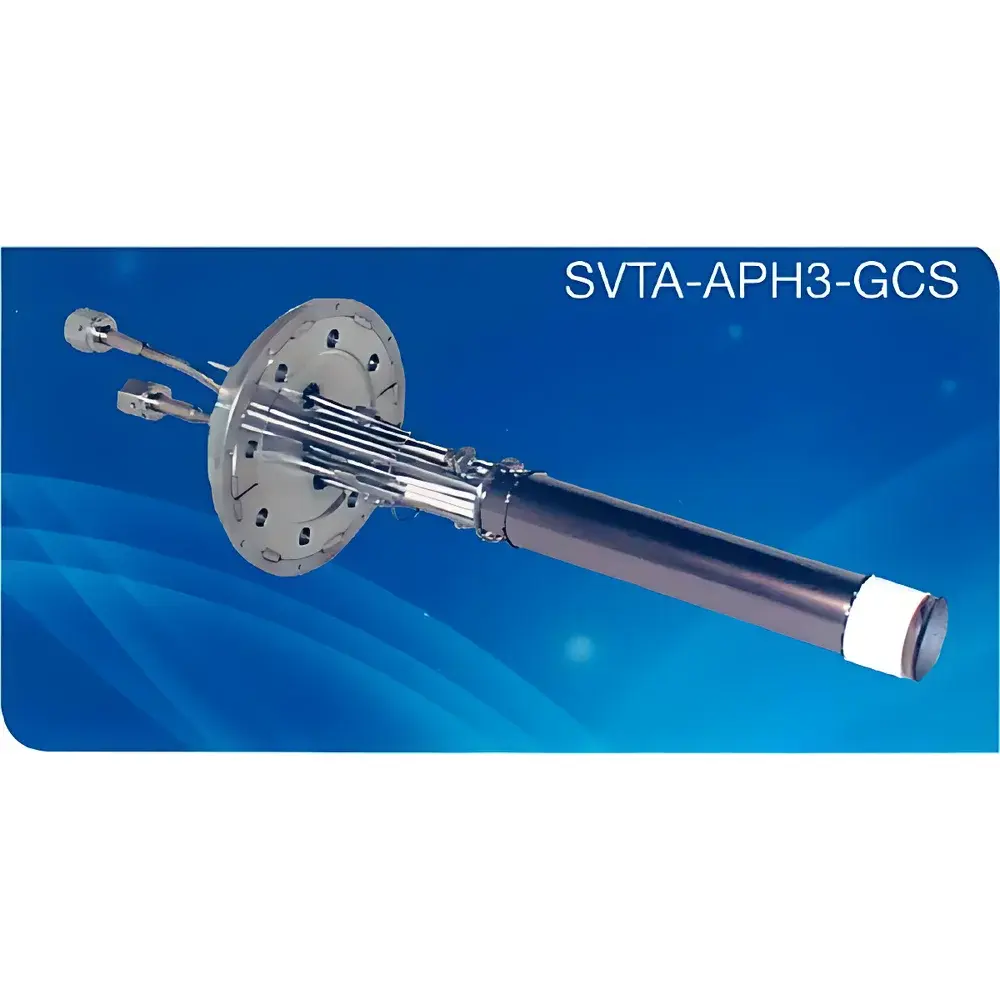
SVT Associates SVTA-APH3-GCS Gas Injection Source for Gas-Source Molecular Beam Epitaxy
| Brand | SVT Associates |
|---|---|
| Origin | USA |
| Model | SVTA-APH3-GCS |
| Operating Temperature Range | 150 °C to 1300 °C |
| Heating Configuration | Single Filament with Dual-Gas-Tube Furnace |
| Cracking Zone Materials | High-Purity Pyrolytic Boron Nitride (PBN) and Tantalum |
| Aperture Plate System | Modular, User-Selectable |
| Gas Delivery | High-Pressure Compatible, MFC-Integrated |
| Beam Uniformity Optimization | Customizable Source Length |
| Control Interface | Automated Beam Flux Regulation via Mass Flow Controllers (MFCs) |
Overview
The SVT Associates SVTA-APH3-GCS Gas Injection Source is a precision-engineered thermal cracker designed specifically for Gas-Source Molecular Beam Epitaxy (GSMBE) systems used in advanced III–V compound semiconductor fabrication. Unlike conventional effusion cells or plasma-based sources, the SVTA-APH3-GCS employs resistive thermal cracking within a tightly controlled, ultra-high-purity environment to decompose highly reactive and toxic precursor gases—including arsine (AsH₃) and phosphine (PH₃)—into reactive atomic or radical species suitable for epitaxial layer growth. Its operational principle relies on precise filament heating combined with dual concentric gas-tube geometry to maximize residence time and thermal dissociation efficiency while minimizing uncracked precursor carryover. The source operates across a wide temperature range (150 °C to 1300 °C), enabling tunable cracking fractions for stoichiometric control of GaAs, InP, AlGaAs, InGaP, and other lattice-matched or strained heterostructures.
Key Features
- Thermally robust cracking zone constructed from high-purity pyrolytic boron nitride (PBN) and tantalum—materials selected for exceptional thermal stability, low outgassing, and resistance to halide and hydride corrosion at elevated temperatures.
- Single tungsten filament design integrated with dual concentric gas delivery tubes, ensuring uniform radial heating profile and enhanced precursor residence time for >95% cracking efficiency under optimized conditions.
- Modular aperture plate system with multiple interchangeable plates—each featuring precisely machined orifices—to allow fine-tuning of beam divergence, angular distribution, and effective source size without hardware replacement.
- Gas transport architecture rated for high-pressure operation (up to 10 bar inlet pressure), compatible with industrial-grade mass flow controllers (MFCs) and integrated pressure regulation for stable, pulsation-free precursor delivery.
- Customizable source length (standard: 300 mm; optional: 200–500 mm) to optimize beam collimation and spatial uniformity across large-area substrates (up to 6″ wafers).
- Full compatibility with UHV-compatible flange standards (CF-63 or CF-100) and bake-out capable to 400 °C, supporting integration into Class 10 or better cleanroom-integrated MBE/GSMBE platforms.
Sample Compatibility & Compliance
The SVTA-APH3-GCS is validated for use with Group V hydride precursors (AsH₃, PH₃, SbH₃) and select Group II/VI precursors requiring thermal activation (e.g., H₂Se, H₂Te). It meets stringent material compatibility requirements for semiconductor R&D and pilot-line manufacturing environments. All wetted components comply with SEMI F57-0218 (specifications for semiconductor process equipment materials) and ASTM F2169 (standard guide for handling toxic gases in microelectronics). The source’s construction supports full traceability documentation per ISO 9001:2015 and facilitates audit readiness for GLP and GMP-aligned epitaxial process development workflows.
Software & Data Management
While the SVTA-APH3-GCS operates as a hardware subsystem, it interfaces seamlessly with industry-standard vacuum and process control platforms—including those compliant with SECS/GEM protocol and OPC UA frameworks. Integrated MFCs support analog (0–10 V) and digital (RS-485, Modbus RTU) feedback loops for closed-loop beam flux regulation. Optional firmware upgrades enable logging of real-time temperature profiles, MFC setpoints, and thermal ramp history—data structured for export in CSV or HDF5 format to support statistical process control (SPC), DOE analysis, and FDA 21 CFR Part 11–compliant electronic records when deployed in regulated environments.
Applications
- Growth of high-electron-mobility transistors (HEMTs) using AlGaAs/GaAs or InAlAs/InGaAs heterojunctions.
- Epitaxial deposition of quantum well lasers (QW lasers), vertical-cavity surface-emitting lasers (VCSELs), and distributed feedback (DFB) laser structures.
- Low-defect-density InP-based photonic integrated circuits (PICs) requiring precise As/P ratio control.
- Research-scale synthesis of dilute nitride alloys (e.g., GaInNAs) where nitrogen incorporation depends critically on PH₃/AsH₃ cracking kinetics.
- Development of tandem solar cell subcells (e.g., GaInP top junctions) demanding reproducible group-V flux ratios over multi-hour growth runs.
FAQ
What precursor gases is the SVTA-APH3-GCS certified to crack?
It is engineered and tested for arsine (AsH₃), phosphine (PH₃), and stibine (SbH₃); compatibility with selenophosphines or tellurophosphines requires prior consultation and qualification testing.
Does the source include temperature calibration certificates?
Yes—each unit ships with NIST-traceable thermocouple calibration data and a vacuum-compatible calibration report valid to 1300 °C.
Can the aperture plate configuration be changed in situ?
No—aperture plates require venting and manual replacement; however, the modular design allows rapid exchange during maintenance cycles with minimal alignment recalibration.
Is remote monitoring supported?
Standard analog I/O enables integration with PLC-based supervision systems; Ethernet-enabled MFCs and optional digital I/O modules provide full remote telemetry and setpoint adjustment.
What vacuum compatibility specifications does it meet?
The source achieves base pressures <5×10⁻¹⁰ mbar after 24-hour bake-out at 400 °C and maintains leak integrity per Helium leak rate ≤1×10⁻¹⁰ mbar·L/s (per ISO 15848-1).
Related Products