
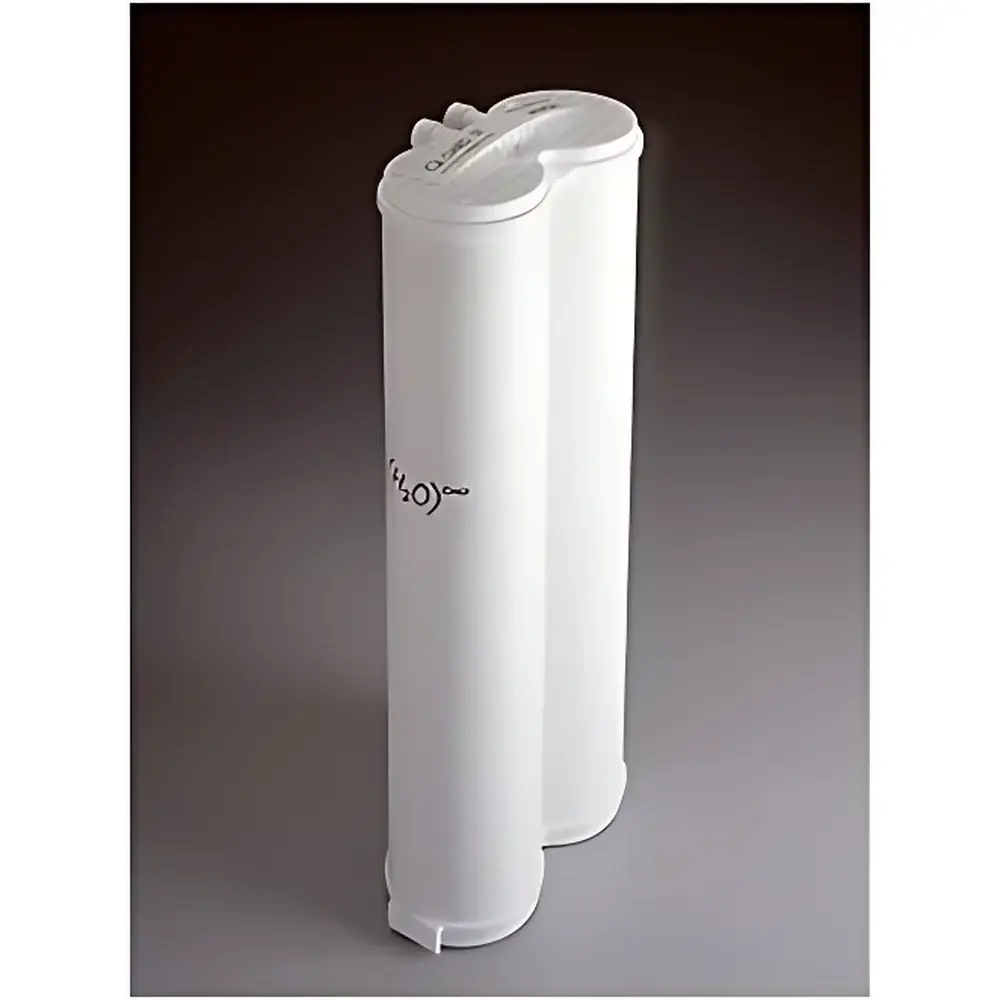
Merck Milli-Q® Q-GARD Purification Cartridge
| Brand | Merck Milli-Q |
|---|---|
| Origin | France |
| Manufacturer | Merck KGaA |
| Product Type | Imported OEM Cartridge |
| Model | Milli-Q Q-GARD Purification Cartridge |
| Water Grade | ASTM Type I / ISO 3696 Grade 1 |
| Resistivity | 18.2 MΩ·cm @ 25 °C |
| Heavy Metals & Soluble Silica | <0.1 ppb |
| Total Organic Carbon (TOC) | <5 ppb |
| Microbial Count / Endotoxins | <0.001 EU/mL |
| Particles (>0.1 µm) | <1 particles/mL |
Overview
The Merck Milli-Q® Q-GARD Purification Cartridge is an OEM-engineered consumable designed exclusively for integration into Milli-Q® ultrapure water systems—including the Milli-Q Advantage A10 and Milli-Q Reference series. It functions as a critical pre-purification stage within the multi-stage water purification architecture, delivering consistent removal of ionic contaminants, trace organics, particulates, endotoxins, and specific elemental impurities prior to final polishing by the system’s integrated 0.22 µm filter and UV oxidation module. The cartridge operates on a dual-mechanism principle: ion exchange via patented Jetpore® resin technology for high-capacity deionization, coupled with high-surface-area synthetic activated carbon for adsorptive removal of low-molecular-weight organic compounds—including volatile organics, chlorine, chloramines, and THMs. Its performance is validated against ASTM D1193-20 (Type I water), ISO 3696:1987 (Grade 1), and CLSI EP22-A guidelines for clinical laboratory water quality.
Key Features
- Patented Jetpore® ion exchange resin: Engineered for high ionic capacity, extended service life, and minimal leaching—ensuring stable resistivity ≥18.2 MΩ·cm at 25 °C over full cartridge lifetime.
- Synthetic high-precision activated carbon: Chemically stabilized and acid-washed to maximize adsorption of small-molecule organics while minimizing carbon fines and TOC release (<5 ppb).
- RFID-enabled smart identification: Integrated RFID tag allows automatic recognition by compatible Milli-Q® systems, verifying cartridge authenticity, tracking usage history, and enforcing firmware-level compatibility checks to prevent mismatched installation.
- Application-specific variants: Available in multiple configurations—including Q-GARD T1/T2/T3 (general pre-purification), Q-GARD B (boron-selective), and Q-GARD VX (volatile organic compound removal)—each optimized for distinct feedwater profiles and analytical requirements.
- Robust housing design: Polypropylene casing rated for continuous operation at 0.1–0.3 MPa, compliant with USP material safety standards for pharmaceutical water contact surfaces.
Sample Compatibility & Compliance
The Q-GARD cartridge is validated for use with municipal tap water, reverse osmosis (RO) permeate, or deionized (DI) feed sources meeting minimum inlet specifications: conductivity ≤50 µS/cm, TOC ≤500 ppb, and free chlorine ≤1 ppm. It is certified per ISO 13485:2016 for medical device manufacturing environments and supports compliance with FDA 21 CFR Part 11 (when used with Milli-Q® systems equipped with audit-trail-enabled software), USP , EP 2.2.43, and JP 17 water quality monographs. All variants undergo end-of-life validation testing per ASTM D5116-17 to confirm residual contaminant breakthrough thresholds remain below specification limits.
Software & Data Management
When installed in RFID-compatible Milli-Q® platforms (e.g., Advantage A10, Reference, IQ 7000), the Q-GARD cartridge enables automated lifecycle management: real-time flow-volume metering, predictive replacement alerts based on cumulative throughput (3000 L nominal capacity), and secure logging of installation/removal timestamps in the system’s internal audit trail. Data export adheres to CSV/Excel formats compliant with LIMS integration protocols. Firmware updates maintain backward compatibility with legacy Q-GARD cartridges while supporting enhanced diagnostics for newer T-series variants.
Applications
Q-GARD cartridges serve as foundational components in laboratories requiring reproducible ultrapure water for high-sensitivity applications: LC-MS and ICP-MS mobile phase preparation; cell culture media formulation; molecular biology workflows (PCR, NGS library prep, CRISPR editing); ELISA and immunoassay reagent dilution; semiconductor wafer rinsing; and calibration of trace-metal analytical instruments. The boron-selective Q-GARD B variant is specified for borosilicate glassware leaching studies and boron-sensitive plant tissue culture; Q-GARD VX is deployed in environmental VOC analysis labs where blank integrity is critical.
FAQ
What is the recommended replacement interval for Q-GARD cartridges?
Cartridges should be replaced every 6–12 months or after processing 3000 L of feed water—whichever occurs first—as determined by system flow monitoring and resistivity stability trends.
Can Q-GARD T-series cartridges be used interchangeably across Milli-Q® models?
Yes, but only within the same generation platform: T1/T2/T3 are cross-compatible with Advantage A10 and Reference systems; however, they are not validated for use in IQ 7000 or Elix® series without firmware verification.
Does the RFID tag store usage data locally on the cartridge?
No—the RFID chip contains only immutable product identifiers (lot number, model, expiration). Usage metrics are logged exclusively in the host Milli-Q® system’s memory.
Is Q-GARD B certified for USP elemental impurities testing?
Yes—Q-GARD B is qualified for boron reduction to <0.1 ppb, enabling compliance with USP Class 1 elemental impurity control in pharmaceutical water used for injectables.
How does Q-GARD compare to third-party generic purification cartridges?
Unlike non-OEM alternatives, Q-GARD undergoes full functional integration testing with Milli-Q® hardware and software, including pressure-drop validation, microbial retention verification per ISO 13408-1, and long-term leachables profiling per USP .



