
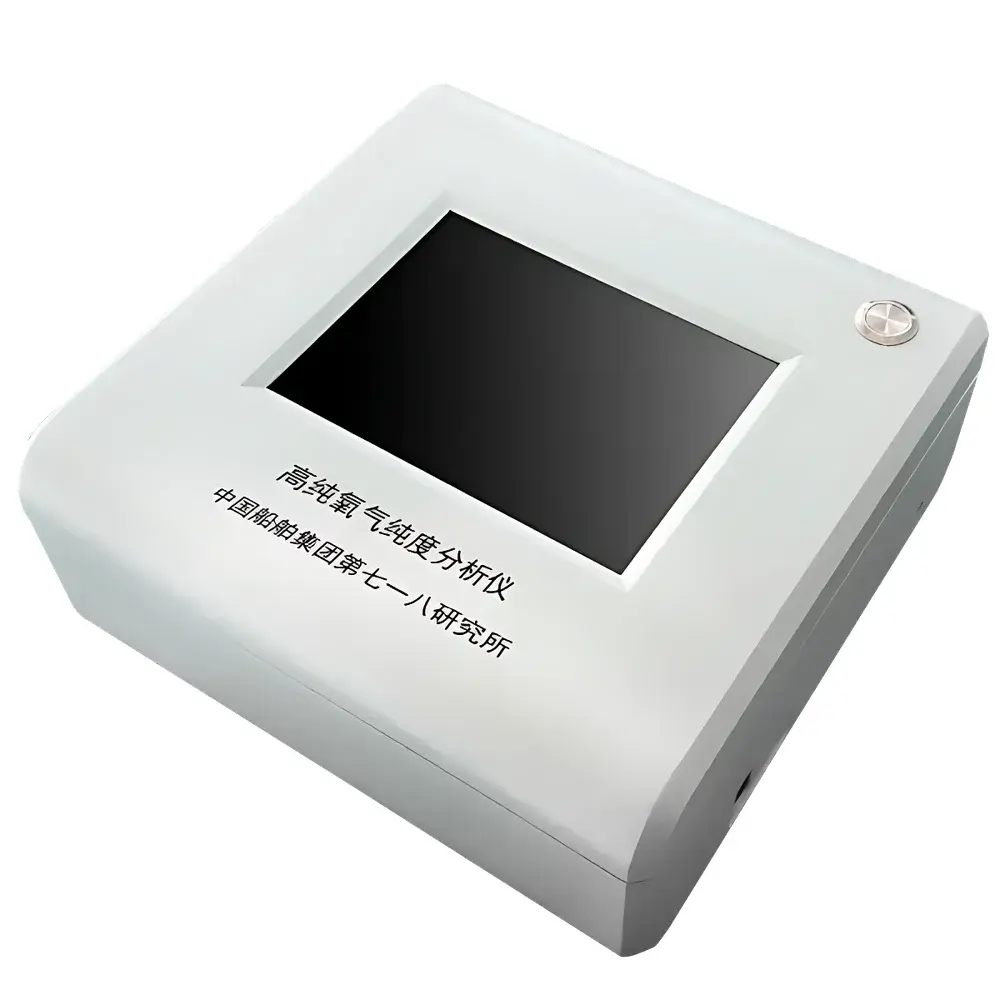
PERIC OX-01 High-Purity Oxygen Purity Analyzer
| Brand | PERIC |
|---|---|
| Origin | Hebei, China |
| Manufacturer Type | Manufacturer |
| Country of Origin | Domestic (China) |
| Model | OX-01 |
| Pricing | Available Upon Request |
| Oxygen (O2) Detection Principle | Zirconia Electrochemical Cell |
| O2 Range | 90–100 % vol |
| O2 Resolution | 0.01 % |
| CO2 Detection Principle | NDIR (Non-Dispersive Infrared) |
| CO2 Range | 0–2000 ppm |
| CO2 Resolution | 0.1 ppm |
| CO Detection Principle | Electrochemical Sensor |
| CO Range | 0–50 ppm |
| CO Resolution | 0.1 ppm |
| Cl₂ Detection Principle | Electrochemical Sensor |
| Cl₂ Range | 0–10 ppm |
| Cl₂ Resolution | 0.1 ppm |
| Dew Point Temperature Measurement Principle | Capacitive Hygrometry |
| Dew Point Range | –60 to +20 °C |
| Dew Point Resolution | 0.01 °C |
| Particulate Matter (PM) Detection Principle | Laser Light Scattering |
| PM Range | 0–1 mg/m³ |
| PM Resolution | 0.001 mg/m³ |
| Display | 5.6-inch high-resolution TFT LCD |
| Data Logging | Internal storage with timestamped records |
| Portability | Handheld, battery-operated design for field deployment |
Overview
The PERIC OX-01 High-Purity Oxygen Purity Analyzer is an integrated, field-deployable gas analysis system engineered for the quantitative verification of oxygen purity in critical breathing gas applications—specifically medical-grade oxygen (USP/EP/JP compliant) and aviation breathing oxygen (SAE AS8010, MIL-STD-810G). Unlike conventional paramagnetic or electrochemical oxygen analyzers optimized for ambient or low-concentration ranges, the OX-01 employs a high-stability zirconia-based electrochemical cell calibrated exclusively across the 90–100 % vol oxygen range. This targeted calibration ensures minimal zero drift, high repeatability (< ±0.03 % vol), and long-term stability under continuous exposure to near-anhydrous, high-purity O₂ streams. Complementing oxygen measurement, the instrument simultaneously quantifies trace contaminants—including carbon monoxide (CO), carbon dioxide (CO₂), chlorine (Cl₂), particulate matter (PM), and dew point temperature—enabling comprehensive quality assurance per ISO 8573-1 (compressed air purity classes) and ASTM D6866 (oxygen purity verification protocols). Its architecture supports real-time, multi-parameter assessment without external gas conditioning, making it suitable for on-site validation during cylinder filling, pipeline distribution, or pre-flight checks.
Key Features
- Zirconia-based oxygen sensor with factory calibration traceable to NIST-standard reference gases for the 90–100 % vol range, delivering <0.01 % vol resolution and <±0.05 % absolute accuracy.
- Multi-sensor fusion platform integrating NDIR for CO₂, dual-electrochemical cells for CO and Cl₂, capacitive dew point sensor (–60 to +20 °C), and forward-scatter laser photometer for PM (0.3–10 µm equivalent aerodynamic diameter).
- 5.6-inch sunlight-readable TFT display with intuitive icon-driven UI, supporting simultaneous visualization of all six parameters with configurable alarm thresholds (audible/visual).
- Onboard data logging capacity for ≥10,000 timestamped records (date, time, all measured values, sensor status flags), exportable via USB-C to CSV-compatible formats.
- IP54-rated ruggedized enclosure with ergonomic grip, rechargeable Li-ion battery (≥8 h continuous operation), and quick-connect stainless-steel sampling probe compatible with CGA-540 and DIN 477 fittings.
Sample Compatibility & Compliance
The OX-01 is validated for use with gaseous oxygen at pressures up to 20 MPa (2900 psi) and flow rates of 0.5–2 L/min. It accommodates both compressed gas cylinders and low-pressure manifold systems without external pressure regulation. All sensors meet IEC 61000-4 electromagnetic compatibility standards and operate within –10 to +50 °C ambient conditions. The analyzer complies with key regulatory frameworks governing breathing gas quality: USP (Oxygen), ISO 8573-1:2010 Class 1 for particles and water content, and SAE AS8010B Annex A for aviation oxygen. While not FDA 510(k)-cleared as a medical device, its measurement methodology aligns with USP , EP 2.5.27, and JP XVII requirements for residual impurity limits in medicinal oxygen (e.g., CO ≤ 5 ppm, CO₂ ≤ 500 ppm, Cl₂ ≤ 0.1 ppm, dew point ≤ –40 °C, PM ≤ 0.1 mg/m³).
Software & Data Management
Data acquisition and reporting are managed through embedded firmware supporting GLP-compliant audit trails: each logged record includes operator ID (optional input), instrument serial number, sensor calibration dates, and firmware version. USB-C interface enables direct file transfer; no proprietary software is required. Exported CSV files contain ISO 8601 timestamps, SI units, and sensor-specific uncertainty estimates derived from calibration certificates. Optional PC-based configuration utility (Windows/macOS) allows custom alarm setpoints, logging intervals (1 s to 60 min), and unit conversion (e.g., ppm ↔ mg/m³ at STP). All firmware updates are digitally signed and delivered via secure HTTPS download.
Applications
- Pre-release verification of medical oxygen cylinders in hospital pharmacies and compounding facilities.
- In-line monitoring during aviation oxygen system maintenance and ground support equipment (GSE) calibration.
- Periodic audits of bulk liquid oxygen vaporization systems per Joint Commission EC.02.05.01 standards.
- Validation of oxygen concentrators and portable hyperbaric chambers where trace contaminant ingress poses clinical risk.
- Field testing of cryogenic oxygen delivery infrastructure in pharmaceutical manufacturing (ISO 14644-1 Class 5 cleanrooms).
FAQ
What calibration standards are used for the zirconia oxygen sensor?
The O₂ sensor is calibrated using certified NIST-traceable gas mixtures containing 95.0 % and 99.5 % O₂ in nitrogen, with calibration certificates issued per ISO/IEC 17025.
Can the OX-01 be used for continuous unattended monitoring?
It is designed for periodic spot-checking and verification—not for permanent installation. For continuous monitoring, PERIC offers the OX-200 series with 4–20 mA outputs and Modbus RTU interface.
How often must the electrochemical sensors be replaced?
CO and Cl₂ sensors have a typical service life of 24 months; CO₂ NDIR cell lifetime exceeds 5 years. All sensors include built-in health diagnostics and end-of-life warnings.
Is the particulate measurement compliant with ISO 21501-4?
Yes—the laser scattering module meets ISO 21501-4 requirements for optical particle counters, with Mie theory-based size calibration using NIST SRM 1930 polystyrene latex spheres.
Does the analyzer support FDA 21 CFR Part 11 compliance?
While the OX-01 provides audit-trail-capable logging, full Part 11 compliance requires integration with a validated third-party electronic lab notebook (ELN) system; PERIC provides API documentation for such integration.
Related Products







