
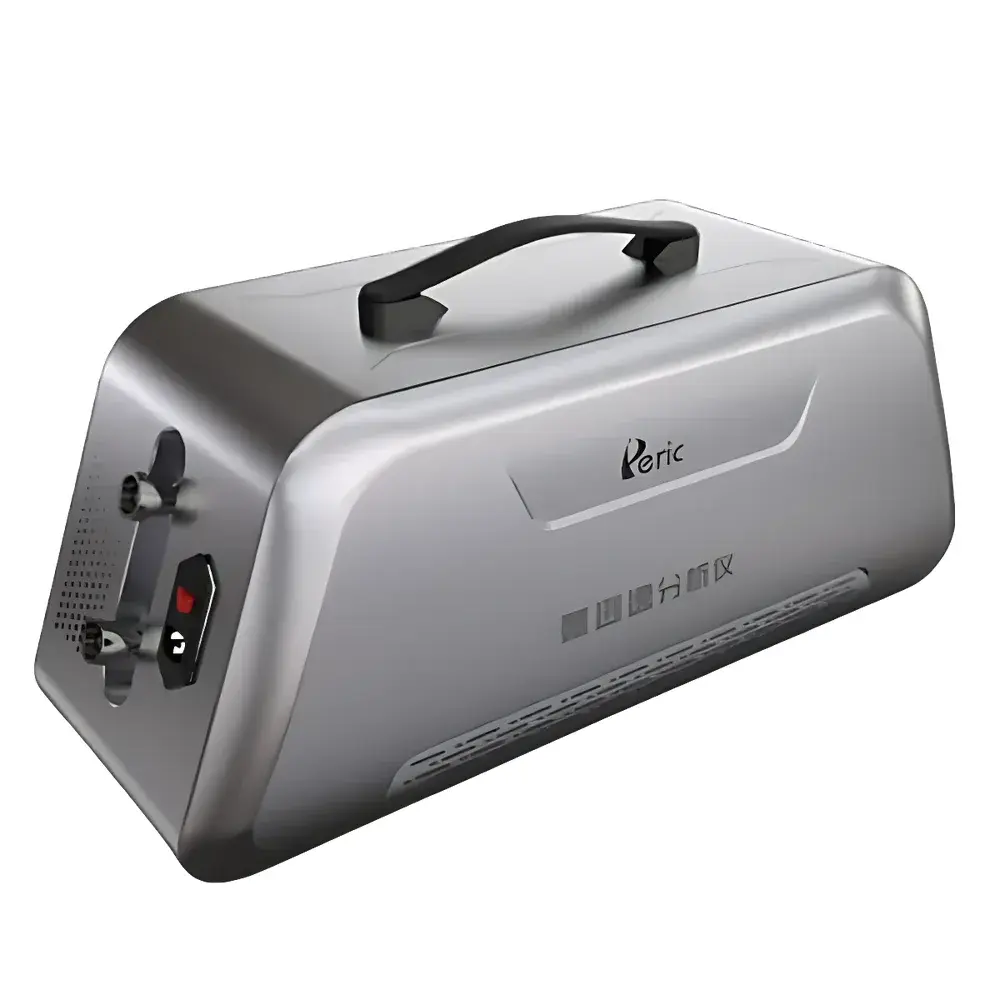
PERIC GAP-D10 Portable Ammonia (NH₃) Analyzer
| Brand | PERIC |
|---|---|
| Model | GAP-D10 |
| Type | Portable Gas Analyzer |
| Measurement Principle | Tunable Diode Laser Absorption Spectroscopy (TDLAS) |
| Measurand | NH₃ |
| Range | 0–100 ppm / 0–1000 ppm (switchable) |
| Detection Limit | <50 ppb (typical, 1σ, 1-s averaging) |
| Sampling Flow Rate | ≥2.8 L/min |
| Response Time (T₉₀) | ≤30 s |
| Operating Temperature | −10 °C to +50 °C |
| Relative Humidity | 0–95 % RH (non-condensing) |
| Accuracy | ≤±1 % FS |
| Power Supply | 220 V AC, 50 Hz |
| Enclosure Rating | IP54 |
| Optical Path | Heated Multi-Pass Gas Cell |
| Signal Processing | Digital Lock-in Amplifier with 2f-WMS Demodulation |
Overview
The PERIC GAP-D10 Portable Ammonia (NH₃) Analyzer is a field-deployable, high-sensitivity gas measurement instrument engineered for quantitative trace-level ammonia detection in industrial exhaust streams, ambient air, and marine engine emissions. It operates on the physical principle of Tunable Diode Laser Absorption Spectroscopy (TDLAS), a well-established optical absorption technique that exploits the unique rovibrational absorption lines of NH₃ molecules in the near-infrared spectral region (typically ~1512 nm or ~6580 cm⁻¹). Unlike broadband spectroscopic methods, TDLAS employs a narrow-linewidth semiconductor laser whose wavelength is precisely scanned across a single, isolated absorption line. This enables exceptional selectivity—effectively eliminating cross-sensitivity from H₂O, CO₂, NOₓ, and other common combustion byproducts—and delivers high reproducibility under dynamic process conditions. The GAP-D10 integrates a temperature-controlled, heated multi-pass optical cell (effective path length >10 m) to enhance sensitivity for sub-ppm measurements, while its digital lock-in amplifier architecture with second-harmonic wavelength modulation spectroscopy (2f-WMS) ensures robust signal recovery even in low-SNR environments typical of hot, humid, or particulate-laden exhaust ducts.
Key Features
- True portability: Compact footprint (≤380 × 280 × 180 mm), integrated sample pump, and self-contained power conditioning enable operation at remote test sites, onboard vessels, or mobile emission laboratories without external support infrastructure.
- Engineered for harsh environments: IP54-rated enclosure; operational stability across −10 °C to +50 °C ambient range; resistance to mechanical vibration, thermal transients, and corrosive gas exposure—validated per IEC 60068-2 environmental stress testing protocols.
- Zero-cross-interference NH₃ quantification: Selective targeting of a fundamental NH₃ absorption line minimizes spectral overlap with water vapor and combustion gases, eliminating the need for empirical correction algorithms or secondary reference sensors.
- Real-time, direct measurement: No consumables, no catalytic converters, and no sample conditioning (e.g., permeation dryers or chemical scrubbers) required—reducing maintenance burden and calibration drift over time.
- Dual-range capability: Switchable full-scale ranges (0–100 ppm and 0–1000 ppm) allow optimal resolution during both low-emission R&D validation and high-concentration process control applications.
Sample Compatibility & Compliance
The GAP-D10 accepts raw, unfiltered gas samples with particulate loading ≤10 mg/m³ and dew point ≤60 °C. Its heated optical cell (maintained at 120 °C ±5 °C) prevents condensation and ammonium salt deposition, ensuring long-term measurement integrity in high-humidity exhaust streams. The analyzer complies with ISO 14644-1 Class 8 cleanroom handling standards during assembly and undergoes factory calibration traceable to NIST-certified NH₃ permeation tubes. While not certified as a regulatory compliance monitor per EPA Method 320 or EN 15267, its performance characteristics align with QA/QC requirements for engineering-grade emission diagnostics under ASTM D6522 (Standard Test Method for Determination of Nitrogen Oxides, Carbon Monoxide, and Oxygen in Engine Exhaust) and ISO 8573-1 (compressed air purity classes) for auxiliary system monitoring. Data logs meet GLP audit-trail requirements when paired with optional timestamped SD card storage.
Software & Data Management
The embedded firmware supports real-time concentration display, trend logging (1 Hz default, configurable up to 10 Hz), and automatic zero/span verification sequences. USB-C interface enables direct data export in CSV format; optional Bluetooth 5.0 module facilitates wireless telemetry to Android/iOS tablets running PERIC’s FieldLink™ mobile application. All configuration changes, calibration events, and alarm triggers are time-stamped and stored locally with immutable metadata—including operator ID, GPS coordinates (when enabled), and ambient pressure/temperature readings. Firmware architecture conforms to IEC 62443-3-3 security principles, with password-protected access levels for operator, technician, and administrator roles. Audit logs comply with FDA 21 CFR Part 11 requirements when used in GxP-aligned development workflows.
Applications
- Marine propulsion R&D: In-situ NH₃ slip monitoring downstream of SCR systems on ammonia-fueled dual-fuel engines—supporting IMO Tier III compliance verification and catalyst efficiency mapping.
- Chemical process optimization: Real-time feedback control of ammonia synthesis purge gas streams, nitric acid plant tail-gas treatment, and fertilizer production off-gas abatement loops.
- Ambient air quality assessment: Mobile surveys of NH₃ fugitive emissions near livestock facilities, wastewater treatment plants, and agricultural buffer zones—aligned with EEA Air Quality Directive reporting frameworks.
- Occupational health & safety: Confined-space entry screening and perimeter monitoring around refrigeration units, SCR urea dosing stations, and laboratory fume hoods.
- Validation of CFD models: High-temporal-resolution NH₃ concentration profiles for boundary condition refinement in computational fluid dynamics simulations of aftertreatment systems.
FAQ
Does the GAP-D10 require daily calibration?
No. Factory calibration remains stable for ≥90 days under typical field use. A two-point (zero/span) verification is recommended before each critical test campaign using certified NH₃ standard gas (e.g., 20 ppm in N₂, traceable to NIST SRM 2626a).
Can it operate inside an engine exhaust duct at 300 °C?
No. The analyzer measures extracted sample gas—not in-situ duct gas. It requires external sampling probe and heated transfer line (optional accessory); maximum inlet gas temperature at analyzer inlet is 80 °C.
Is the device compatible with third-party SCADA or DCS systems?
Yes. Modbus RTU (RS-485) and analog 4–20 mA output (isolated, HART-enabled) are available as factory-installed options for integration into industrial control architectures.
What maintenance is required beyond calibration?
Annual inspection of the internal particle filter, O-ring integrity of the sample manifold, and verification of heater controller functionality. No optical alignment or laser replacement is required within the 5-year design service life.
Does it meet explosion-proof certification for Zone 1 hazardous areas?
Not natively. For use in classified locations, the GAP-D10 must be installed in an approved pressurized enclosure (e.g., ATEX-certified purge system) or deployed in safe-area sampling configurations per IEC 60079-10-1.
Related Products







