
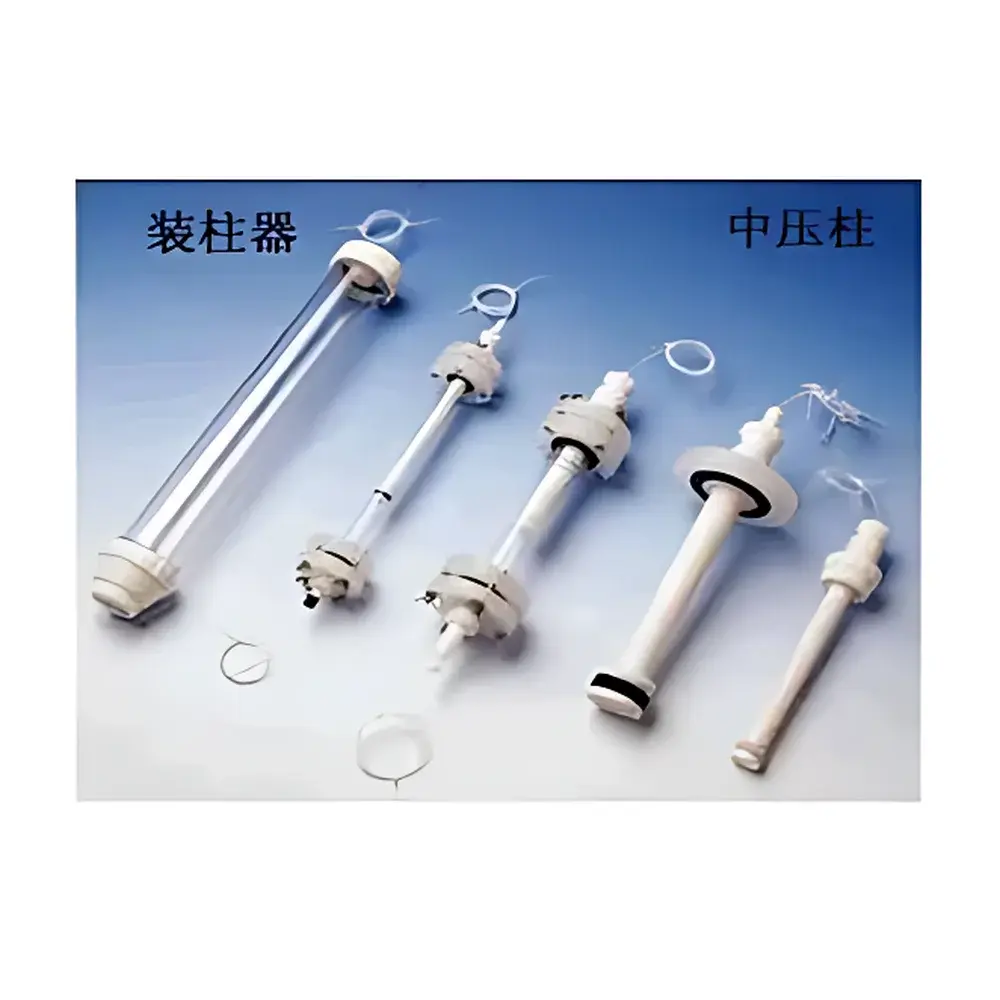
Truelab VC020201 Glass Chromatography Column (1.5 cm ID × 20 cm Length)
| Brand | Truelab |
|---|---|
| Origin | Shanghai, China |
| Model | 1.5 cm Inner Diameter × 20 cm Length |
| Construction | Borosilicate Glass |
| Max Operating Pressure | 4 bar |
| Dead Volume | < 50 µL |
| Thread Standard | Female Luer Lock Inlet / Male Luer Lock Outlet |
| Optional Adapters | Adjustable-length LKB/Pharmacia-compatible conversion fittings (200 mm range) |
| Compliance | Designed for GLP-compliant lab workflows |
Overview
The Truelab VC020201 is a precision-engineered borosilicate glass chromatography column optimized for analytical and preparative-scale separation techniques in life science and biopharmaceutical laboratories. Unlike generic filtration or ultrafiltration modules, this device functions as a rigid, pressure-rated chromatographic bed support system—designed explicitly for packed-bed applications including size-exclusion chromatography (SEC), ion-exchange chromatography (IEX), affinity chromatography, and gel permeation chromatography (GPC). Its 1.5 cm internal diameter and 20 cm effective bed length provide a controlled flow path geometry that ensures laminar flow profiles, minimizes radial dispersion, and maintains high resolution across diverse biomolecular analytes—from monoclonal antibodies and viral vectors to plasmid DNA and synthetic oligonucleotides. The column’s all-glass construction delivers exceptional chemical inertness against organic solvents (e.g., acetonitrile, isopropanol), aqueous buffers (pH 1–14), and chaotropic agents (e.g., guanidine HCl), enabling reproducible method transfer between R&D, QC, and process development environments.
Key Features
- Borosilicate glass body with Class A dimensional tolerance (±0.1 mm ID/OD), ensuring consistent packing density and inter-column reproducibility
- Low-dead-volume fluidic interface: female Luer lock inlet and male Luer lock outlet minimize extra-column band broadening (< 50 µL total system dead volume)
- Integrated frit support system engineered to preserve gel integrity during packing and elution—prevents channeling and surface erosion under typical flow rates (0.1–5 mL/min)
- Modular adapter compatibility: accepts standardized LKB and Pharmacia-style conversion fittings for seamless integration into legacy and modern FPLC/HPLC systems
- Adjustable-height top assembly (200 mm vertical range) enables precise bed compression control and accommodates variable gel swelling behavior across hydration states
- Autoclavable and gamma-sterilizable (validated per ISO 11137), supporting aseptic processing requirements for therapeutic protein purification
Sample Compatibility & Compliance
The VC020201 supports a broad spectrum of stationary phases—including Sephadex®, Sepharose®, Toyopearl®, SOURCE™, and custom-synthesized resins—without compromising mechanical stability or chemical resistance. It is routinely deployed in workflows aligned with ICH Q5A (viral clearance validation), USP (chromatography), and ASTM D5292 (gel permeation analysis of polymers). Columns are supplied with full traceability documentation, including raw material certificates (DIN ISO 3585), dimensional inspection reports, and pressure-test certification (4 bar @ 25°C, 100% hydrostatic test). For regulated environments, the design supports 21 CFR Part 11–compliant electronic record generation when paired with validated chromatography data systems (CDS).
Software & Data Management
While the VC020201 is a hardware-only component, its geometric consistency and low variability enable robust method scalability—from analytical (1.5 cm ID) to pilot-scale (7.5–10 cm ID variants in the same VC0202xx series). When integrated into automated platforms (e.g., AKTA systems), column dimensions are directly referenced in method files for accurate residence time calculation, linear velocity calibration, and void volume estimation. All models adhere to the Truelab Column Metadata Schema (v2.1), facilitating structured import into LIMS and ELN systems via CSV or direct API feed. Batch-specific performance data (e.g., backpressure vs. flow rate curves, plate count validation reports) are archived per ISO/IEC 17025 requirements.
Applications
- High-resolution SEC analysis of mAb aggregates and fragments under native or denaturing conditions
- IEX-based polishing steps in downstream processing of recombinant enzymes and fusion proteins
- Affinity capture of His-tagged proteins using Ni-NTA or Co²⁺-chelating media
- GPC characterization of PEGylated therapeutics and synthetic polymer conjugates
- Method development for continuous chromatography configurations (e.g., periodic counter-current chromatography)
- Training and education in chromatographic theory—ideal for university core facilities due to optical clarity and real-time bed visualization
FAQ
Is this column suitable for high-pressure HPLC applications?
No. The VC020201 is rated for maximum operating pressure of 4 bar (58 psi) and is intended for low-to-medium pressure liquid chromatography (e.g., gravity-fed, peristaltic pump, or FPLC systems). For UHPLC or HPLC applications, stainless-steel or PEEK columns with pressure ratings ≥ 400 bar are recommended.
Can I use this column with organic mobile phases?
Yes—borosilicate glass exhibits full compatibility with common HPLC-grade organics including methanol, acetonitrile, THF, and chloroform. Avoid prolonged exposure to concentrated hydrofluoric acid or hot alkali solutions (>1 M NaOH at >60°C).
What is the recommended packing procedure?
Slurry packing under gentle vacuum or low-flow centrifugation is advised. Use manufacturer-recommended slurry concentration (typically 30–50% w/v) and settle overnight prior to equilibration. Always pre-wet frits with ethanol/water (70:30) before resin introduction.
Are replacement frits available separately?
Yes—Truelab supplies PTFE-reinforced sintered glass frits (10–15 µm pore size) under part number FR-VC15, sold in packs of five with certified pore size distribution reports.
Does Truelab offer column regeneration protocols?
Standard regeneration guidelines—including sodium hydroxide sanitization (0.1–0.5 M, 30 min), 20% ethanol wash, and 0.5 M acetic acid stripping—are provided in the Technical Support Bulletin TS-VC0202 Rev. 3. Validation data for reuse over ≥50 cycles is available upon request for GMP clients.




