
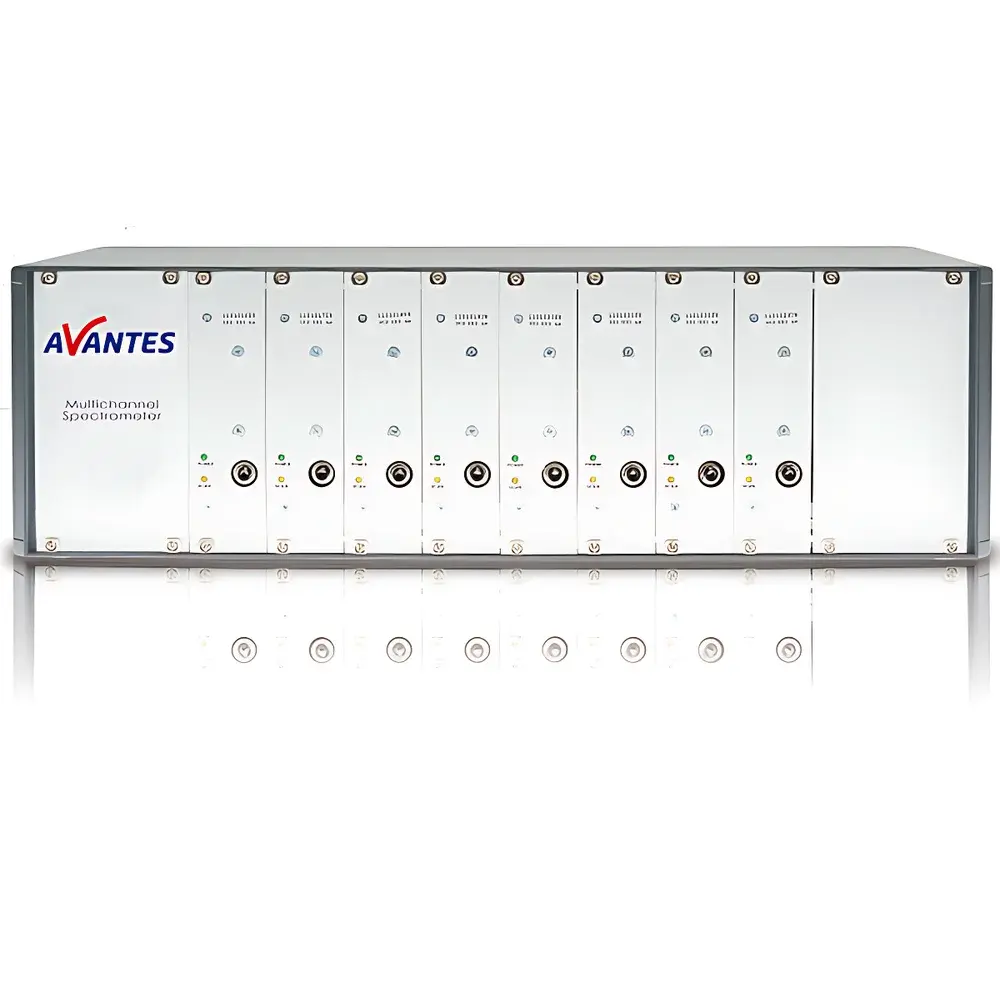
Avantes AvaSpec Laser-Induced Breakdown Spectroscopy (LIBS) System
| Brand | Avantes |
|---|---|
| Origin | Netherlands |
| Instrument Type | Benchtop |
| Integration | Integrated Multi-Channel Platform |
| Laser Energy | Not Integrated (External Laser Required) |
| Compatible Spectrometer Series | AvaSpec-EVO, AvaSpec-ULS |
| Communication Interfaces | USB 2.0 / USB 3.0 / Gigabit Ethernet |
| Max Channel Count | 10 (Rack-Mount), 4 (Desktop) |
| Power Supply | 100–240 VAC |
| Compliance | CE, RoHS, IEC 61326-1 (EMC for Laboratory Equipment) |
Overview
The Avantes AvaSpec Laser-Induced Breakdown Spectroscopy (LIBS) System is a modular, multi-channel optical platform engineered for elemental analysis in research laboratories and industrial process monitoring environments. Unlike conventional LIBS instruments with fixed optical architectures, this system decouples the laser excitation source from the spectral detection subsystem—enabling users to integrate high-repetition-rate Q-switched Nd:YAG lasers (e.g., 1064 nm, 532 nm, or 266 nm) externally while leveraging Avantes’ high-performance fiber-coupled spectrometers for broadband, time-resolved plasma emission collection. The core measurement principle relies on laser ablation of solid, liquid, or aerosol samples to generate transient microplasmas; subsequent atomic and ionic line emissions are dispersed and resolved across UV-VIS-NIR ranges (typically 190–1100 nm) using precision holographic or ruled gratings. This architecture supports simultaneous multi-wavelength detection across up to ten independent optical channels—each configurable with distinct spectral resolution, integration time, and averaging parameters—making it suitable for real-time compositional mapping, alloy sorting, slag analysis, and geological survey applications where spatial or temporal multiplexing is critical.
Key Features
- Modular multi-channel design: Supports up to 10 synchronized spectrometer channels in a 19-inch rack-mount chassis or 4 channels in a compact 9-inch desktop enclosure.
- Flexible spectrometer compatibility: Fully compatible with Avantes EVO-series (USB 3.0 / Gigabit Ethernet) and legacy USB 2.0 platforms—including ULS2048L, ULS3648, NIR256/512, and AS7010-based detectors.
- Independent channel configuration: Each channel can be individually assigned slit width (10–200 µm), grating (e.g., 2400 l/mm for UV high-res, 300 l/mm for broad NIR coverage), and detector gain settings.
- Synchronized acquisition: Hardware-level triggering via DB26 I/O connector enables precise temporal alignment (<100 ns jitter) between laser pulse and spectrometer integration windows—essential for gated LIBS measurements.
- Robust industrial interface: Rack-mount variants include integrated 100–240 VAC power supplies, DIN-rail mounting options, and optional Ethernet-based remote control compliant with IEEE 802.3 standards.
- Scalable communication architecture: USB 3.0 supports up to 4 channels per host controller; Gigabit Ethernet configurations support 10-channel operation when paired with AVS-RM-ADDON-5-10ETH expansion modules.
Sample Compatibility & Compliance
The AvaSpec LIBS platform accommodates heterogeneous sample forms—including bulk metals, ceramics, polymers, soils, powders, and thin-film coatings—via standard fiber-optic probe coupling (e.g., SMA 905 connectors). Sample interaction geometry (e.g., orthogonal vs. collinear beam arrangement) is determined by external laser delivery optics and focusing optics, not by the spectrometer chassis itself. All units comply with EU Directive 2014/30/EU (EMC) and 2011/65/EU (RoHS), and meet IEC 61326-1 requirements for electromagnetic immunity in laboratory-grade instrumentation. While the spectrometer subsystem does not contain an integrated laser source, its synchronization interface supports full traceability under GLP and GMP frameworks when used with validated external lasers and calibrated reference materials (e.g., NIST SRM 2781, 2782). Data acquisition logs—including timestamped trigger events, integration parameters, and hardware ID—can be exported in CSV or HDF5 formats to satisfy FDA 21 CFR Part 11 audit trail requirements when deployed with AvaSoft-Advanced software and secure user authentication.
Software & Data Management
System operation is managed through Avantes’ cross-platform AvaSoft software suite. AvaSoft-Basic provides real-time spectrum visualization, basic peak identification, and batch export functionality. For advanced LIBS workflows, AvaSoft-Advanced adds multivariate calibration tools (PLS, PCA), time-gated spectral stacking, background subtraction algorithms, and customizable reporting templates. All acquired spectra are stored with embedded metadata: spectrometer serial number, grating ID, slit width, integration time, laser pulse count, and user-defined sample tags. Raw data files adhere to the ANDI/NetCDF standard for long-term archival interoperability. Remote monitoring and control are enabled via TCP/IP socket interface—supporting integration into SCADA systems or Python-based automation pipelines (e.g., using PyAvantes SDK). Firmware updates and configuration backups are performed over USB or Ethernet without requiring physical access to internal components.
Applications
- Real-time metal alloy identification and grade verification in scrap sorting and foundry feedstock control.
- In-line monitoring of coating composition uniformity during PVD/CVD deposition processes.
- Geological core scanning for rapid elemental profiling (e.g., Fe, Mg, Si, Al, Ca) without sample digestion.
- Forensic glass and paint chip analysis using fingerprint spectral libraries.
- Environmental monitoring of heavy metal contamination in soil and sediment samples.
- Pharmaceutical raw material verification via elemental impurity screening per ICH Q3D guidelines.
FAQ
Does the AvaSpec LIBS system include an integrated laser source?
No. This is a spectrometer-only platform designed for external laser integration. Users must supply a pulsed laser meeting minimum energy (≥10 mJ @ 1064 nm), repetition rate (1–100 Hz), and beam quality specifications appropriate for their sample type and ablation efficiency requirements.
Can I mix different spectrometer models within one multi-channel chassis?
Yes. The rack-mount and desktop enclosures accept any combination of Avantes spectrometers—provided they share the same communication protocol (e.g., all USB 3.0 EVO units or all USB 2.0 ULS models). Mixed-interface configurations (e.g., USB + Ethernet) require separate host controllers.
What spectral resolution can be achieved with this system?
Resolution depends on selected slit width, grating density, and pixel binning. Typical configurations yield FWHM values between 0.05 nm (UV, 2400 l/mm grating, 10 µm slit) and 1.5 nm (NIR, 300 l/mm grating, 100 µm slit).
Is calibration traceable to NIST standards?
Yes. Avantes provides optional factory calibration services using NIST-traceable Hg/Ne/Ar lamp sources. Wavelength and intensity calibrations are documented in certificate reports compliant with ISO/IEC 17025 requirements.
How is synchronization handled between multiple channels and the laser?
Hardware-triggered synchronization is implemented via low-jitter TTL signals routed through the DB26 I/O port. A master trigger signal initiates both laser firing and spectrometer integration simultaneously across all active channels, ensuring sub-microsecond timing coherence.





