
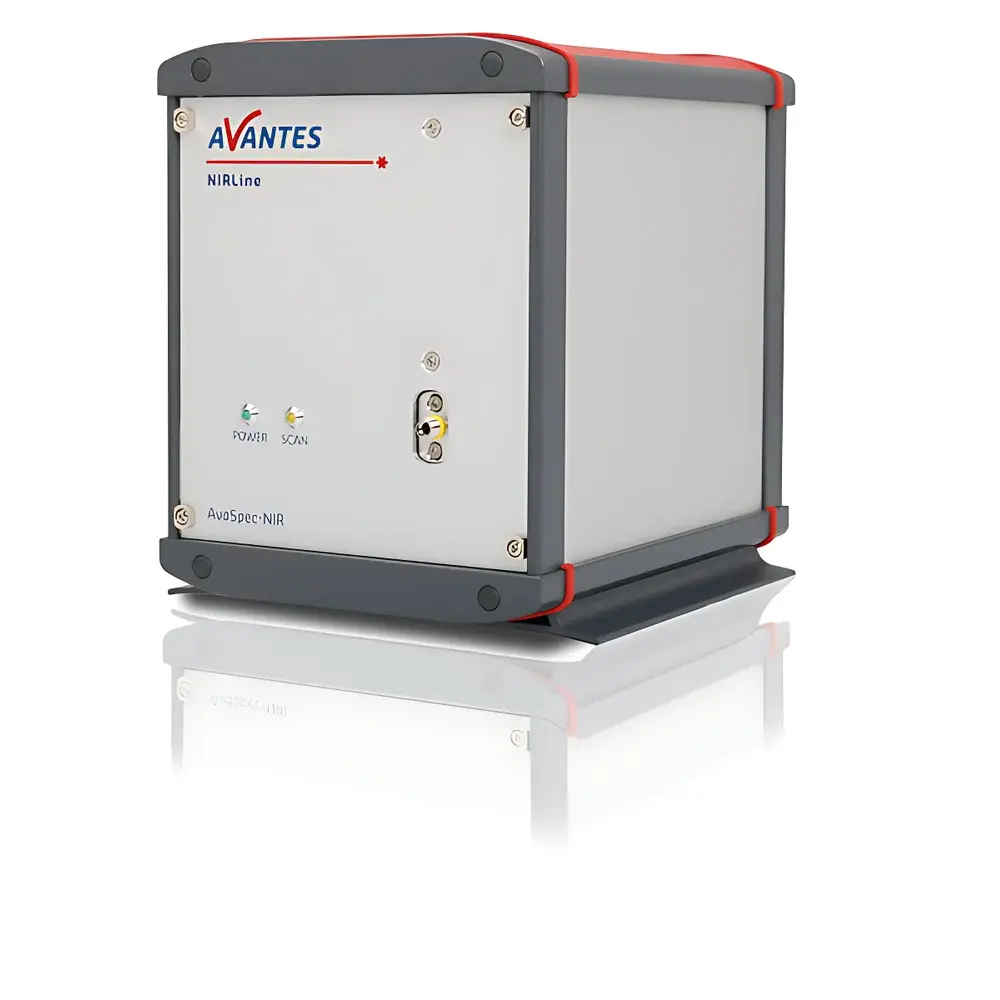
Avantes AvaSpec-NIR512-1.7-HSC-EVO Thermoelectrically Cooled Near-Infrared Spectrometer
| Brand | Avantes |
|---|---|
| Origin | Netherlands |
| Model | NIR512-1.7-HSC-EVO |
| Wavelength Range | 900–1750 nm |
| Scan Speed | 0.24 ms/scan |
| Detector | TE-cooled InGaAs linear array, 512 pixels (25 µm × 500 µm) |
| Optical Platform | Symmetrical Czerny-Turner, 100 mm focal length, 1st-order TE cooling |
| Resolution (FWHM) | 1.7–32 nm (dependent on grating and slit) |
| Stray Light | <1% |
| Sensitivity (HS mode) | 2,500,000 counts/µW·ms (1000–1750 nm) |
| SNR (LN mode) | 5000:1 |
| Integration Time | 20 µs – 20 s |
| AD Converter | 16-bit, 1.2 MHz |
| Interfaces | USB 3.0 (5 Gbps), Gigabit Ethernet (1 Gbps), HD-26 digital I/O |
| Dimensions & Weight | 185 × 160 × 184 mm, 3.6 kg |
Overview
The Avantes AvaSpec-NIR512-1.7-HSC-EVO is a high-performance, thermoelectrically cooled near-infrared spectrometer engineered for demanding quantitative and qualitative analysis in research laboratories and industrial process environments. Based on a symmetrical Czerny-Turner optical design with a 100 mm focal length, the instrument delivers exceptional optical throughput and wavelength stability across its full spectral range of 900–1750 nm. Unlike scanning monochromator-based systems, this spectrometer employs a fixed-grating, non-scanning architecture with a 512-pixel TE-cooled InGaAs linear array detector — enabling true snapshot acquisition without mechanical movement. The integrated single-stage thermoelectric cooler maintains detector temperature at approximately –10 °C (±0.1 °C), significantly suppressing dark current and thermal noise to ensure high signal fidelity during extended integrations. Its compact, robust aluminum housing meets ISO 14644-1 Class 8 cleanroom-compatible mechanical tolerances and is rated for continuous operation in ambient temperatures up to 35 °C.
Key Features
- High-speed spectral acquisition: 0.24 ms per scan with full-frame readout and sub-millisecond data transfer via USB 3.0 (0.53 ms/scan) or Gigabit Ethernet
- Dual-gain electronic architecture: Selectable High-Sensitivity (HS) and Low-Noise (LN) modes optimized for dynamic range flexibility — HS mode delivers 2.5 million counts/µW·ms (1000–1750 nm); LN mode achieves 5000:1 SNR with 20 s maximum integration
- Modular optical configuration: Four interchangeable holographic gratings (NIR150-1.2 through NIR600-1.2/NIR400-1.6) and user-replaceable entrance slits (25–500 µm) enable precise resolution tuning from 1.7 nm to 32 nm (FWHM)
- Industrial-grade I/O interface: HD-26 connector provides 13 bidirectional digital I/O lines, 2 analog inputs, 2 analog outputs — supporting hardware triggering, external shutter/laser control, TTL synchronization, and pulsed source gating
- Comprehensive connectivity: Native support for USB 3.0 (5 Gbps), Gigabit Ethernet (1 Gbps), and optional OEM-ready SDKs (C/C++, Python, LabVIEW, MATLAB) for seamless integration into automated platforms
Sample Compatibility & Compliance
The AvaSpec-NIR512-1.7-HSC-EVO supports both transmission and reflectance measurement geometries via fiber-coupled configurations (SMA 905 or FC/PC), making it compatible with liquid cells, integrating spheres, diffuse reflectance probes, and flow-through cuvettes. Its 900–1750 nm spectral window covers key overtones and combination bands of C–H, O–H, and N–H bonds — critical for quantification of moisture, fat, protein, starch, and polymer composition in pharmaceuticals, agrifood, petrochemicals, and biomaterials. The system complies with IEC 61326-1 (EMC for laboratory equipment), RoHS 2011/65/EU, and CE marking requirements. When operated with validated AvaSoft-Bio or AvaSoft-Chem software under documented SOPs, the platform supports GLP/GMP-aligned workflows including audit trail generation, electronic signatures (per FDA 21 CFR Part 11), and calibration traceability to NIST-traceable standards.
Software & Data Management
AvaSoft v8.11+ provides native driver support, real-time spectrum visualization, multi-channel averaging, baseline correction (asymmetric least squares), peak detection, and embedded chemometric tools (PLS, PCA, PCR). Raw spectra are stored in HDF5 format with embedded metadata (wavelength calibration, integration time, gain mode, temperature log), ensuring FAIR (Findable, Accessible, Interoperable, Reusable) data principles. Batch processing scripts can be exported to Python via the AvaSoft-Python Bridge, enabling integration with scikit-learn, PyTorch, or custom ML pipelines. All firmware updates, grating/slit configuration files, and wavelength calibration coefficients are managed through the centralized AvaSoft Device Manager — eliminating manual registry edits or low-level register programming.
Applications
- Real-time monitoring of API concentration and polymorphic form in continuous pharmaceutical manufacturing (PAT framework)
- Non-destructive quality grading of cereal grains, nuts, and dairy powders based on moisture and oil content prediction models
- In-line analysis of hydrocarbon composition (e.g., octane number, benzene content) in refinery streams using fiber-optic dip probes
- Quantitative assessment of collagen cross-linking and water binding in tissue engineering scaffolds
- Development and validation of multivariate calibration models for handheld NIR sensor deployment (transfer learning from benchtop reference data)
FAQ
What cooling method is used, and how does it impact long-term stability?
The detector uses single-stage thermoelectric (Peltier) cooling to maintain a stable –10 °C operating temperature. This reduces dark current by >95% compared to uncooled InGaAs arrays, enabling reproducible baselines over 8-hour acquisitions without recalibration.
Can this spectrometer operate in true continuous-monitoring mode?
Yes — with its 20 µs minimum integration time and hardware-triggered acquisition, it supports synchronous sampling at fixed intervals (e.g., 100 Hz) directly controlled via digital I/O, eliminating host PC timing jitter.
Is NIST-traceable calibration available as a factory option?
Avantes offers optional factory calibration against NIST SRM 2035 (tungsten halogen) and SRM 2068 (rare-earth oxide glass), delivered with uncertainty budgets compliant with ISO/IEC 17025:2017.
How is spectral resolution determined for a given configuration?
Resolution depends on grating line density, entrance slit width, and pixel binning. A complete resolution matrix is provided in the technical manual; for example, using the NIR400-1.6 grating with a 25 µm slit yields ~1.7 nm FWHM at 1550 nm.
Does the system support remote operation in hazardous environments?
While the spectrometer itself is not ATEX-certified, it may be deployed in Zone 2/Class I Div 2 areas when housed in an appropriate purge enclosure and connected via fiber optic cable (>10 m separation from electronics).
Related Products




