
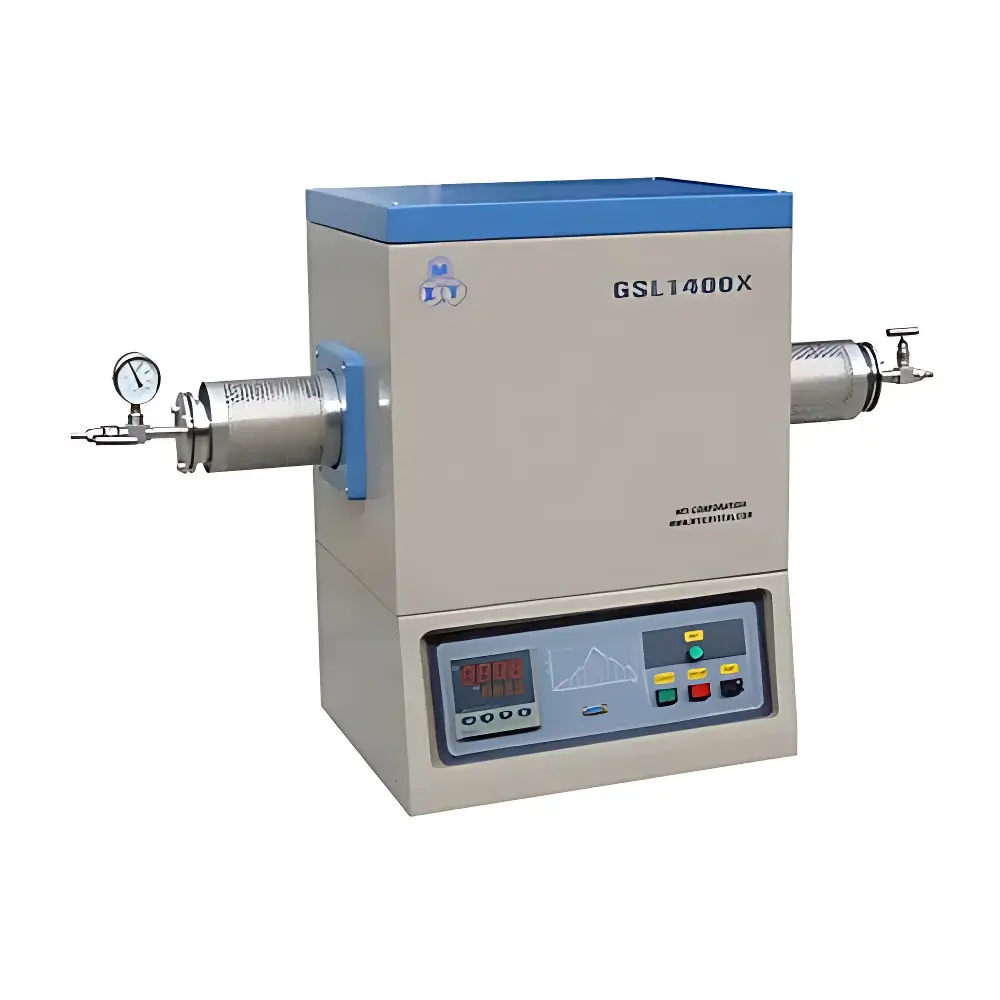
KJ GROUP GSL-1400X 1400°C Compact Tube Furnace
| Brand | KJ GROUP |
|---|---|
| Origin | Liaoning, China |
| Manufacturer Type | Authorized Distributor |
| Country of Origin | China |
| Model | GSL-1400X |
| Power Supply | AC 220 V, 50/60 Hz, 4 kW |
| Maximum Temperature | 1400 °C (continuous at 1300 °C) |
| Temperature Uniformity Zone | 120 mm |
| Control Accuracy | ±1 °C |
| Heating Element | 1600 °C-rated SiC rods |
| Thermocouple Type | S-type |
| Tube Dimensions | Φ60 × 1000 mm or Φ80 × 1000 mm (Al₂O₃ ceramic) |
| Chamber Lining | High-purity alumina fiber with imported US alumina reflective coating |
| Control System | PID-based SCR phase-angle firing controller, 30-segment programmable ramp-soak profile |
| Safety Features | Over-temperature and thermocouple break alarms |
| Certification | CE-compliant |
| Dimensions (W×D×H) | 590 × 490 × 740 mm |
| Weight | 150 kg |
| Operating Environment | ≤1000 m altitude, 10–40 °C ambient, 45–65 % RH |
| Electrical Requirement | Grounded AC 220 V supply |
| Ventilation | Required |
| Vacuum/Atmosphere Compatibility | Equipped with dual vacuum-tight flanges |
Overview
The KJ GROUP GSL-1400X is a compact, benchtop-compatible tube furnace engineered for precise high-temperature thermal processing in research and small-scale production environments. It operates on the principle of resistive heating via silicon carbide (SiC) elements, delivering stable and repeatable temperature profiles up to 1400 °C within a high-purity alumina (Al₂O₃) ceramic tube. The furnace employs a dual-layer insulated shell with an inner chamber lined with high-density alumina fiber and coated with a proprietary U.S.-sourced alumina reflective layer—enhancing thermal efficiency, minimizing radial heat loss, and extending refractory service life. Its robust mechanical design includes two vacuum-tight stainless-steel flanges with O-ring sealing capability, enabling operation under inert, reducing, oxidizing, or low-pressure atmospheres. The system is fundamentally suited for applications requiring controlled thermal ramps, dwell stability, and compatibility with downstream vacuum or gas delivery subsystems—such as solid-state synthesis, annealing, sintering, CVD precursor decomposition, and catalyst activation.
Key Features
- Dual-shell construction with high-purity alumina fiber insulation and surface-applied high-emissivity alumina reflective coating for improved thermal uniformity and energy efficiency.
- High-stability 1600 °C-rated silicon carbide heating elements arranged symmetrically around the tube axis to ensure axial and radial temperature homogeneity across the 120 mm uniform zone.
- PID-controlled SCR phase-angle firing system offering ±1 °C steady-state accuracy and full programmability of up to 30 independent ramp-and-soak segments.
- Integrated safety architecture including over-temperature cutoff, thermocouple failure detection, and audible/visual alarm outputs compliant with IEC 61000-6-2 EMC immunity standards.
- CE-marked design meeting essential requirements of the Low Voltage Directive (2014/35/EU) and Electromagnetic Compatibility Directive (2014/30/EU).
Sample Compatibility & Compliance
The GSL-1400X accommodates cylindrical samples up to Φ58 mm (in Φ60 mm tube) or Φ78 mm (in Φ80 mm tube), with maximum sample length constrained by the 120 mm isothermal zone. Compatible sample materials include ceramics, metals, oxides, nitrides, and carbon-based precursors—provided they remain chemically inert toward alumina at operating temperatures. The furnace supports GLP/GMP-aligned workflows when paired with optional PC-based data logging (via RS485/Modbus RTU interface) and audit-trail-capable software. While not intrinsically rated for hazardous area use, it may be integrated into Class 1000 cleanroom-adjacent setups when installed with appropriate ventilation and gas exhaust routing per ISO 14644-1 guidelines.
Software & Data Management
An optional Windows-compatible control suite enables remote configuration, real-time temperature graphing, automated data export (CSV), and electronic signature support for 21 CFR Part 11–aligned validation protocols. Communication occurs via isolated RS485 interface using standard Modbus RTU protocol, ensuring interoperability with SCADA systems and centralized lab management platforms. Firmware updates are delivered via USB flash drive, with version history and checksum verification embedded in the bootloader. All setpoint changes, alarm events, and power state transitions are timestamped and stored locally in non-volatile memory for traceability.
Applications
- Thermal treatment of battery electrode materials (e.g., LiCoO₂ calcination, NMC precursor annealing)
- CVD and ALD precursor pyrolysis for thin-film metal oxide deposition
- Graphene and carbon nanotube synthesis via catalytic thermal decomposition
- High-temperature calibration of thermocouples and reference materials (per ASTM E230/E230M)
- Controlled-atmosphere sintering of dental zirconia and bioceramic compacts
- Phase transformation studies in ferroelectrics and multiferroic oxides (e.g., BaTiO₃, BiFeO₃)
FAQ
What vacuum level can the GSL-1400X achieve when coupled with a two-stage rotary vane pump?
With a properly maintained KF25-compatible dual-stage pump and leak-free flange seals, base pressures of ≤5 × 10⁻² mbar are routinely attainable.
Is the S-type thermocouple certified to ITS-90 traceability standards?
The supplied S-type thermocouple meets IEC 60584-1 tolerance Class 1 specifications; NIST-traceable calibration certificates are available as a value-added service.
Can the furnace be operated continuously at 1400 °C?
No—maximum continuous duty temperature is 1300 °C. Operation at 1400 °C is rated for ≤2 hours per cycle to preserve heating element longevity and thermal insulation integrity.
Are replacement alumina tubes available with custom dimensions?
Yes—standard Φ60 × 1000 mm and Φ80 × 1000 mm tubes are stocked; custom lengths up to 1200 mm and diameters from Φ50 to Φ100 mm can be ordered with 4–6 week lead time.
Does the CE marking cover RoHS compliance?
Yes—the unit conforms to Directive 2011/65/EU (RoHS 2) with full material declaration documentation available upon request.



