
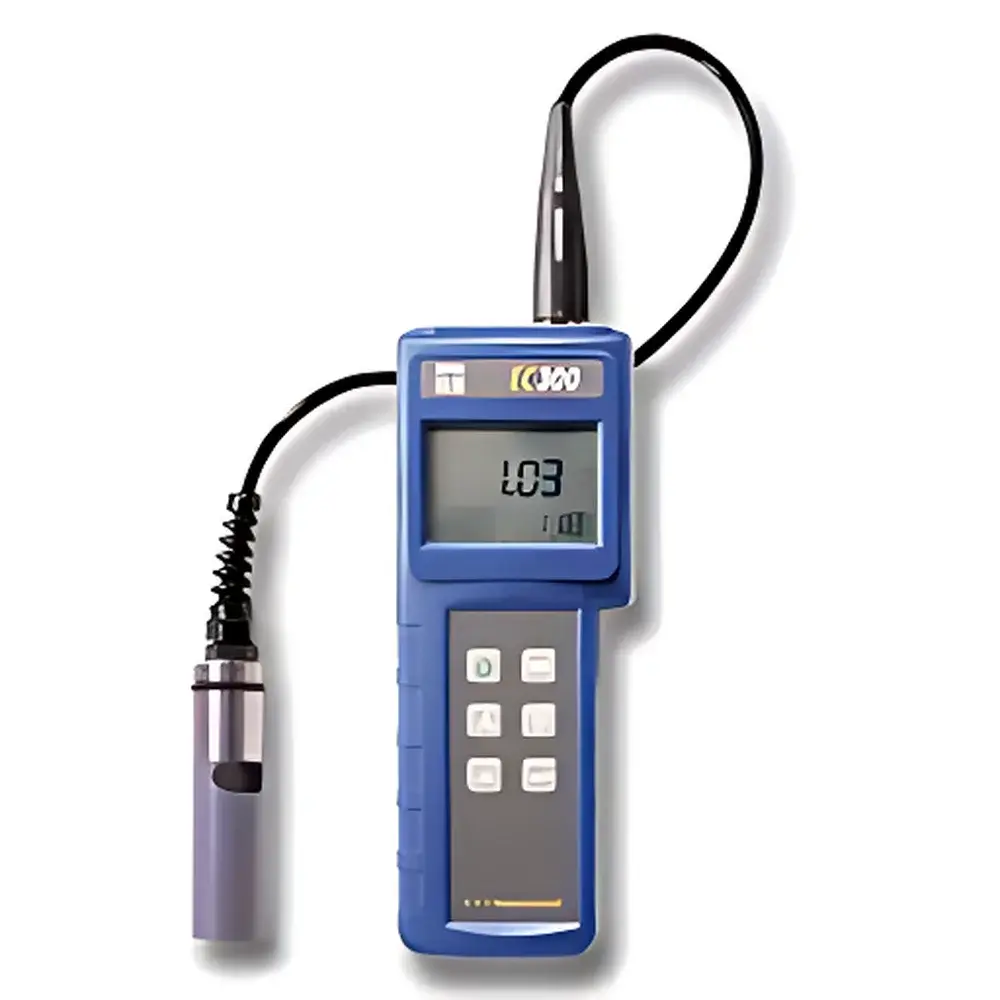
YSI EC300 Conductivity, Salinity & Temperature Meter
| Origin | USA |
|---|---|
| Manufacturer Type | Authorized Distributor |
| Origin Category | Imported |
| Model | YSI EC300 |
| Pricing | Available Upon Request |
| Temperature Range | –10°C to +90°C |
| Temperature Resolution | 0.1°C |
| Temperature Accuracy | ±0.2°C or ±0.4% of full scale, whichever is greater |
| Conductivity Ranges | 0–499.9 µS/cm, 500–4999 µS/cm, 5.00–49.99 mS/cm, 50.0–200.0 mS/cm |
| Conductivity Resolution | 0.1 µS/cm / 1 µS/cm / 0.01 mS/cm / 0.1 mS/cm |
| Conductivity Accuracy | ±1% reading + 2 µS/cm / ±1% + 5 µS/cm / ±1% + 0.05 mS/cm / ±2.5% + 0.5 mS/cm (per range) |
| Salinity Range | 0.0–70.0 ppt |
| Salinity Resolution | 0.1 ppt |
| Salinity Accuracy | ±0.2% of full scale |
| TDS Calculation | User-adjustable conversion factor (0.30–1.00), default 0.65 |
| Reference Temperature | 15.0–25.0°C (default 25°C) |
| Temperature Coefficient | 0.0–4.0% (default 1.91%) |
| Cell Constant | 4.50–5.50 cm⁻¹ (default 5.00 cm⁻¹) |
| Operating Environment | 0–50°C, ≤95% RH |
| IP Rating | IP65 (instrument body) |
| Power | One 9 V alkaline battery (typical life: 150 hours) |
| Dimensions | 18.6 × 7.0 × 3.7 cm |
| Weight | 430 g (with battery) |
| Warranty | 1 year on instrument, probe, and cable |
Overview
The YSI EC300 Conductivity, Salinity & Temperature Meter is a field-deployable, handheld electrochemical analyzer engineered for precision measurement of electrical conductivity, salinity, total dissolved solids (TDS), and temperature in aquatic environments. Based on four-electrode conductivity sensing technology, the EC300 eliminates polarization errors and electrode fouling effects common in two-electrode systems—enabling stable, reproducible measurements across wide dynamic ranges (0.0–200.0 mS/cm). Its integrated temperature sensor operates simultaneously with conductivity acquisition, allowing real-time automatic temperature compensation (ATC) using user-selectable coefficients (0.0–4.0% per °C) and reference temperatures (15–25°C). Designed for compliance with ASTM D1125 and ISO 7888 standards for conductivity measurement, the EC300 delivers traceable, laboratory-grade data under variable field conditions—from estuarine monitoring to industrial effluent screening and aquaculture management.
Key Features
- Four-electrode conductivity cell with stainless-steel electrodes and integrated Pt1000 temperature sensor—optimized for long-term stability and minimal maintenance in turbid or biofouling-prone waters
- Auto-ranging conductivity measurement across four decades (0.001 mS/cm to 200.0 mS/cm), with range-specific accuracy specifications aligned with USP General Chapter <645> guidance
- Simultaneous display of conductivity, specific conductance (temperature-compensated to 25°C), salinity (ppt), TDS (mg/L or g/L), and raw temperature—all calculated in real time
- Configurable TDS conversion factor (0.30–1.00), supporting method-specific calibration per EPA Method 120.1 and APHA Standard Methods 2510B
- IP65-rated housing ensures protection against water splashes and dust ingress—suitable for outdoor deployment in humid or coastal environments
- Stress-relieved cable interface and reinforced strain relief on optional 4 m and 10 m probe cables extend service life under repeated bending and submersion cycles
- Acoustic key feedback and one-handed operation support efficient use during boat-based or shoreline sampling workflows
- Non-volatile memory stores calibration history, date/time stamps, and operator-defined metadata—supporting GLP-compliant data traceability
Sample Compatibility & Compliance
The EC300 is validated for use with natural waters (freshwater, brackish, seawater), wastewater effluents, cooling tower fluids, and process streams where conductivity exceeds 100 µS/cm. It is not intended for highly deionized water (<1 µS/cm) or aggressive chemical solvents. The instrument meets IEC 61000-4 electromagnetic compatibility requirements and conforms to RoHS Directive 2011/65/EU. Calibration verification may be performed using NIST-traceable YSI-certified standards (e.g., 1.00, 10.00, and 50.00 mS/cm KCl solutions, catalog numbers 3167-1, 3168-1, 3169-1). Data output supports audit readiness for ISO/IEC 17025-accredited laboratories when paired with documented calibration procedures and environmental logs.
Software & Data Management
While the EC300 operates as a standalone field meter without mandatory software dependency, its stored calibration records and measurement timestamps can be manually transcribed into LIMS or Excel-based QA/QC spreadsheets. For enhanced traceability, users may integrate EC300-generated data with YSI’s ProQuatro or EcoMapper post-processing platforms via CSV export from companion logging tools. All calibrations are automatically timestamped and retained in non-volatile memory—even after battery replacement—supporting 21 CFR Part 11-aligned record integrity when combined with procedural controls (e.g., dual-operator verification, logbook entries).
Applications
- Environmental monitoring: Estuarine salinity gradients, freshwater conductivity baselines, wetland TDS profiling
- Drinking water treatment: Source water characterization, disinfection byproduct precursor assessment (via conductivity correlation)
- Aquaculture: Real-time salinity control in hatcheries and recirculating aquaculture systems (RAS)
- Industrial hygiene: Cooling water cycle concentration ratio tracking, boiler feedwater purity screening
- Educational labs: Undergraduate physical chemistry and environmental science field exercises requiring portable, multi-parameter electrochemical validation
FAQ
What calibration standards are recommended for routine use?
NIST-traceable KCl solutions at 1.00 mS/cm (3167-1), 10.00 mS/cm (3168-1), and 50.00 mS/cm (3169-1) are specified for three-point verification across the operational range.
Can the EC300 measure resistivity directly?
No—the instrument calculates and displays conductivity only; resistivity is the mathematical inverse and must be derived externally if required.
Is the probe suitable for continuous immersion?
Yes—the stainless-steel four-electrode probe is rated for indefinite submersion in non-corrosive aqueous media; however, periodic cleaning with dilute HCl (0.1 M) is advised to remove carbonate deposits.
Does the EC300 support GLP audit trails?
It maintains internal calibration timestamps and user-modifiable configuration settings, but full electronic audit trail functionality requires external documentation protocols per institutional GLP policy.
How often should the cell constant be verified?
Annually—or after mechanical impact, exposure to extreme pH (12), or deviation exceeding ±2% from certified standard values during calibration checks.




