
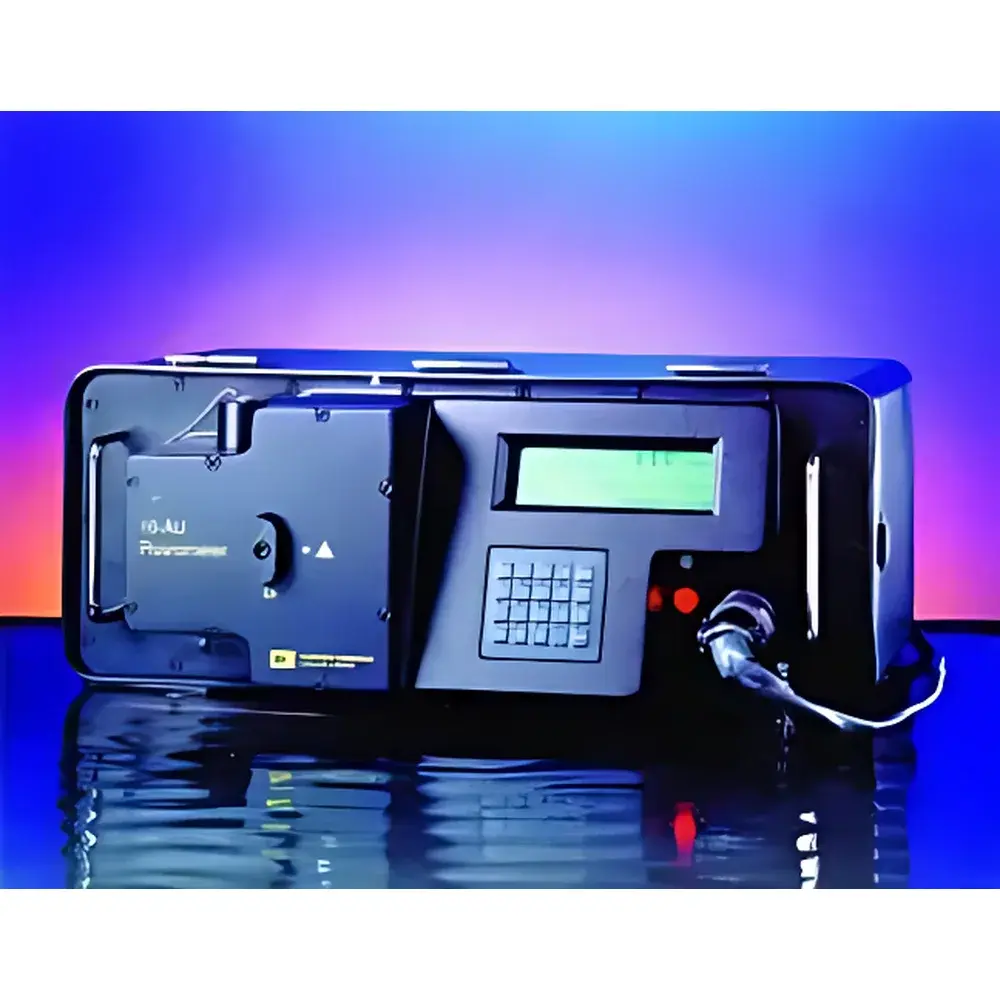
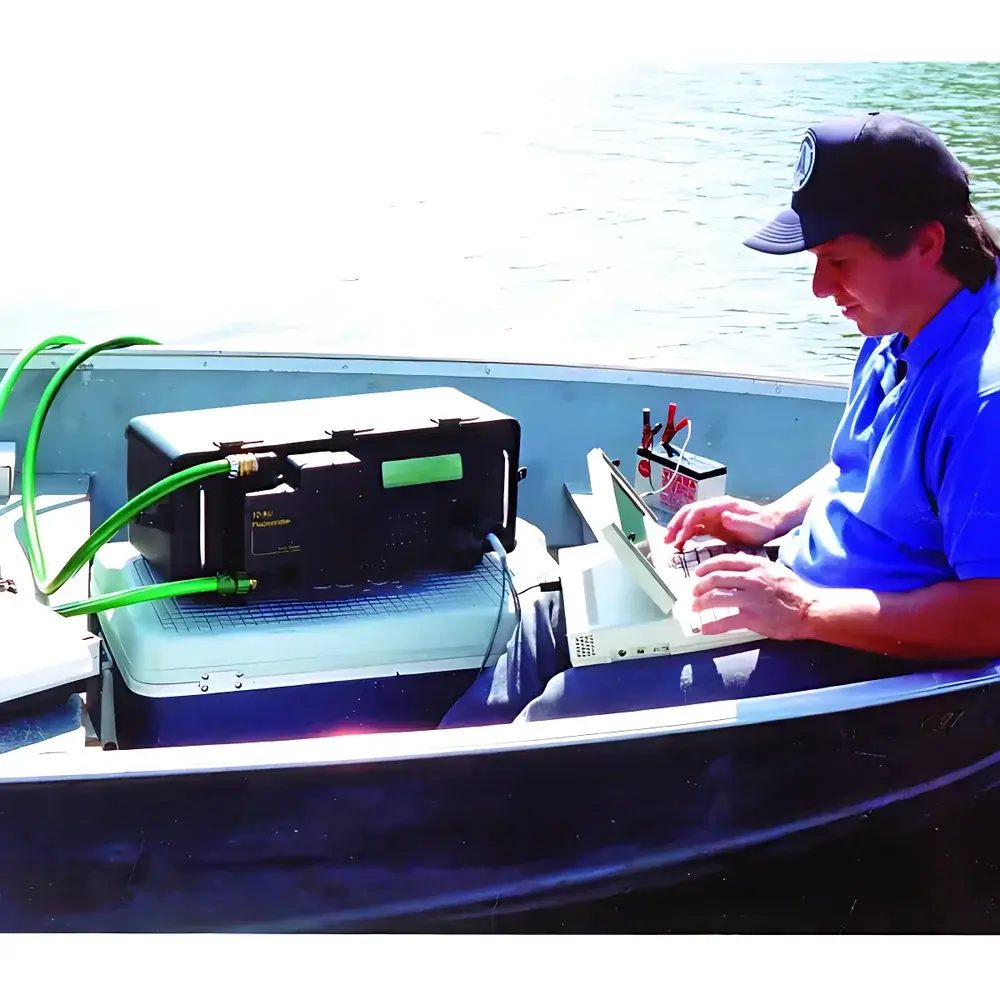
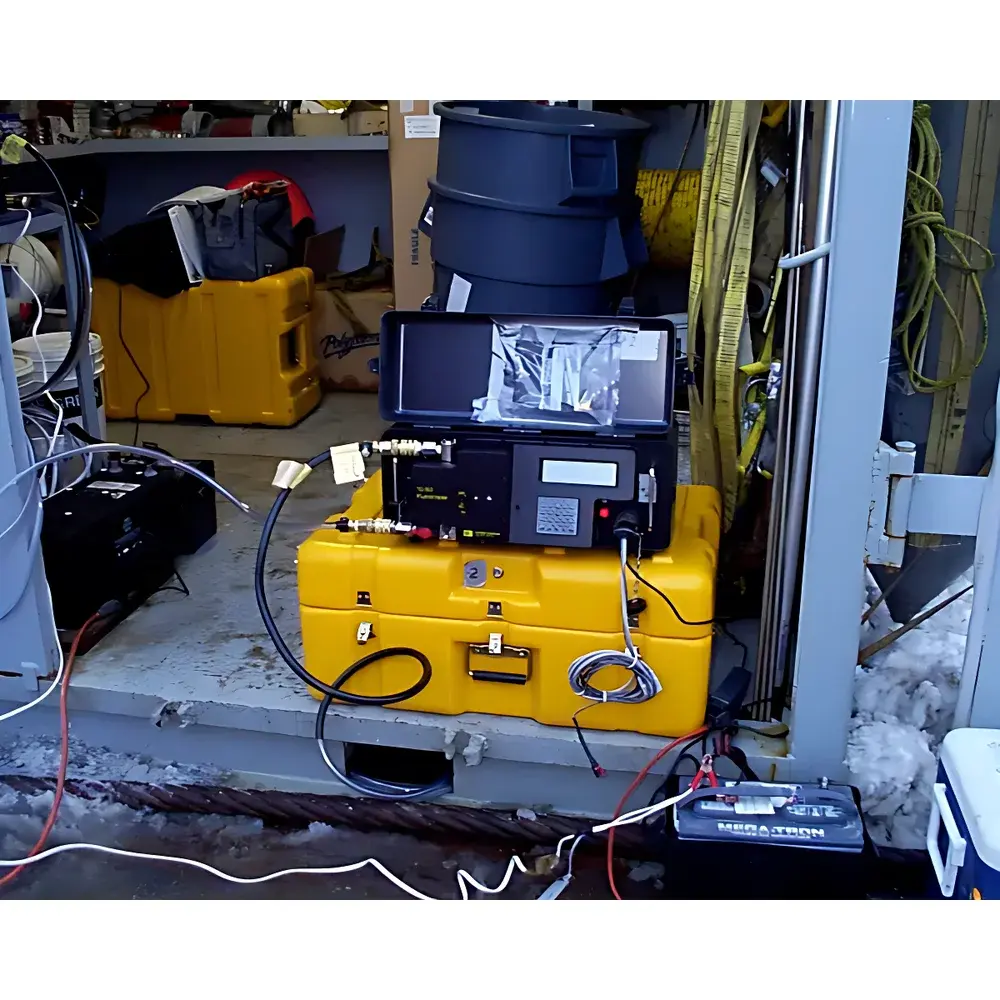
Turner Designs 10-AU Portable Field Fluorometer
| Brand | Turner Designs |
|---|---|
| Origin | USA |
| Model | 10-AU |
| Detection Principle | Dual-beam UV-Vis fluorescence spectroscopy |
| Sensitivity | 10 ppt Rhodamine WT |
| Dynamic Range | 4 decades (0–9999.999 fluorescence units) |
| Optical Path Options | 1 mm, 3 mm, 10 mm, 25 mm flow cells |
| Environmental Rating | IP67-rated enclosure with removable waterproof optical filter chamber |
| Calibration | Single-point auto-ranging calibration |
| Compliance | Designed for ASTM D5867, ISO 10260, and EPA Method 445.0-compatible workflows |
Overview
The Turner Designs 10-AU Portable Field Fluorometer is an engineered solution for in situ and laboratory-based quantification of fluorescent compounds in aqueous matrices. Based on dual-beam ultraviolet–visible fluorescence detection, the instrument compensates for lamp intensity drift and photomultiplier tube (PMT) signal instability in real time—ensuring measurement integrity across extended deployments. Its core architecture supports both continuous-flow and discrete-sample configurations, making it suitable for unattended monitoring stations, shipboard operations, and rapid-response environmental assessments. The 10-AU operates by exciting target analytes—such as chlorophyll a, Rhodamine WT tracers, or polycyclic aromatic hydrocarbons (PAHs) in crude oil—with narrow-band UV light, then measuring emitted fluorescence at defined wavelengths via interchangeable optical filters. This principle enables selective, interference-resistant detection without chemical derivatization or solvent extraction in most routine applications.
Key Features
- Dual-beam optical design with real-time compensation for source and detector drift—critical for multi-day field deployments under variable ambient temperature and power supply conditions.
- IP67-rated ruggedized housing with front-access, waterproof optical filter chamber—enabling rapid exchange of excitation and emission filters without disassembly or exposure to moisture.
- Auto-ranging fluorescence detection across three decades per range setting, with automatic sensitivity selection based on sample signal magnitude—eliminating manual gain adjustment while preserving calibration traceability.
- Modular sample interface: supports 1 mm, 3 mm, 10 mm, and 25 mm pathlength flow cells for continuous monitoring; accommodates standard discrete formats including 10 × 10 mm square cuvettes, 13 × 100 mm test tubes, and 25 × 150 mm culture tubes.
- Integrated data logger with timestamped storage (up to 32,000 readings), USB export capability, and battery-powered operation (>12 h typical runtime on rechargeable Li-ion pack).
- Sealed sample chamber design prevents analyte concentration artifacts caused by evaporation or flow-cell fouling—maintaining quantitative fidelity during low-flow or intermittent sampling scenarios.
Sample Compatibility & Compliance
The 10-AU is validated for direct measurement of chlorophyll a in filtered or unfiltered natural waters, including marine, lacustrine, and reservoir systems. It meets methodological requirements for EPA Method 445.0 (in vivo chlorophyll a), ASTM D5867 (fluorescence-based algal biomass estimation), and ISO 10260 (water quality—determination of chlorophyll a by fluorescence). When configured with appropriate excitation/emission filters (e.g., 436/680 nm for chlorophyll a; 530/585 nm for Rhodamine WT), the system delivers performance consistent with GLP-aligned field validation protocols. All firmware and calibration routines are auditable and support 21 CFR Part 11–compliant electronic recordkeeping when used with Turner Designs’ optional data management software.
Software & Data Management
Instrument control, calibration, and data review are managed through Turner Designs’ FluoroSoft™ desktop application (Windows-compatible). FluoroSoft provides full audit trail functionality—including user login tracking, parameter change logs, and calibration history—with export options to CSV, Excel, and XML formats. Raw fluorescence unit (FU) values are stored with metadata (date/time, range setting, filter IDs, temperature sensor output), enabling post-acquisition correction for temperature-dependent quenching where required. The software supports batch calibration curve generation using NIST-traceable standards and allows user-defined conversion factors for reporting in µg/L, mg/m³, or relative fluorescence units (RFU).
Applications
- Real-time chlorophyll a monitoring in eutrophication studies, harmful algal bloom (HAB) early warning systems, and wastewater effluent compliance tracking.
- Rhodamine WT tracer studies for hydrodynamic modeling, groundwater transport validation, and reservoir residence time analysis.
- Crude oil spill detection and delineation in marine and freshwater environments—leveraging native PAH fluorescence signatures.
- Algal physiology experiments requiring non-destructive, repeated measurements of photosynthetic pigment status under controlled or field conditions.
- Calibration verification of benchtop fluorometers and cross-validation against HPLC-based chlorophyll quantification methods.
FAQ
What excitation/emission filter sets are available for chlorophyll a measurement?
Standard configuration includes 436 nm excitation / 680 nm emission filters optimized for in vivo chlorophyll a detection in phytoplankton. Alternate sets for pheophytin correction or phycocyanin quantification are available as factory-installed options.
Can the 10-AU operate submerged or in heavy rain?
Yes—the instrument achieves IP67 ingress protection when fitted with the optional waterproof housing kit. It may be deployed in shallow water (<1 m depth) for up to 30 minutes or operated continuously in torrential rainfall without functional compromise.
Is temperature compensation built into the measurement algorithm?
The 10-AU includes an integrated thermistor that records ambient and optical chamber temperature with each reading. While fluorescence yield is inherently temperature-sensitive, FluoroSoft enables post-hoc correction using published quenching coefficients for chlorophyll a and other common fluorophores.
How often does the lamp require replacement?
The xenon flash lamp is rated for ≥1 × 10⁶ flashes. Under typical field use (1–5 readings/minute), service life exceeds 24 months. Replacement is user-performed with alignment-free cartridge installation.
Does the 10-AU comply with regulatory reporting requirements?
When used with documented calibration procedures, audit-trail-enabled software, and certified reference materials, the 10-AU supports data submission for state and federal water quality programs—including those governed by Clean Water Act Section 304(h) and EPA Region-specific monitoring protocols.







