
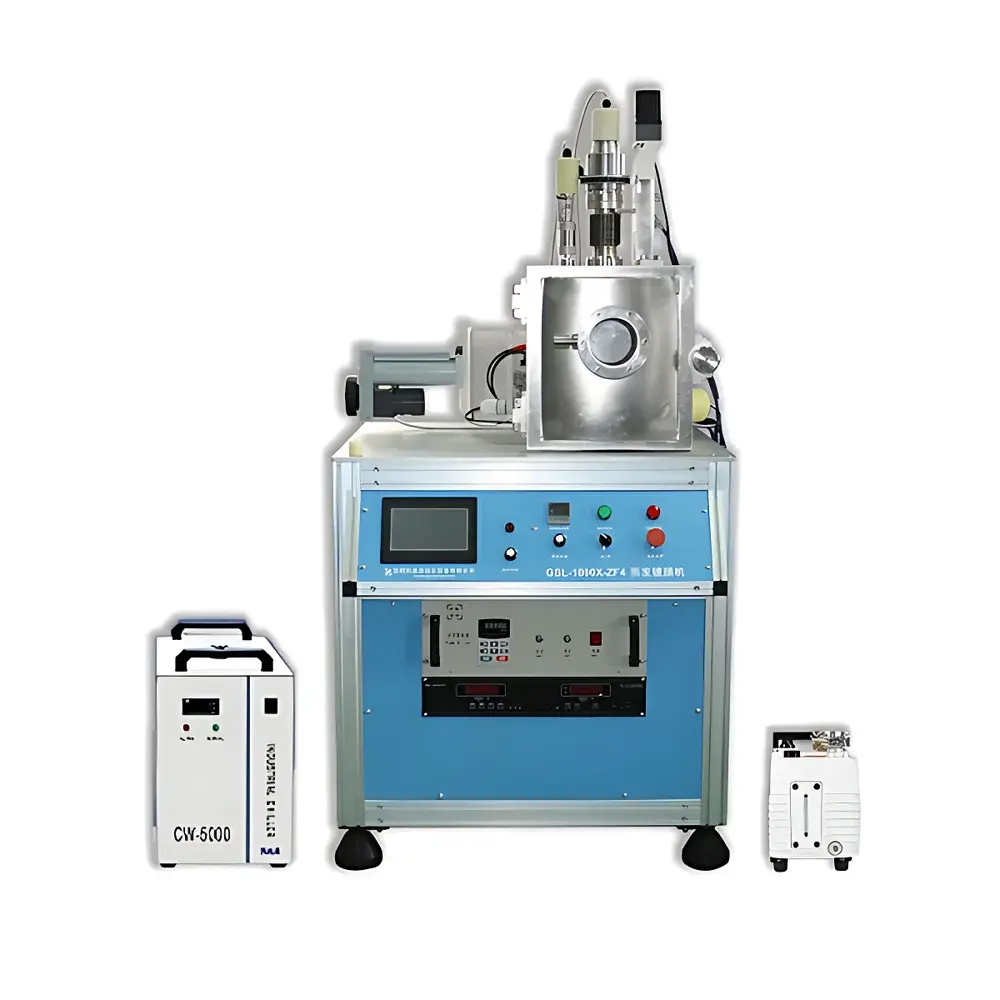
KJ GROUP GSL-1800X-ZF4 High-Vacuum Thermal Evaporation Coater
| Brand | KJ GROUP |
|---|---|
| Origin | Liaoning, China |
| Manufacturer Type | Authorized Distributor |
| Country of Origin | China |
| Model | GSL-1800X-ZF4 |
| Vacuum Chamber | Ø300 mm × 400 mm (stainless steel, electropolished interior) |
| Base Pressure | ≤8.0×10⁻⁵ Pa |
| Ultimate Vacuum | ≤8.0×10⁻⁴ Pa |
| Leak Rate | ≤6.7×10⁻⁸ Pa·L/s |
| Evaporation Source | 4 independent tungsten boat heaters |
| Max Evaporation Current | 200 A |
| Evaporation Voltage Range | AC 0–8 V (continuously adjustable) |
| Sample Stage | Ø120 mm, top-mounted, heated (RT–500 °C, PID-controlled) |
| Substrate-to-Source Distance | 140–200 mm |
| Film Thickness Resolution (Al) | 0.1 Å |
| Cooling Water Flow | 15 L/min |
| Power Input | AC 220 V, 50/60 Hz, <2.16 kW (excl. pumps) |
| Dimensions (W×D×H) | 900 × 1100 × 1800 mm |
| Weight | 230 kg |
Overview
The KJ GROUP GSL-1800X-ZF4 is a high-vacuum thermal evaporation coater engineered for precise, contamination-controlled thin-film deposition under ultra-low pressure conditions. It operates on the principle of resistive thermal evaporation—where conductive materials (e.g., Ti, Al, Au, Ag, Cr, and small-molecule organics) are heated to vaporization temperature in a high-vacuum environment, enabling directional condensation onto substrates with minimal oxidation or background gas incorporation. With a base pressure of ≤8.0×10⁻⁵ Pa (achievable via a 600 L/s turbomolecular pump backed by a mechanical pump), the system ensures exceptional film purity and stoichiometric fidelity—critical for optoelectronic device fabrication, including OLEDs, organic photovoltaics (OPVs), and fundamental surface science studies. Its all-metal, electropolished stainless-steel chamber minimizes outgassing and supports rapid pump-down, while the top-mounted, programmable sample stage (RT–500 °C) enables in-situ annealing and controlled interfacial growth.
Key Features
- Four independently controllable tungsten boat evaporation sources, each with dedicated current regulation for sequential or co-evaporation processes.
- Motorized rotating shutter assembly positioned above the source array—mechanically isolates active and inactive boats during deposition to prevent cross-contamination.
- Five water-cooled electrical feedthroughs at the chamber base, supporting stable high-current operation (up to 200 A) without electrode degradation.
- Integrated vacuum control module housing all critical instrumentation—including KF40 bypass valve (for fast rough pumping), CF150 gate valve (for molecular pump isolation), KF16 flange (for Pirani gauge), and six CF35 ports (dedicated to ion gauge, dual-pin feedthrough, quartz crystal microbalance (QCM), and three spares).
- High-resolution quartz crystal thickness monitor (QCM) compatible with CF35 mounting; aluminum-equivalent resolution of 0.1 Å enables sub-monolayer process control.
- Self-contained cooling system interface—designed for integration with external recirculating chillers using deionized water (flow rate: 15 L/min).
Sample Compatibility & Compliance
The GSL-1800X-ZF4 accommodates standard planar substrates up to Ø120 mm and supports both rigid (Si, glass, ITO/PET) and flexible (PI, PET) carriers. Its oxygen-free high-vacuum environment (<10⁻⁴ Pa residual partial pressure of O₂ and H₂O) is suitable for air-sensitive metals and thermally labile organic semiconductors (e.g., Alq₃, NPB, C₆₀). The system meets essential mechanical and electrical safety requirements per IEC 61010-1. While not pre-certified for GMP or ISO 13485, its architecture—including sealed metal gasketing, traceable temperature control (±1 °C), and configurable data logging—supports GLP-compliant documentation when paired with validated third-party software. All vacuum components comply with ASTM F2627 (standard guide for vacuum system qualification).
Software & Data Management
The coater features a centralized analog/digital control panel with real-time display of chamber pressure (Pirani + cold cathode), substrate temperature, evaporation current/voltage, and QCM-derived thickness/growth rate. Optional RS485 or Ethernet connectivity enables integration into LabVIEW™, Python-based automation frameworks, or enterprise MES systems. Raw sensor outputs—including time-stamped thickness, temperature, and power traces—are exportable as CSV for post-process analysis. Audit trail functionality (user login, parameter changes, start/stop timestamps) can be implemented via external SCADA platforms compliant with FDA 21 CFR Part 11 when configured with electronic signatures and access controls.
Applications
- Deposition of reflective and adhesion layers (Ti, Cr, NiCr) for microelectronics and MEMS packaging.
- Fabrication of emissive and charge-transport layers in multilayer OLED test structures.
- Controlled co-evaporation of donor–acceptor blends for bulk heterojunction OPV optimization.
- Preparation of model catalytic surfaces (e.g., Au/TiO₂) for UHV surface analysis (XPS, AES).
- Calibration-grade metal films for optical interferometry and ellipsometry reference standards.
FAQ
What vacuum level is required for organic semiconductor deposition?
For sublimable small molecules (e.g., Alq₃, TPD), a base pressure ≤5×10⁻⁵ Pa is recommended to minimize quenching and decomposition—achievable with the GSL-1800X-ZF4’s 600 L/s turbomolecular pump and optimized chamber geometry.
Can the system perform multi-source sequential deposition without breaking vacuum?
Yes—the four independent tungsten boats, combined with the motorized rotating shutter, allow fully automated, in-situ layer-by-layer deposition of up to four distinct materials without venting.
Is the sample stage rotation capability available?
No—rotation is not standard; however, the top-mounted stage design permits straightforward integration of custom rotary feedthroughs via one of the three spare CF35 ports.
What maintenance intervals are recommended for the turbomolecular pump?
Per manufacturer guidelines, the pump requires bearing inspection every 12 months and full service (oil replacement, rotor balancing) every 24 months under continuous operation at ≤10% duty cycle.
Does the system support reactive evaporation (e.g., oxide formation)?
Not natively—the chamber lacks controlled O₂ or N₂ inlet lines; however, optional MFC-integrated gas dosing modules can be installed via spare CF35 flanges for limited reactive evaporation experiments.
Related Products



