
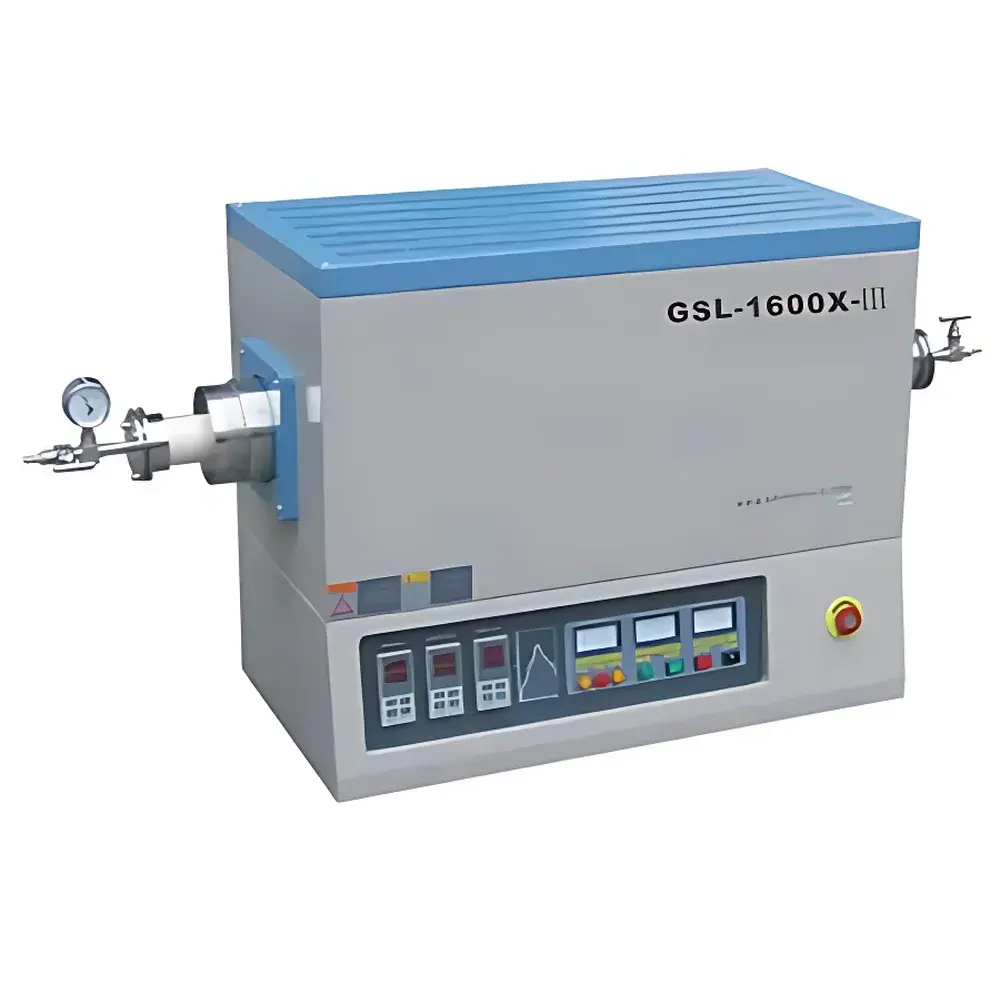
KJ GROUP GSL-1600X-III Triple-Zone High-Temperature Vacuum Tube Furnace
| Brand | KJ GROUP |
|---|---|
| Origin | Liaoning, China |
| Model | GSL-1600X-III |
| Power Supply | AC 220 V, 50/60 Hz, 4 kW |
| Max Temperature | 1400 °C (Zone I), 1600 °C (Zone II), 1400 °C (Zone III) |
| Working Temperature | 1300 °C (Zone I), 1500 °C (Zone II), 1300 °C (Zone III) |
| Control Accuracy | ±1 °C |
| Tube Dimensions | Ø60 mm / Ø80 mm × 1200 mm (Al₂O₃ ceramic) |
| Furnace Dimensions | 860 × 470 × 720 mm |
| Weight | 150 kg |
| Heating Elements | SiC rods (Zones I & III), MoSi₂ rods (Zone II) |
Overview
The KJ GROUP GSL-1600X-III is a precision-engineered triple-zone high-temperature vacuum tube furnace designed for controlled thermal processing under inert, reducing, or vacuum atmospheres. It operates on the principle of resistive heating via zone-specific heating elements—silicon carbide (SiC) rods in Zones I and III, and molybdenum disilicide (MoSi₂) rods in the central Zone II—enabling independent temperature control across three axially aligned heating zones. This architecture supports precise thermal gradient establishment, critical for processes such as solid-state reaction staging, multi-step sintering, chemical vapor deposition (CVD), and controlled pyrolysis. The furnace achieves a maximum rated temperature of 1600 °C in Zone II, with continuous operation up to 1500 °C, making it suitable for advanced ceramic synthesis, thin-film fabrication, and high-temperature materials research where thermal uniformity and reproducibility are essential.
Key Features
- Triple independent heating zones with digital PID controllers for programmable ramp-hold profiles and cross-zone thermal gradient control
- High-purity alumina (99.7% Al₂O₃) ceramic tube with dual standard diameters (Ø60 mm and Ø80 mm) and 1200 mm length, rated for sustained use up to 1600 °C
- Zone-specific heating element configuration: SiC rods (Zones I & III) for robust low-to-mid range stability; MoSi₂ rods (Zone II) for superior high-temperature performance and oxidation resistance
- Integrated water-cooled stainless steel vacuum flange assembly with dual O-ring sealing and standard Swagelok-compatible fittings (Barker-type inlet; optional double ferrule conversion available)
- ±1 °C temperature control accuracy verified per ASTM E220 calibration methodology, supported by Type S thermocouples embedded in each zone
- Robust structural design: 150 kg unit weight, reinforced steel frame, and optimized insulation stack (multi-layer ceramic fiber + reflective aluminum foil) ensuring surface temperature <60 °C at ambient conditions
Sample Compatibility & Compliance
The GSL-1600X-III accommodates a broad range of sample geometries and containment systems—including high-purity alumina crucibles, quartz boats, and custom graphite fixtures—within its 1200 mm tube length. It is routinely deployed in laboratories adhering to ISO/IEC 17025-accredited quality management systems and supports process validation under GLP and GMP frameworks when paired with audit-trail-capable software (optional PC control module). While not FDA-cleared as a medical device, its thermal stability and repeatability meet ASTM C1171 (for ceramic sintering) and ASTM F2692 (for CVD precursor decomposition studies) requirements. Vacuum compatibility extends to ≤10⁻³ mbar using optional two-stage rotary vane pumps; inert gas purging conforms to ISO 8573-1 Class 2 purity standards when integrated with mass flow controllers.
Software & Data Management
The furnace ships with standalone 3-channel temperature controllers featuring RS485 Modbus RTU output. An optional PC-based control package (sold separately) provides full SCADA functionality: real-time multi-zone temperature logging at 1 Hz resolution, automated recipe execution, event-triggered data export (CSV/Excel), and electronic signature support compliant with FDA 21 CFR Part 11 Annex 11 requirements. All system logs—including setpoint changes, alarm events, and power fluctuations—are time-stamped and stored locally with tamper-resistant file attributes. Data integrity is maintained via cyclic redundancy check (CRC) verification during transfer and encrypted local backup.
Applications
- Sintering and densification of advanced ceramics (e.g., ZrO₂, Si₃N₄, AlN) with controlled grain growth kinetics
- Pre-sintering and final firing of multilayer electronic substrates and LTCC/HTCC components
- Thermal annealing of oxide and nitride thin films deposited via pulsed laser deposition (PLD) or sputtering
- Chemical vapor deposition (CVD) of carbon nanotubes, graphene, and transition metal dichalcogenides (TMDs)
- Controlled thermal decomposition of metal-organic precursors for catalyst synthesis
- High-temperature phase transformation studies under dynamic atmosphere switching (e.g., N₂ → H₂ → vacuum cycles)
FAQ
What vacuum level can be achieved with the standard configuration?
The base configuration includes a vacuum flange but no pump; with an optional two-stage rotary vane pump, ultimate pressure reaches ≤1×10⁻³ mbar after bake-out.
Can the furnace operate under positive pressure?
Yes—when equipped with pressure-rated quartz or alumina tubes and appropriate sealing hardware, it supports up to 0.5 bar(g) inert gas overpressure with flow-controlled purge protocols.
Is remote monitoring supported out-of-the-box?
Standard controllers offer RS485 Modbus output; Ethernet or Wi-Fi connectivity requires the optional PC software suite and industrial gateway.
What safety interlocks are integrated?
Over-temperature cutoff (hardware-independent), door-open shutdown, cooling-water flow sensor (if water-cooled flange selected), and real-time heater resistance monitoring to detect open-circuit faults.
Are calibration certificates provided with shipment?
A factory-as-tested report with zone-wise thermocouple verification is included; NIST-traceable calibration certificates are available upon request (additional lead time and fee apply).



