
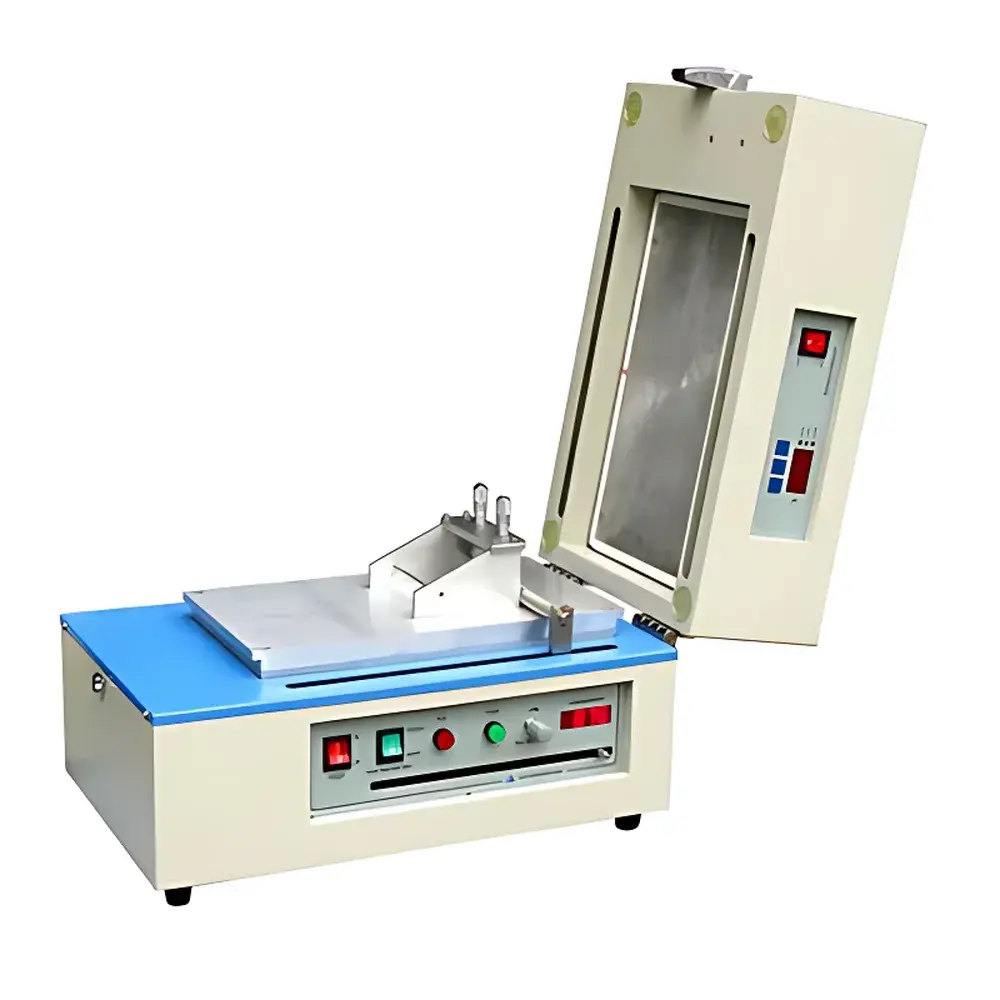
KJ GROUP MSK-AFA-III Benchtop Automatic Doctor Blade Coater with Integrated Hotplate Drying
| Brand | KJ GROUP |
|---|---|
| Origin | Liaoning, China |
| Model | MSK-AFA-III |
| Power Supply | AC 220 V, 50 Hz |
| Total Power | 1100 W |
| Coating Speed | 10–100 mm/s (adjustable) |
| Coating Stroke | 10–250 mm (adjustable) |
| Vacuum Platen Dimensions | 360 × 200 mm |
| Effective Vacuum Area | 300 × 150 mm |
| Max Heating Temperature | 120 °C |
| Temperature Control Accuracy | ±2 °C |
| Adjustable Doctor Blade | 150 mm, micrometer-adjustable (0.01–5 mm range) |
| Film Thickness Repeatability | ±0.01 mm |
| Overall Dimensions (Closed) | 600 × 400 × 380 mm |
| Weight | 50 kg |
Overview
The KJ GROUP MSK-AFA-III Benchtop Automatic Doctor Blade Coater with Integrated Hotplate Drying is an engineered solution for controlled, reproducible thin-film fabrication in academic and industrial R&D laboratories. It operates on the principle of precision doctor-blade coating—where a metered volume of slurry or paste is spread uniformly across a substrate via a mechanically driven, height-adjustable blade under vacuum-assisted immobilization. This method ensures minimal edge effects, high thickness consistency, and compatibility with shear-thinning and non-Newtonian formulations common in solid-state electrolyte slurries, cathode/anode pastes, ceramic precursors, and functional nanocomposites. Unlike manual drawdown or spin-coating techniques, the MSK-AFA-III delivers deterministic control over wet-film thickness, coating speed, and post-deposition thermal conditioning—all within a compact, CE-certified footprint suitable for Class 10,000 cleanroom-adjacent environments.
Key Features
- Integrated hotplate drying system with PID-controlled heating up to 120 °C and ±2 °C thermal stability—enabling solvent evaporation, binder crosslinking, or pre-sintering steps immediately after coating.
- Vacuum-assisted substrate fixation using a 360 × 200 mm aluminum platen with 300 × 150 mm active suction zone—eliminates substrate curling, wrinkling, or lateral drift during coating.
- Micrometer-adjustable 150 mm doctor blade with 0.01–5 mm gap resolution—supports precise wet-film thickness tuning for multilayer stacking or gradient film studies.
- Programmable linear motion stage with adjustable coating speed (10–100 mm/s) and stroke length (10–250 mm)—ensuring repeatable shear history and uniform mass transfer across the coated area.
- Benchtop architecture (600 × 400 × 380 mm closed; 870 × 400 × 750 mm open) designed for integration into standard fume hoods or laminar flow cabinets—no external ventilation required.
- Compliance with CE safety directives (2014/35/EU Low Voltage Directive and 2014/30/EU EMC Directive), supporting audit-ready documentation for GLP/GMP-aligned battery and materials development workflows.
Sample Compatibility & Compliance
The MSK-AFA-III accommodates rigid and semi-flexible substrates including stainless steel foil, aluminum foil, copper foil, PET, glass slides, and silicon wafers—up to 300 × 150 mm in dimension. Its vacuum platen design ensures flatness retention for low-tension films critical in solid-state battery electrode manufacturing. The system supports aqueous, NMP-based, and DMF-based slurries with viscosities ranging from 100 to 10,000 mPa·s (measured per ASTM D2196). All electrical components meet IEC 61000-6-3 emission standards, and thermal insulation conforms to EN 60529 IP20 enclosure rating. While not intrinsically rated for explosive atmospheres, it may be operated in conjunction with external inert-gas purge systems when processing air-sensitive Li-rich cathodes or sulfide-based electrolytes.
Software & Data Management
The MSK-AFA-III operates via front-panel tactile controls with real-time LED display of setpoints (speed, stroke, temperature) and status indicators (vacuum level, heater readiness, motion completion). No proprietary software is required; however, operational parameters—including coating speed, dwell time, and temperature ramp profiles—are manually logged for traceability. For labs requiring electronic recordkeeping, the device’s analog outputs (0–10 V) can interface with third-party DAQ systems (e.g., National Instruments CompactDAQ) to capture time-synchronized temperature and motion data. All parameter settings comply with ALCOA+ principles when documented alongside batch records—supporting FDA 21 CFR Part 11 readiness when paired with validated electronic lab notebook (ELN) platforms.
Applications
- Preparation of composite solid-state electrolyte membranes (e.g., LLZO/PVDF-HFP, LATP/PEO) with controlled porosity and interfacial density.
- Coating of NMC811, LFP, or silicon-carbon anode slurries onto current collectors for half-cell and pouch-cell prototyping.
- Fabrication of ferroelectric, piezoelectric, or dielectric thin films (e.g., PZT, BaTiO₃) via sol-gel or polymer-derived ceramic routes.
- Deposition of conductive polymer films (PEDOT:PSS, PANI) for flexible electronics and organic photovoltaics.
- Rapid screening of slurry rheology–film morphology correlations under defined shear and drying conditions—supporting DOE-driven formulation optimization.
FAQ
What substrate sizes are supported?
Standard operation supports substrates up to 300 × 150 mm. Custom vacuum platens or extended blades (e.g., 200 mm or 250 mm) are available upon request.
Is the heating plate surface temperature uniform across the platen?
Yes—the integrated aluminum hotplate features dual-zone embedded heaters and calibrated thermocouple feedback, delivering ≤±1.5 °C spatial variation across the central 200 × 100 mm region.
Can the MSK-AFA-III be used under inert atmosphere?
The base unit is not sealed; however, it can be housed inside a glovebox or coupled with a chamber adapter (optional accessory) for N₂- or Ar-purged operation.
Does the system support multi-pass coating?
Yes—by repositioning the substrate and resetting the stroke origin, sequential layers can be deposited with independent speed and gap control.
What maintenance is required for long-term reliability?
Routine cleaning of the vacuum channel and blade edges with isopropanol is recommended after each use. Annual calibration of the temperature sensor and vacuum gauge is advised for ISO/IEC 17025-compliant labs.



