
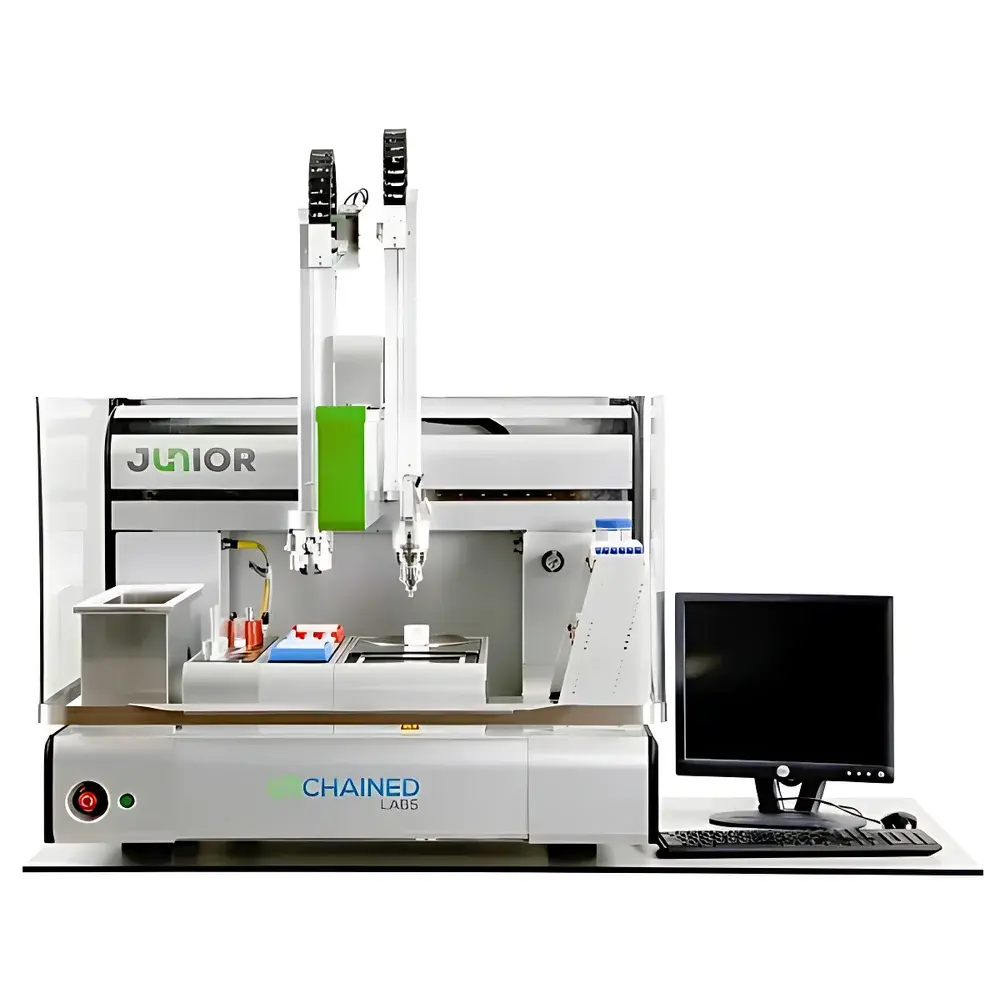
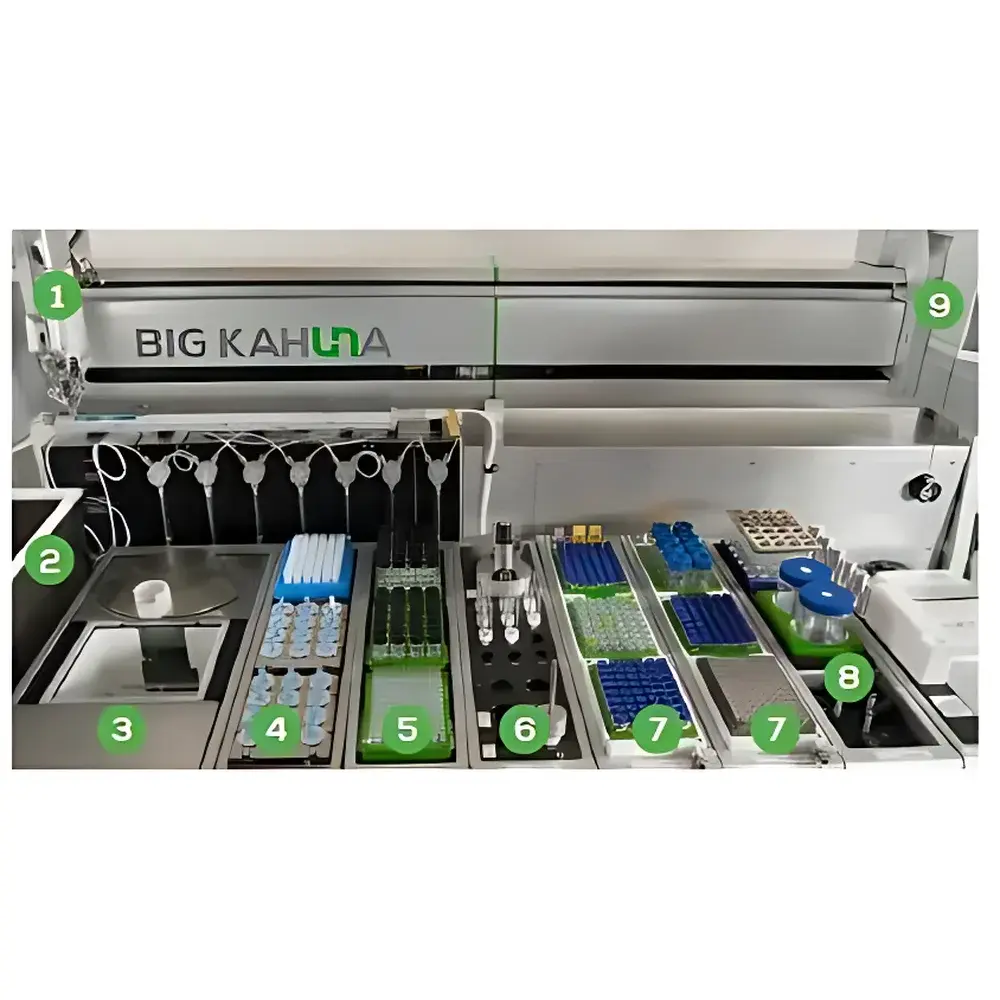
Unchained Labs Big Kahuna Automated High-Throughput Process Optimization Platform
| Brand | Unchained Labs |
|---|---|
| Origin | USA |
| Model | Big Kahuna |
| Reaction Pressure Range | 0–400 PSI |
| Reaction Temperature Range | −15 to 150 °C |
| Catalyst Bed Volume | 5–25 mL |
| Liquid Handling | Automated reagent dispensing for solids, liquids, slurries, and viscous materials |
| pH Monitoring & Control | Real-time in-line pH sensing with automated titrant addition |
| Platform Integration | Simultaneous heating, cooling, stirring, suspension, precipitation, evaporation, and gas handling |
Overview
The Unchained Labs Big Kahuna is an integrated, automated high-throughput platform engineered for systematic process optimization in synthetic chemistry and catalysis development. It operates on a modular robotic architecture that combines precise liquid/solid handling, dynamic thermal control (−15 to 150 °C), pressure-regulated reaction vessels (up to 400 PSI), and real-time physicochemical monitoring—including in-line pH measurement and automated acid/base dosing. Unlike conventional parallel reactors or manual screening rigs, the Big Kahuna implements closed-loop experimental workflows grounded in Design of Experiments (DoE) principles. Its core function is to reduce the time and resource intensity of identifying optimal reaction conditions—spanning catalyst selection, stoichiometric ratios, solvent effects, temperature gradients, residence time, and mass-transfer constraints—while maintaining full traceability and reproducibility across hundreds of sequential or parallel experiments.
Key Features
- Automated multi-phase reagent handling: Accurately dispenses powders, viscous liquids, slurries, and suspensions into individual reactor vessels using gravimetric and volumetric calibration protocols.
- Integrated thermal management system: Independently controlled heating and cooling modules enable rapid ramping, precise setpoint maintenance (±0.5 °C), and simultaneous operation of heterogeneous thermal profiles across up to 8 reaction zones.
- In-line pH monitoring and feedback-controlled titration: Uses sterilizable, flow-through pH electrodes coupled with peristaltic pumps to maintain target acidity/basicity during extended reactions—critical for hydrolysis, enantioselective catalysis, or acid-catalyzed condensations.
- Pressure-rated reaction stations: Each vessel supports inert-atmosphere operation under regulated pressure (0–400 PSI), enabling safe evaluation of hydrogenation, carbonylation, or supercritical fluid-mediated transformations.
- Modular scalability: System architecture supports expansion with additional modules—for example, inline FTIR sampling, automated sampling loops, or integrated gas chromatography interfaces—for advanced kinetic profiling.
Sample Compatibility & Compliance
The Big Kahuna accommodates diverse sample formats including heterogeneous catalysts (e.g., supported Pd/C, Ni/Raney, zeolites), air-sensitive organometallics (handled under nitrogen or argon glovebox-integrated mode), thermally labile substrates, and high-boiling solvents (e.g., DMF, NMP, ionic liquids). Vessel materials—316 stainless steel, Hastelloy C-276, and chemically resistant glass liners—ensure compatibility with corrosive reagents (HF, HCl, Br₂) and strong oxidants. The platform complies with ISO/IEC 17025 requirements for test method validation and supports audit-ready documentation aligned with FDA 21 CFR Part 11 for electronic records and signatures. All hardware and software components are designed to meet GLP and GMP operational standards for pharmaceutical process R&D.
Software & Data Management
The LEA (Laboratory Experiment Automation) software suite provides a unified interface for experiment design, execution scheduling, real-time data visualization, and statistical analysis. Users define custom DoE templates (e.g., central composite, D-optimal, or space-filling designs), assign physical parameters to each run, and deploy sequences across available hardware resources. LEA captures timestamped metadata—including temperature, pressure, pH, stir rate, reagent mass, and event logs—and exports structured datasets compliant with ASTM E1990 and ISA-88 batch record conventions. Integrated Python and MATLAB APIs allow for custom model fitting (e.g., kinetic parameter estimation, response surface modeling) and bidirectional integration with LIMS or ELN systems.
Applications
- Catalyst screening and loading optimization for asymmetric epoxidation, cross-coupling, and enzymatic biotransformations.
- Solvent effect mapping across polarity, boiling point, and coordination strength parameters.
- Robustness testing of API synthesis routes under ICH Q5A–Q5E environmental stress conditions.
- Development of continuous-flow hybrid processes by coupling with microreactor modules and residence time distribution analysis.
- Impurity profiling via automated quench-and-analyze sequences linked to UPLC-MS data acquisition triggers.
FAQ
What types of catalysts can be evaluated on the Big Kahuna?
Solid-supported catalysts (e.g., Pd on carbon, immobilized enzymes), homogeneous metal complexes (e.g., Ru-based olefin metathesis catalysts), and heterogeneous nanomaterials—all within the 5–25 mL bed volume range and compatible with pressure/temperature constraints.
Does the system support reaction monitoring beyond pH?
Yes—LEA software allows third-party instrument integration (e.g., inline UV-Vis, Raman, or FTIR spectrometers) via standardized OPC-UA or TCP/IP protocols for real-time spectral tracking.
How is data integrity ensured during long-duration experiments?
All sensor readings, actuator commands, and environmental logs are written to a redundant SQLite + Parquet archive with SHA-256 checksums; audit trails include user identity, timestamp, and change history per ALCOA+ principles.
Can the Big Kahuna operate unattended overnight or over weekends?
Yes—the platform includes hardware-level safety interlocks (pressure relief, thermal cutoff, leak detection) and software-defined fail-safes (e.g., automatic shutdown on communication loss or out-of-spec condition), certified for Class 1 Division 2 laboratory environments.
Related Products



