
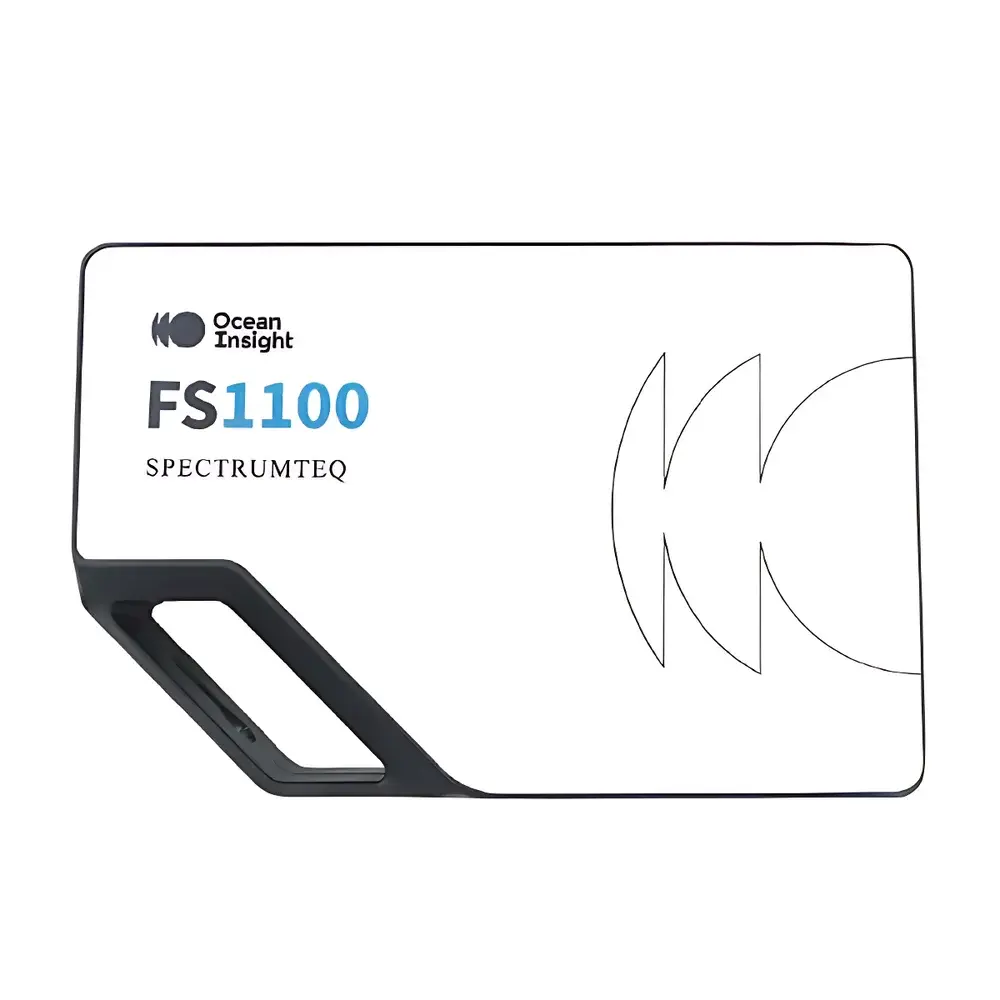
Ocean Optics FS1100 Portable Field Spectroradiometer
| Brand | Ocean Optics |
|---|---|
| Origin | USA |
| Model | FS1100 |
| Spectral Range | 300–1100 nm |
| Detector Type | CCD |
| Optical Resolution (FWHM) | 1.3 nm |
| Signal-to-Noise Ratio | 450:1 |
| Dynamic Range | 8000:1 |
| Stray Light | <0.05% at 600 nm |
| Operating System Compatibility | Android & Windows |
| Display | Low-Power Monochrome E-Ink Screen |
| Power Efficiency | Optimized for extended field deployment |
Overview
The Ocean Optics FS1100 Portable Field Spectroradiometer is a rugged, battery-powered fiber-optic spectrometer engineered for high-fidelity spectral measurements in uncontrolled outdoor and remote environments. Based on a stabilized Czerny-Turner optical bench with a UV-VIS-NIR optimized grating and thermoelectrically stabilized back-thinned CCD detector, the FS1100 delivers laboratory-grade radiometric accuracy under field conditions. Its core measurement principle relies on calibrated spectral irradiance and radiance acquisition via interchangeable fiber-coupled fore-optics (e.g., cosine correctors, lens attachments, or underwater probes), enabling traceable quantification of electromagnetic radiation across the 300–1100 nm range. Designed explicitly for Earth observation workflows, the instrument supports bidirectional reflectance distribution function (BRDF) sampling, spectral index derivation (e.g., NDVI, PRI, REIP), and in situ calibration traceability to NIST-traceable standards — critical for inter-comparison studies in multi-institutional remote sensing campaigns.
Key Features
- Optimized optical architecture: Fixed 1.3 nm FWHM resolution ensures consistent bandpass definition across the full spectral range, minimizing spectral leakage in narrow-band vegetation or pigment analysis.
- Thermoelectric cooling (−5 °C stabilization): Reduces dark current drift and improves long-integration stability—essential for low-light soil reflectance or twilight aquatic measurements.
- Integrated monochrome e-ink display: Consumes <15 mW during static viewing; enables full spectral preview, metadata tagging, and real-time quality assessment without backlight-induced eye fatigue or battery drain.
- Modular mounting system: Precision-machined aluminum tripod adapter with 1/4″-20 thread and tilt-locking mechanism allows rapid repositioning for canopy-level, ground-level, or nadir-viewing configurations.
- Zero-latency acquisition: Hardware-triggered “one-touch” capture mode synchronizes integration time, dark reference subtraction, and spectral averaging in a single firmware-controlled sequence—eliminating operator-dependent timing errors.
- Embedded non-volatile memory: 8 GB onboard storage retains raw spectra, calibration files, GPS-tagged georeferenced metadata, and user annotations independent of host device connectivity.
Sample Compatibility & Compliance
The FS1100 interfaces with standardized SMA 905 fiber optic cables (core diameters 50–400 µm) and supports third-party optical accessories compliant with ISO 17123-8 (field instruments for spectral reflectance) and ASTM E275 (standard practices for UV-VIS-NIR spectrophotometers). Its spectral response is validated per NIST SRM 2035 (diffuse reflectance standard) and calibrated using traceable tungsten-halogen and deuterium lamps. The instrument meets IEC 60529 IP54 ingress protection requirements for dust and water resistance, and its firmware implements audit-ready logging aligned with GLP principles—including immutable timestamps, operator ID fields, and calibration certificate linkage. All spectral data exports include embedded EXIF-like metadata compliant with the PICS (Portable Instrument Calibration Standard) schema used by NASA’s AEROSE and ESA’s FLEX mission ground validation networks.
Software & Data Management
The FS1100 operates natively with OceanView Mobile (Android) and OceanView Desktop (Windows), both supporting real-time spectral visualization, batch processing, and export to HDF5, CSV, ENVI BIL, and NetCDF-4 formats. Software modules include automated dark/light correction, spectral smoothing (Savitzky-Golay), atmospheric correction (using MODTRAN-derived look-up tables), and spectral library matching against USGS, ECOSTRESS, and SPECCHIO databases. Data integrity is enforced through SHA-256 checksums per acquisition, and all calibration actions generate timestamped, digitally signed logs compliant with FDA 21 CFR Part 11 requirements when configured in audit mode. Remote firmware updates are delivered via signed OTA packages with cryptographic verification.
Applications
- Vegetation phenotyping: Quantification of chlorophyll-a/b ratios, carotenoid indices, and water content via continuum-removed absorption features near 970 nm and 1200 nm.
- Aquatic optics: In-water downwelling irradiance (Ed) and upwelling radiance (Lu) profiling using submersible cosine collectors; supports QAA (Quasi-Analytical Algorithm) input for CDOM and Chl-a retrieval.
- Soil spectroscopy: Discrimination of clay mineralogy (e.g., kaolinite vs. smectite) and organic carbon content using diagnostic absorption features between 400–2500 nm (with optional extended-range fiber).
- Ecological disturbance monitoring: Detection of spectral shifts associated with invasive species encroachment, wildfire burn severity mapping, and post-harvest residue cover estimation.
- Calibration transfer: Deployment as a field reference spectrometer for vicarious calibration of airborne hyperspectral sensors (e.g., AVIRIS-NG, HySpex) and UAV-mounted multispectral cameras.
FAQ
What spectral calibration standards are supported out-of-the-box?
The FS1100 ships with factory calibration using NIST-traceable tungsten-halogen (VIS-NIR) and deuterium (UV) sources. Users may import custom calibration files conforming to the Ocean Optics SPC format or generate new calibrations using certified reflectance standards (e.g., Labsphere Spectralon®).
Can the instrument operate continuously for >12 hours on a single charge?
Yes—under typical field use (10-second integrations, e-ink display active, no continuous USB tethering), battery life exceeds 14 hours. Optional external power banks (USB-C PD 5 V/3 A) enable indefinite operation.
Is GPS geotagging hardware-integrated or accessory-dependent?
An internal u-blox M8N GNSS module provides autonomous 2.5 m CEP accuracy. External RTK receivers may be connected via UART for centimeter-level positioning in survey-grade applications.
How is stray light performance verified during manufacturing?
Each unit undergoes full-spectrum stray light mapping using a monochromator-based test setup per ISO 14871:2022 Annex B. Reported values (<0.05% @ 600 nm) are recorded in the individual Certificate of Conformance shipped with the instrument.
Related Products






