
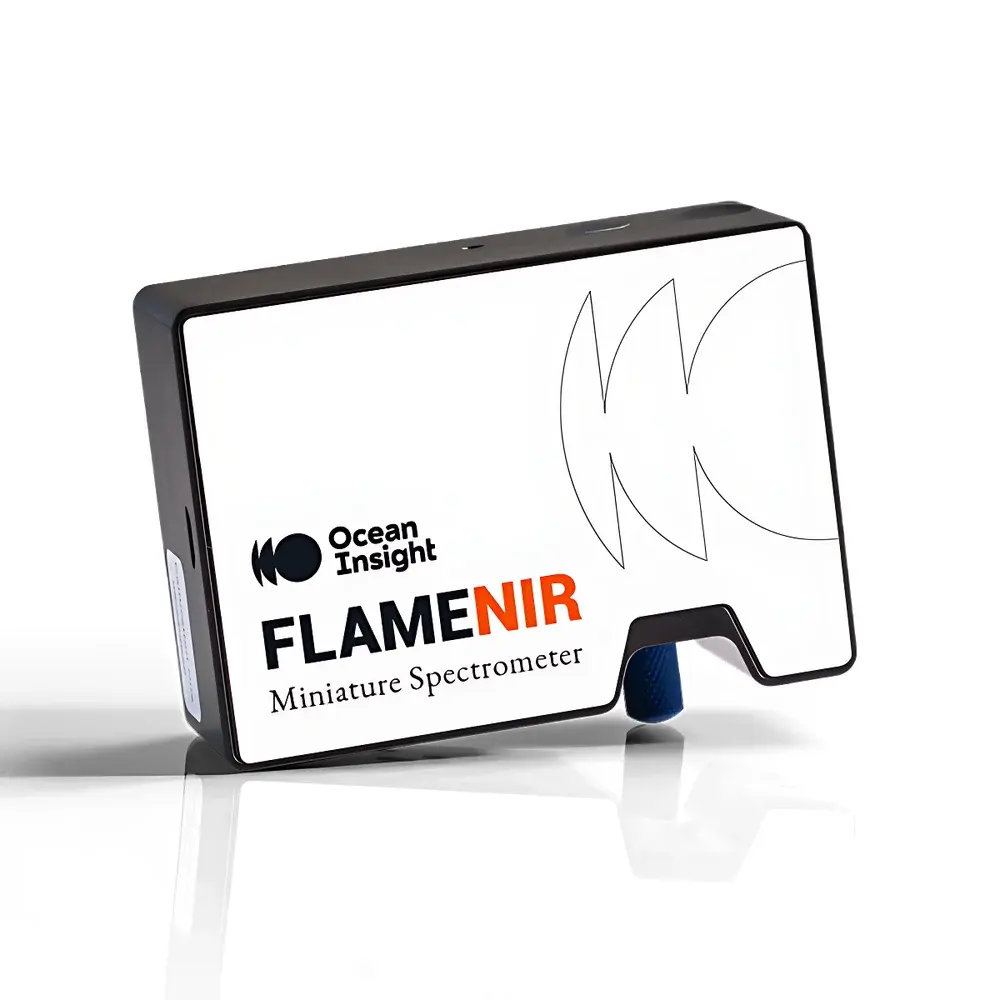
Ocean Optics FLAME-NIR Portable Near-Infrared Spectrometer
| Brand | Ocean Optics |
|---|---|
| Model | FLAME-NIR |
| Type | Portable NIR Spectrometer |
| Principle | Fiber-coupled, non-cooled InGaAs detection |
| Wavelength Range | 950–1650 nm |
| Optical Resolution | ~10 nm FWHM (configuration-dependent) |
| Scan Rate | 400 spectra/sec |
| Integration Time | 1 ms – 65 s |
| Sampling Interval | 1 ms → 65 s |
| Measurement Mode | Transmission |
| Detector | Uncooled 128-pixel InGaAs array (900–1700 nm response) |
| SNR | 6000:1 (full signal) |
| Dynamic Range | 6000:1 |
| Dimensions | 89.1 × 63.3 × 34.4 mm (incl. feet) |
| Weight | 265 g |
| Interface | Micro-USB (plug-and-play) |
| Software Compatibility | OceanView, OmniDriver, NIR chemometrics suite |
| Slit Options | User-replaceable for resolution/sensitivity tuning |
| LED Indicators | Power & acquisition status |
Overview
The Ocean Optics FLAME-NIR is a compact, fiber-optic coupled near-infrared spectrometer engineered for field-deployable and embedded spectroscopic applications requiring robust performance in the 950–1650 nm spectral region. Unlike traditional cooled InGaAs systems, the FLAME-NIR utilizes a thermoelectrically uncooled 128-pixel linear InGaAs detector array, enabling low power consumption (<1 W typical), rapid thermal stabilization, and immunity to condensation-related drift—critical attributes for portable, battery-operated, or OEM-integrated platforms. Its optical design follows the proven FLAME platform architecture, featuring fixed grating optics, precision-aligned entrance slit, and optimized light path geometry to deliver consistent spectral fidelity across units. The instrument operates on standard USB power, eliminating external power supplies and simplifying integration into handheld analyzers, process monitoring nodes, or laboratory-grade benchtop setups where size, weight, and energy efficiency are constrained.
Key Features
- Ultra-compact form factor: Dimensions of 89.1 × 63.3 × 34.4 mm and mass of only 265 g enable seamless integration into handheld probes, drone-mounted sensors, or space-limited industrial enclosures.
- Uncooled InGaAs detection: Eliminates TEC power draw and thermal lag, supporting stable operation from −10 °C to +50 °C ambient without active cooling—ideal for outdoor or mobile deployment.
- High-speed spectral acquisition: Capable of acquiring up to 400 full-spectrum scans per second with programmable integration times ranging from 1 ms to 65 s, accommodating both transient kinetic studies and high-duty-cycle process monitoring.
- User-configurable resolution: Interchangeable entrance slits (e.g., 5 µm, 10 µm, 25 µm, 50 µm) allow optimization of spectral resolution (~10 nm FWHM typical at 25 µm slit) versus sensitivity based on application requirements.
- Plug-and-play USB interface: Micro-USB connectivity provides both power and data transfer; no drivers required on Windows, macOS, or Linux—compatible with standard USB 2.0 host controllers.
- Low inter-unit variability: Tight manufacturing tolerances ensure <±0.5 nm wavelength repeatability and <±3% intensity variation across instruments, facilitating multi-unit calibration transfer and fleet-level method deployment.
Sample Compatibility & Compliance
The FLAME-NIR is designed for transmission-mode measurements using fiber-optic sampling accessories—including bifurcated probe assemblies, flow cells, cuvette holders, and integrating spheres—enabling analysis of liquids, powders, granules, and semi-solid matrices. Its 950–1650 nm range aligns with fundamental overtones and combination bands of C–H, O–H, and N–H bonds, making it suitable for quantitative and qualitative analysis in agricultural, pharmaceutical, food, and chemical sectors. The instrument complies with IEC 61326-1 (EMC for laboratory equipment) and meets RoHS 2/REACH material restrictions. When used with validated chemometric models and calibrated reference standards, data generated by the FLAME-NIR supports compliance with ISO 12099 (animal feed analysis), ASTM E1655 (NIR multivariate calibration), and USP (near-infrared spectroscopy for pharmaceuticals). Full audit trail functionality—including user login, parameter logging, and timestamped spectrum metadata—is supported via OceanView software under FDA 21 CFR Part 11-compliant configurations when paired with appropriate IT infrastructure.
Software & Data Management
Ocean Insight provides native support through OceanView (GUI-based acquisition and visualization), OmniDriver (SDK for C/C++, Python, MATLAB, LabVIEW, and .NET), and dedicated NIR chemometrics tools including PLS regression, PCA, and spectral preprocessing modules (baseline correction, Savitzky-Golay smoothing, multiplicative scatter correction). All software packages support real-time spectral streaming, batch processing, and export to CSV, HDF5, or JCAMP-DX formats. Data integrity is preserved via embedded metadata (wavelength calibration coefficients, integration time, detector temperature, firmware version), and raw spectra retain full 16-bit depth for downstream modeling. For regulated environments, optional OceanView IQ mode enables electronic signatures, change control logs, and secure user role management aligned with GLP/GMP documentation workflows.
Applications
- Grain and feed quality assessment: Rapid quantification of moisture, protein, starch, and oil content in cereals, soybeans, and compound feeds without sample preparation.
- Pharmaceutical blend uniformity testing: Real-time monitoring of API distribution in powder blends during continuous manufacturing, compliant with ICH Q5C and Q8(R2) guidelines.
- Fat and oil characterization: Determination of iodine value, free fatty acid content, and oxidation state in edible oils and biodiesel feedstocks.
- Moisture analysis in hygroscopic materials: Non-destructive water content measurement in tablets, excipients, polymers, and desiccants.
- Industrial process analytics: In-line monitoring of reaction endpoints, solvent composition, or concentration gradients in chemical synthesis and bioprocessing streams.
FAQ
Is the FLAME-NIR suitable for use in GMP-regulated environments?
Yes—when deployed with OceanView IQ software, validated methods, and documented system qualification (IQ/OQ/PQ), the FLAME-NIR meets core data integrity and traceability requirements of FDA 21 CFR Part 11 and EU Annex 11.
Can I extend the wavelength range beyond 1650 nm?
No—the FLAME-NIR is factory-optimized for 950–1650 nm. For extended NIR coverage (e.g., up to 2200 nm), consider the Ocean HDX-NIR or QE Pro-NIR platforms with cooled InGaAs detectors.
What is the typical optical resolution, and how is it affected by slit selection?
Resolution is configuration-dependent: ~10 nm FWHM with a 25 µm slit; narrower slits improve resolution but reduce throughput, while wider slits increase sensitivity at the expense of resolution.
Does the instrument require recalibration after transport or temperature fluctuation?
No—its monolithic optical bench and uncooled detector architecture provide inherent thermal stability; wavelength calibration remains valid across operating temperature ranges without routine recalibration.
How is spectral data synchronized with external triggers or process signals?
The FLAME-NIR supports hardware triggering via TTL input (rising/falling edge) and software-triggered acquisition, enabling precise temporal alignment with pump cycles, valve actuations, or PLC timestamps.
Related Products




