
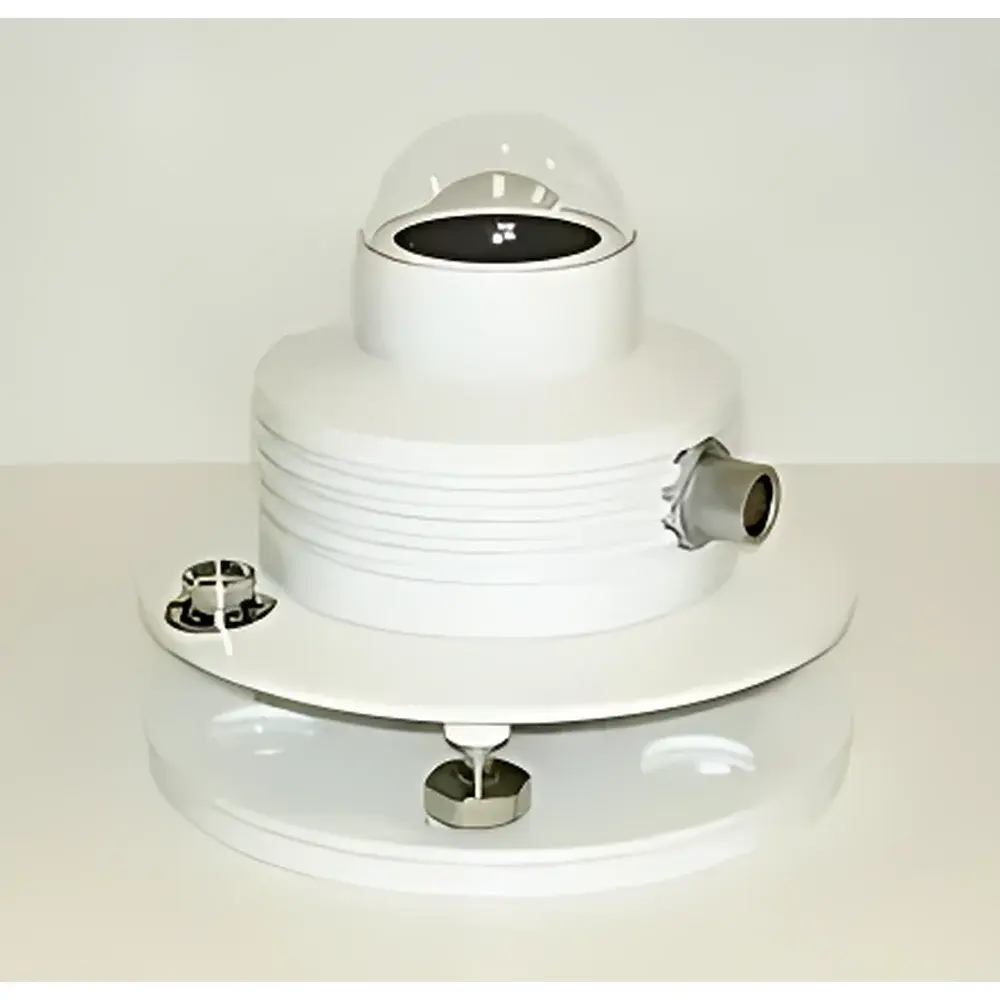
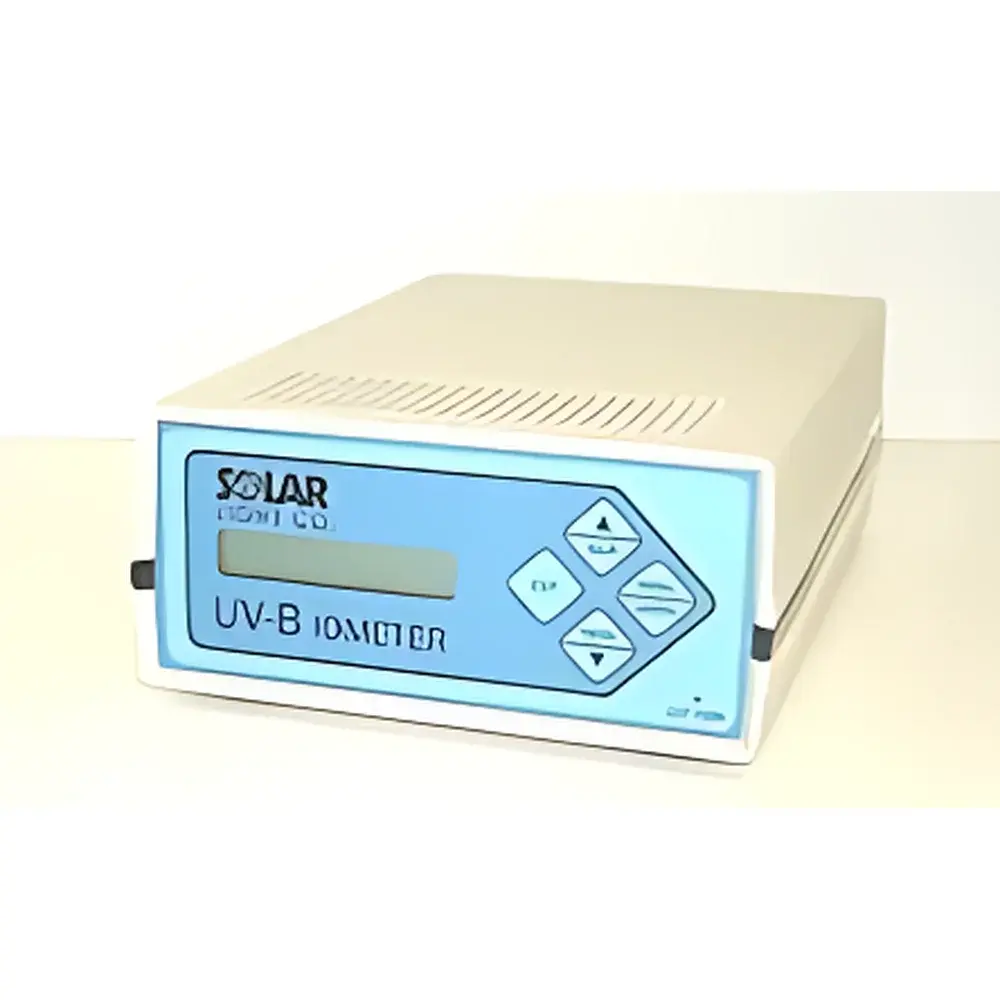
Solar Light Model 501 UVA Radiometer
| Brand | Solar Light |
|---|---|
| Origin | USA |
| Model | Model 501 |
| Spectral Range | 320–400 nm |
| Measurement Range | 0–10 mW/cm² |
| Cosine Response Error | ≤ ±5% |
| Response Time | 1 s (optional 0.1 s) |
| Temperature Coefficient | ±1% per °C |
| Operating Temperature | −40 to +50 °C |
| Submersible Depth | up to 5 m |
| Output | 0–2.5 V (UV signal), 0–1 V (sensor temperature) |
| Power Supply | 5.5–25 VDC (signal circuit), 11–15 VDC/1 A (temperature stabilization) |
| Detector Dimensions | 14 cm H × 15 cm dia. |
| Weight | 0.9 kg (detector only) |
Overview
The Solar Light Model 501 UVA Radiometer is a meteorological-grade, NIST-traceably calibrated instrument engineered for continuous, high-fidelity measurement of ultraviolet-A (UVA) irradiance in outdoor and submerged environments—up to 5 meters depth. It operates on the principle of broadband photodiode detection with spectral filtering optimized to match the CIE erythemal action spectrum (320–400 nm), enabling quantification of biologically relevant UV exposure. Designed for long-term unattended deployment, the Model 501 integrates an active temperature stabilization system that maintains detector thermal equilibrium—critical for minimizing drift in field applications where ambient temperatures fluctuate between −40 °C and +50 °C. Its robust aluminum housing, IP68-rated sealing, and marine-grade stainless-steel mounting hardware ensure structural integrity under harsh environmental conditions, including coastal exposure, polar stations, and freshwater/marine monitoring sites. The instrument complies with ISO/IEC 17025 calibration traceability requirements and supports adherence to WHO/EPA UV Index reporting protocols.
Key Features
- Active thermal regulation: Integrated Peltier-based temperature control reduces thermal sensitivity to ±1% per °C, ensuring stable responsivity across extreme climatic gradients.
- NIST-traceable calibration: Each unit ships with a certificate documenting spectral irradiance calibration at three reference wavelengths (320, 365, and 400 nm), traceable to NIST Standard Reference Photometers.
- Dual analog outputs: Simultaneous 0–2.5 V UV irradiance signal (0.250 V per MED/hr) and 0–1 V temperature telemetry (20 mV/°C) enable real-time correction and data validation without external loggers.
- Submersible capability: Rated for continuous operation at depths up to 5 m (15 ft), validated per IEC 60529 IP68 specifications; includes pressure-compensated quartz window and epoxy-sealed connector interface.
- Field-deployable data acquisition: Optional integrated data logger features non-volatile memory (6 months of hourly dose integrals for two sensors), rechargeable backup battery, and RS-232 serial interface (300–9600 bps).
- Mechanical precision: Equipped with three adjustable leveling screws and concentric bubble level for optimal cosine-corrected orientation; angular response deviation < ±5% from ideal Lambertian profile.
Sample Compatibility & Compliance
The Model 501 is compatible with natural solar irradiance, artificial UV sources (e.g., fluorescent UVA lamps, LED arrays), and underwater light fields in clear or turbid waters. Its spectral response closely approximates the ISO 17166:2019/CIE S 007/E erythemal weighting function, supporting compliance with WHO Global Solar UV Index reporting standards. The instrument meets ASTM G177-22 requirements for terrestrial UV monitoring systems and is referenced in NOAA’s UV-B Monitoring and Research Program (UVBMRP) technical guidelines. For regulatory applications—including environmental health surveillance and occupational UV exposure assessment—the system supports audit-ready data logging with time-stamped metadata, consistent with GLP principles and FDA 21 CFR Part 11 electronic record requirements when paired with compliant software.
Software & Data Management
Data acquisition is supported via native Solar Light Logger software (Windows-compatible), which enables remote configuration, real-time graphing, and automated export to CSV or Excel formats. The embedded data logger stores irradiance dose (MED/hr), cumulative UV dose (J/m²), and sensor temperature at user-defined intervals (1 min to 1 hr). All stored records include timestamp, sensor ID, and checksum validation. Firmware updates are performed via serial command protocol, preserving calibration coefficients and historical settings. When integrated into SCADA or IoT frameworks, the Model 501’s RS-232 output interfaces seamlessly with Campbell Scientific CR1000X, Delta-T DL6, or custom Python-based acquisition scripts using PySerial libraries.
Applications
- Long-term ecological monitoring: Quantifying UV-driven photobiological effects on phytoplankton communities, coral symbiont bleaching thresholds, and terrestrial plant photomorphogenesis.
- Ozone layer research: Supporting ground-based validation of satellite-derived total ozone column estimates through synchronized spectral irradiance measurements at high-altitude observatories.
- Public health infrastructure: Serving as primary sensor nodes in national UV Index networks operated by ARPANSA (Australia) and NREL (USA), delivering validated input to real-time public alert systems.
- Materials degradation testing: Accelerated weathering studies of polymers, coatings, and textiles under controlled UV exposure regimes aligned with ISO 4892-3 and ASTM D4329.
- Underwater optical profiling: Measuring vertical attenuation of UVA in coastal and lacustrine environments to parameterize radiative transfer models (e.g., Hydrolight, EcoSim).
FAQ
Is the Model 501 suitable for underwater deployment in saltwater environments?
Yes—the detector housing, cable jacket, and connector assembly are rated for continuous immersion in seawater up to 5 m depth, with corrosion-resistant 316 stainless steel fasteners and UV-stabilized polyurethane encapsulation.
How often does the instrument require recalibration?
Solar Light recommends NIST-traceable recalibration every 24 months for critical applications; annual verification against a reference standard is advised for operational continuity.
Can the Model 501 be integrated into an existing weather station network?
Yes—it provides industry-standard 0–2.5 V analog output and RS-232 digital interface, compatible with Campbell Scientific, Vaisala, and Onset HOBO data loggers without signal conditioning.
Does the internal temperature stabilization consume significant power?
The thermoelectric cooler draws ≤1 A at 12 VDC only during active stabilization; power consumption drops to <5 mA in steady-state operation, enabling solar-battery hybrid deployment.
What documentation accompanies each unit?
Each shipment includes a NIST-traceable calibration certificate, ISO 17025-compliant uncertainty budget, mechanical installation manual, electrical interface specification sheet, and CE/UKCA conformity declaration.
Related Products







