
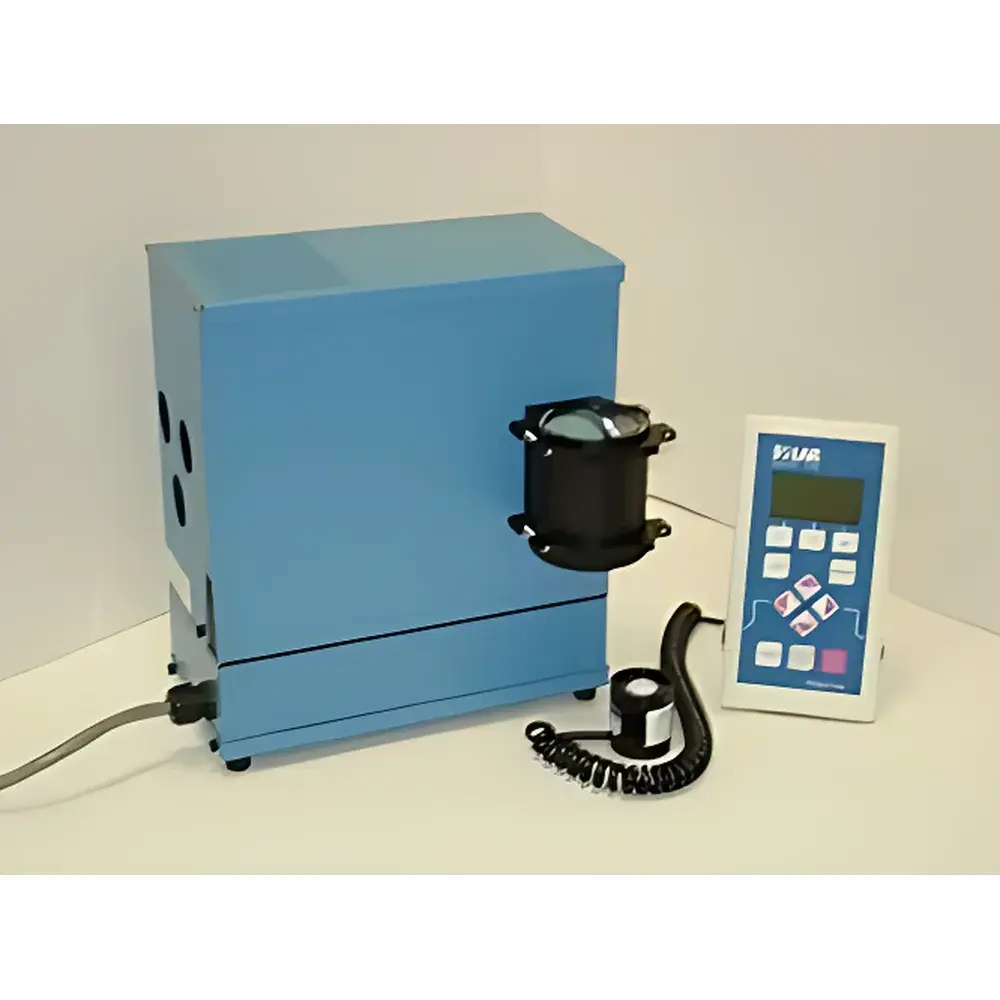
Solar Light 16S Advanced Photovoltaic Solar Simulator
| Brand | Solar Light |
|---|---|
| Origin | USA |
| Model | 16S |
| Lamp Type | 150 W / 300 W Xenon Arc |
| Spectral Class | ASTM Class A (AM1.5G) |
| Calibration | NIST-traceable |
| Power Supply | XPS200 (200 W) or XPS400 (400 W) |
| Beam Orientation | Horizontal or Vertical (with optional PMA2144-compatible vertical adapter) |
| Output Intensity Range | 10–100% (80–100% via front-panel knob |
| Typical Irradiance | 1000 W/m² (6 cm Ø), 2000 W/m² (3 cm Ø), 4000 W/m² (2 cm Ø) |
| Spot Uniformity | Compliant with ASTM E927-19 requirements |
| Filter | AM1.5G, NIST-traceable, integrated |
| Compliance | ASTM G151, G155, E948, E927, G173 |
Overview
The Solar Light 16S Advanced Photovoltaic Solar Simulator is a precision-engineered optical instrument designed to replicate terrestrial solar irradiance under controlled laboratory conditions. Based on a stabilized xenon arc lamp source and rigorously filtered to meet ASTM Class A spectral match requirements (AM1.5G reference spectrum per ASTM G173-03), the 16S delivers high-fidelity solar simulation for photovoltaic (PV) device characterization, calibration, and accelerated aging studies. Its optical architecture incorporates high-efficiency collimating optics and spatial uniformity control mechanisms engineered to satisfy ASTM E927-19 criteria for irradiance uniformity across the test plane. The system operates at either 150 W or 300 W lamp power configurations, supporting flexible integration into standard IV curve tracers, quantum efficiency setups, and multi-junction cell evaluation platforms.
Key Features
- ASTM Class A spectral match (AM1.5G) verified per ASTM E927-19 and G173-03 reference spectra
- NIST-traceable factory calibration included with certificate of conformance and spectral irradiance data
- Integrated AM1.5G filter assembly with documented transmittance profile and long-term stability validation
- Dual-power xenon arc lamp option (150 W or 300 W) with matched XPS200 or XPS400 regulated DC power supplies
- Built-in electronic igniter enabling reliable cold-start operation without external triggering hardware
- Adjustable output intensity: 80–100% via front-panel rotary control; extended 10–100% range achievable using Solar Light’s calibrated neutral-density attenuation kit
- Beam orientation flexibility: horizontal output standard; vertical downward configuration available via optional PMA2144-compatible adapter (part number 16S-002)
- Optimized optical train delivering ≤±2% spatial non-uniformity over defined circular test areas (per ASTM E927 Annex A1)
Sample Compatibility & Compliance
The 16S accommodates standard PV sample formats including single-junction Si, CIGS, CdTe, perovskite, and multi-junction III-V cells up to 6 cm in diameter. Its circular beam geometry supports both manual probe station alignment and automated stage integration. All configurations comply with international testing standards required for IEC 61215, IEC 61646, and UL 1703 certification workflows. The system satisfies irradiance stability criteria per ASTM G151 (accelerated exposure apparatus) and G155 (xenon-arc exposure apparatus), and is validated for use in performance testing per ASTM E948 (electrical performance of PV cells) and E1036 (electrical performance of modules). Full documentation packages—including spectral irradiance reports, uniformity maps, and calibration certificates—are provided to support GLP-compliant lab audits and ISO/IEC 17025 accreditation requirements.
Software & Data Management
While the 16S operates as a stand-alone optical source, it is fully compatible with third-party IV measurement systems (e.g., Keysight B2900 series, Keithley 2400/2600 families) via analog 0–10 V intensity control input and TTL-ready status outputs. Solar Light provides detailed interface schematics and timing specifications for synchronized triggering in pulsed or steady-state measurement modes. For traceability-critical applications, the system supports audit-ready logging when paired with compliant DAQ platforms that implement 21 CFR Part 11 electronic signature and audit trail functionality. Raw spectral data files (ASCII .csv format) and irradiance uniformity reports are delivered with each unit and archived upon request for long-term metrological continuity.
Applications
- Primary calibration of reference cells and pyranometers against NIST-traceable standards
- Quantum efficiency (QE) and external quantum efficiency (EQE) measurements across 300–1200 nm
- Steady-state and flash-based current-voltage (I-V) characterization of lab-scale and mini-module PV devices
- Light soaking and bias-assisted stability testing per IEC 61215-1 Ed. 2 Annex A
- Spectral mismatch correction factor (MMF) determination for multi-junction cell evaluation
- Accelerated UV and thermal stress testing under controlled irradiance profiles per ASTM G155 Cycle 1–5
FAQ
Does the 16S require periodic recalibration?
Yes — while factory calibration is NIST-traceable and valid for one year, annual recalibration is recommended to maintain compliance with ASTM E927 and ISO/IEC 17025 requirements. Solar Light offers return-to-factory recalibration services with updated spectral and uniformity reports.
Can the 16S be used for UV-A and UV-B accelerated testing?
No — the integrated AM1.5G filter intentionally attenuates UV-B (<280 nm) and strongly suppresses UV-C. For full-spectrum UV exposure per ASTM G154, a dedicated UV fluorescent or metal halide source is required.
What is the expected lamp lifetime under normal operating conditions?
Xenon arc lamps operate for approximately 1,000 hours at rated power before spectral drift exceeds ASTM Class A tolerances. Solar Light recommends scheduled replacement and spectral verification after 800 hours for critical metrology applications.
Is remote intensity control supported?
Yes — the XPS200/XPS400 power supplies include 0–10 V analog input for external intensity modulation and RS-232 communication port for firmware-level parameter interrogation and fault logging.
How is beam uniformity verified during installation?
A two-point scanning procedure using a calibrated reference detector (e.g., PMA2144 with ND filters) is performed at nine positions across the defined test plane, following the grid pattern specified in ASTM E927-19 Annex A1. Uniformity deviation must remain within ±2% for Class A classification.





