
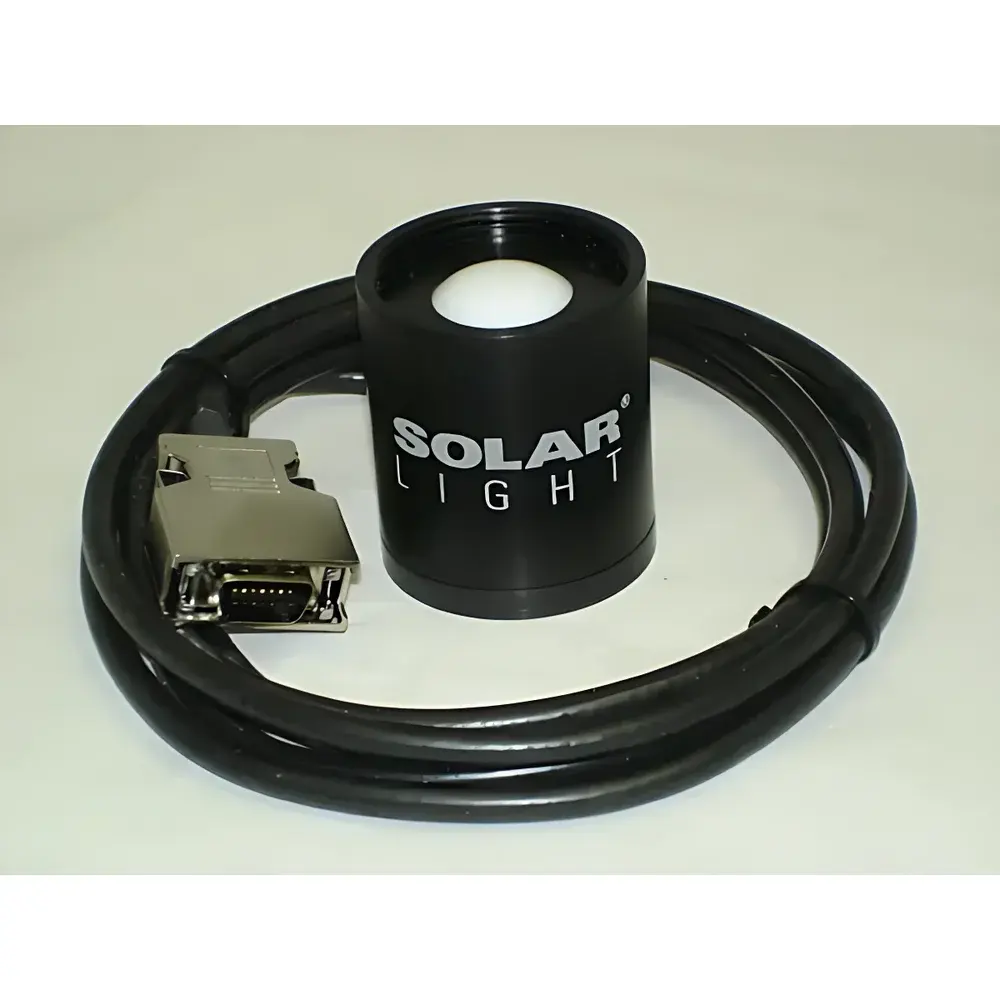
Solar Light PMA2107 Non-Weighted UVA+UVB Radiometer
| Brand | Solar Light |
|---|---|
| Origin | USA |
| Model | PMA2107 |
| Spectral Range | 280–400 nm (UVA: 315–400 nm, UVB: 280–315 nm) |
| Detector Type | Silicon photodiode with precision optical filter and cosine-corrected diffuser |
| Angular Response | ≤5% deviation from ideal Lambertian response up to 60° incidence angle |
| Measurement Range | 0.001–200 mW/cm² (0.01–2000 W/m²) |
| Resolution | 0.001 mW/cm² / 0.01 W/m² |
| Operating Temperature | 0–50 °C (32–120 °F), non-condensing |
| Temperature Coefficient | ±1 %/°C (for solar irradiance) |
| Calibration | NIST-traceable, factory-calibrated for broadband UVA+UVB irradiance |
| Physical Dimensions | Ø40.6 mm × H45.8 mm |
| Weight | 200 g |
| Cable | Retractable coaxial cable, 0.3–1.5 m |
Overview
The Solar Light PMA2107 Non-Weighted UVA+UVB Radiometer is a precision broadband ultraviolet detector engineered for quantitative measurement of unweighted (spectrally flat) irradiance across the combined UVA (315–400 nm) and UVB (280–315 nm) spectral bands. Unlike biologically weighted meters (e.g., erythemal or vitamin D action-weighted), the PMA2107 delivers spectrally integrated radiometric output—expressed in physical units of irradiance (mW/cm² or W/m²)—without applying any biological or photochemical weighting function. Its measurement principle relies on a temperature-stabilized silicon photodiode coupled with a custom interference filter stack and a high-fidelity cosine-corrected diffuser, ensuring accurate angular response under both direct and diffuse irradiation conditions. This architecture enables traceable, repeatable quantification of total UV photon flux relevant to material degradation studies, photostability testing, lamp output validation, and environmental UV monitoring where spectral weighting is not required.
Key Features
- True non-weighted spectral integration across 280–400 nm, compliant with ISO 17166:2019 Annex B definitions for “unweighted UV irradiance”
- High-fidelity cosine response: ≤5% deviation from ideal Lambertian behavior up to ±60° angle of incidence—validated per IEC 62471 and ASTM E3135 test protocols
- Extended dynamic range: 0.001–200 mW/cm² (1×10⁻⁵–2×10³ W/m²), supporting low-intensity ambient UV monitoring and high-flux artificial source characterization
- NIST-traceable calibration certificate supplied with each unit; recalibration recommended annually per ISO/IEC 17025 guidelines for accredited laboratories
- Thermal stability compensation: ±1 %/°C drift correction applied in firmware for solar-spectrum irradiance measurements
- Compact, ruggedized aluminum housing (IP54-rated against dust and light splashing) with integrated 40.6 mm active aperture and retractable 1.5 m coaxial output cable
Sample Compatibility & Compliance
The PMA2107 is compatible with all Solar Light PMA-series radiometers and compatible data loggers (e.g., PMA2100, PMA2200), as well as third-party systems accepting 0–5 V analog or RS-232 digital output. It meets mechanical and electrical safety requirements per UL 61010-1 and EN 61010-1. For regulatory compliance, the instrument supports GLP/GMP documentation workflows through its NIST-traceable calibration record and serial-numbered certification report. While not itself a medical device, it is routinely deployed in FDA-regulated environments—including phototherapy device validation per IEC 60601-2-57 and ISO 15858—for verification of broadband UV output prior to clinical use. Its unweighted response also aligns with ASTM G154 and ISO 4892-3 protocols for accelerated weathering chamber irradiance monitoring.
Software & Data Management
Data acquisition is supported via Solar Light’s proprietary WinUV™ software (Windows-based), enabling real-time graphing, time-stamped logging, statistical analysis (min/max/avg/std dev), and export to CSV or Excel formats. The PMA2107 outputs calibrated irradiance values directly—no post-processing weighting functions are applied. All measurement sessions retain full audit trail metadata, including timestamp, ambient temperature, instrument serial number, and calibration expiration date—facilitating 21 CFR Part 11-compliant electronic records when used with validated software configurations. Firmware updates and calibration coefficient loading are performed via USB-to-serial interface using secure, password-protected utility tools.
Applications
- Photostability testing of pharmaceuticals and polymers per ICH Q1B and ISO 11664-3
- Validation and routine monitoring of UV curing lamps (mercury arc, LED, excimer) in industrial coating and printing lines
- Environmental UV index baseline surveys and long-term solar UV trend analysis (non-erythemal)
- Calibration transfer between reference-grade spectroradiometers and field-deployable broadband sensors
- Agricultural UV exposure studies assessing plant morphogenesis and secondary metabolite induction
- Quality control of UV-transmitting materials (e.g., greenhouse films, optical filters, protective eyewear)
FAQ
What does “non-weighted” mean in this context?
Non-weighted indicates that the detector integrates spectral irradiance uniformly across its 280–400 nm band without applying biological action spectra (e.g., CIE erythemal curve). Output is pure radiometric power density.
Is the PMA2107 suitable for measuring UV LEDs?
Yes—its flat spectral responsivity and high dynamic range accommodate narrowband UV-A (365 nm, 385 nm) and UV-B (310 nm) LED sources, provided peak emission falls within the 280–400 nm passband.
How often should the sensor be recalibrated?
Annual recalibration is recommended for ISO/IEC 17025-compliant operations; more frequent calibration may be required in high-irradiance or high-temperature environments.
Can it be used outdoors in rain or snow?
No—the operating specification explicitly excludes precipitation. Use only under sheltered conditions or with optional weatherproof enclosures rated IP65 or higher.
Does it comply with FDA 21 CFR Part 11 for electronic records?
When paired with validated WinUV™ software and documented procedural controls, the system supports Part 11 requirements for audit trails, electronic signatures, and data integrity—subject to site-specific validation.




