Solar Light PMA2107 UVB+UVA Broadband Radiometer
| Brand | Solar Light |
|---|---|
| Origin | USA |
| Model | PMA2107 |
| Angular Response | ±5% deviation from ideal cosine response up to 60° incidence |
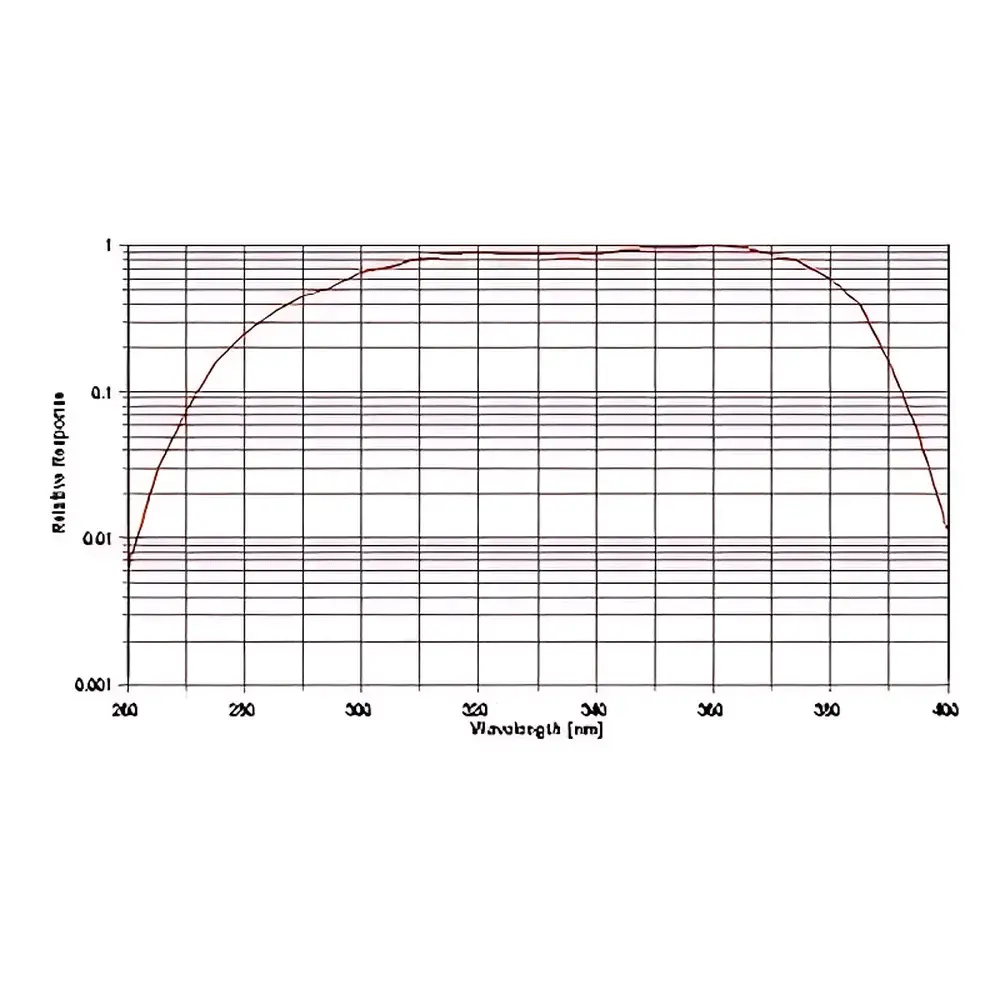
| Spectral Range | UVB (280–320 nm) + UVA (320–400 nm), non-weighted |
| Measurement Range | 0.001–200 mW/cm² (0.01–2,000 W/m²) |
| Display Resolution | 0.001 mW/cm² / 0.01 W/m² |
| Operating Temperature | 0–50 °C (32–120 °F), non-condensing |
| Temperature Coefficient | ±1 %/°C (for solar irradiance) |
| Cable | Retractable coaxial cable, 0.3–1.5 m |
| Detector Diameter | 40.6 mm |
| Height | 45.8 mm |
| Mass | 200 g |
| Calibration | NIST-traceable, factory-calibrated for broadband UVB+UVA irradiance |
Overview
The Solar Light PMA2107 UVB+UVA Broadband Radiometer is a precision optical sensor engineered for quantitative measurement of unweighted ultraviolet irradiance across the combined UVB (280–320 nm) and UVA (320–400 nm) spectral bands. Unlike spectroradiometers or weighted biologically effective instruments (e.g., erythemal or vitamin D action spectra), the PMA2107 delivers absolute irradiance values in physical units—mW/cm² or W/m²—without spectral weighting. Its detection principle relies on a thermopile-based or photodiode-based sensing element (depending on configuration) coupled with a precisely engineered optical filter stack and diffuser assembly that ensures near-Lambertian angular response. This cosine-corrected performance—verified to within ±5% up to 60° off-normal incidence—is essential for accurate measurement of diffuse sky radiation, large-area UV lamps, and non-collimated sources encountered in environmental, clinical, and industrial settings.
Key Features
- True broadband UVB+UVA response without spectral weighting, enabling direct comparison with radiometric reference standards
- High dynamic range spanning five orders of magnitude (2 × 10⁵), supporting measurements from ambient solar UV under overcast conditions (≥0.001 mW/cm²) to high-intensity artificial UV sources (up to 200 mW/cm²)
- NIST-traceable calibration certificate provided with each unit; calibration maintained per ISO/IEC 17025-accredited procedures and includes uncertainty budget documentation
- Robust mechanical design: compact cylindrical form factor (40.6 mm diameter × 45.8 mm height), IP54-rated housing for laboratory and field use, and integrated retractable coaxial cable (0.3–1.5 m)
- Thermal stability optimized via low-drift electronics and temperature-compensated signal conditioning; specified temperature coefficient of ±1 %/°C relative to solar irradiance conditions
- Long-term stability verified through accelerated aging tests and inter-laboratory round-robin studies; typical drift <±2% per year under normal operating conditions
Sample Compatibility & Compliance
The PMA2107 is compatible with all common UV-emitting sources—including fluorescent UV lamps (e.g., QUV, UVA-340), mercury-vapor arc lamps, LED-based UV arrays, and natural sunlight—provided spectral output falls within its defined 280–400 nm passband. It complies with ASTM E772 (Standard Terminology of Solar Energy Conversion), ISO 17166:2019 (Erythema reference action spectrum), and IEC 62471 (Photobiological safety of lamps). While not itself a biological dosimeter, its unweighted irradiance data serves as foundational input for downstream action-spectrum-weighted calculations (e.g., UV Index, MED estimation). The instrument meets GLP requirements for data integrity when used with compliant data loggers and supports audit-ready documentation for regulated environments including FDA-regulated phototherapy device validation and ISO 9001-certified material testing labs.
Software & Data Management
The PMA2107 operates as an analog-output radiometer (typically 0–2 V or 4–20 mA) and interfaces seamlessly with industry-standard data acquisition systems (e.g., National Instruments DAQ, Campbell Scientific CR series, or custom LabVIEW applications). When paired with Solar Light’s PMA2100-series meter base units or third-party DAQ hardware featuring 16-bit ADC resolution, users achieve full traceability of raw voltage-to-irradiance conversion using the certified calibration factor (µW/cm² per mV). All calibration metadata—including date, NIST reference standard ID, spectral responsivity curve, and measurement uncertainty—is digitally archived and exportable in CSV or XML format. For regulated applications, integration with 21 CFR Part 11-compliant software platforms enables electronic signatures, audit trails, and secure user access controls.
Applications
- Quantitative validation of UV curing systems in electronics and coating manufacturing
- Phototherapy lamp output monitoring in dermatology and psoriasis treatment clinics
- Outdoor and greenhouse UV exposure characterization for plant physiology and crop stress modeling
- Accelerated weathering test chamber irradiance profiling per ASTM G154 and ISO 4892-3
- Material degradation studies involving polymer yellowing, ink fading, and textile UV resistance
- Calibration transfer between reference-grade spectroradiometers and field-deployable sensors
FAQ
Is the PMA2107 suitable for measuring UV index?
No—the UV Index requires erythemally weighted irradiance (CIE 1987 action spectrum); the PMA2107 provides unweighted broadband UVB+UVA only. Weighted values must be derived computationally using spectral data or secondary instrumentation.
Can it be used underwater or in high-humidity environments?
No—the operating specification excludes precipitation and condensing conditions. IP54 rating permits indoor and sheltered outdoor use only; submersion or prolonged >85% RH exposure is not supported.
Does it require periodic recalibration?
Yes. Solar Light recommends annual recalibration against NIST-traceable standards to maintain metrological integrity, especially after mechanical shock, thermal cycling beyond specification, or use in high-radiance environments.
What is the spectral rejection ratio outside the 280–400 nm band?
Typical out-of-band rejection exceeds OD4 (0.01% transmission) at λ 420 nm, verified by spectral responsivity mapping per ISO/CIE 13185-2.
How does temperature affect measurement accuracy during extended field deployment?
Within the 0–50 °C operating range, real-time compensation corrects for thermal drift; however, rapid ambient shifts (>2 °C/min) may introduce transient errors ≤±3% until thermal equilibrium is reestablished.