
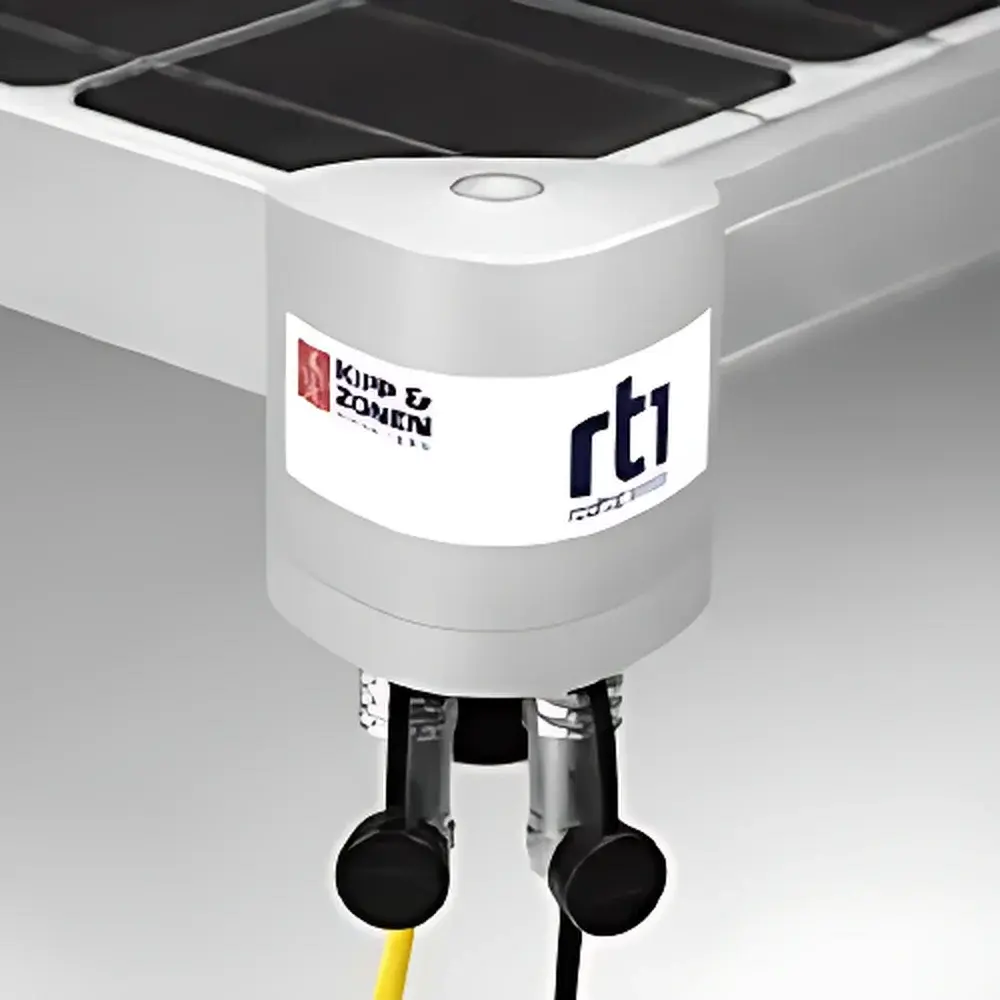

Kipp&Zonen Rt1 Pyranometer
| Brand | Kipp & Zonen |
|---|---|
| Origin | Imported |
| Manufacturer Type | Authorized Distributor |
| Model | Rt1 |
| Output Interface | RS-485 Modbus® |
| Signal Cable | Pre-terminated 20 m shielded cable with IP68 waterproof connector |
| Compliance | ISO 9847 Annex A.3 (Field Calibration of Pyranometers by Comparison with Reference Instruments) |
| Operating Principle | Thermopile-based broadband solar irradiance measurement (285–3000 nm) |
Overview
The Kipp & Zonen Rt1 is a high-precision thermopile pyranometer engineered for continuous, industrial-grade measurement of global horizontal irradiance (GHI) — the total solar radiant flux incident on a horizontal plane, comprising both direct beam and diffuse sky radiation. Operating across the spectral range of 285–3000 nm, the Rt1 conforms to the ISO 9060:2018 classification for Secondary Standard pyranometers, ensuring metrological integrity in demanding outdoor environments. Its sensing element consists of a blackened thermopile detector housed beneath two precision-ground, spectrally neutral quartz domes. This dual-dome configuration minimizes thermal offset errors and suppresses directional response deviations — particularly critical during low solar elevation angles (e.g., dawn/dusk), where cosine error and azimuthal asymmetry are most pronounced. Unlike silicon-cell sensors, the thermopile architecture delivers spectrally flat responsivity and long-term stability without degradation from UV exposure or thermal cycling.
Key Features
- Thermopile-based detection with integrated Pt100 temperature sensor for real-time thermal compensation of detector sensitivity drift
- Dual-quartz dome optical system optimized for minimal cosine and azimuthal error — validated per ISO 9060:2018 requirements for Secondary Standard class
- RS-485 Modbus® RTU digital interface, enabling direct integration with PLCs, SCADA systems, inverters, and industrial data loggers without external signal conditioning
- Pre-terminated, 20-meter shielded signal cable with IP68-rated waterproof M12 connector — factory-calibrated and tested for EMC resilience in photovoltaic (PV) plant environments
- Optional integrated PV panel temperature sensor (3 m lead) for concurrent module temperature monitoring, supporting performance ratio (PR) and yield analysis per IEC 61724-1
- Robust anodized aluminum housing with hydrophobic surface treatment and optimized geometry to reduce dust accumulation and facilitate passive self-cleaning via wind and rain
Sample Compatibility & Compliance
The Rt1 is designed for unattended, year-round deployment in utility-scale solar farms, meteorological networks, and research-grade solar resource assessment campaigns. It meets the physical and metrological criteria specified in ISO 9060:2018 (Secondary Standard), IEC 61724-1:2021 (Photovoltaic system performance monitoring), and ASTM G173-03 (Standard Tables for Reference Solar Spectral Irradiances). Each unit undergoes individual calibration at the Kipp & Zonen Calibration Laboratory in Delft, Netherlands, traceable to the World Radiometric Reference (WRR) maintained by PMOD/WRC in Davos, Switzerland. Field calibration protocols follow ISO 9847 Annex A.3 — “Calibration of field pyranometers by comparison with reference instruments” — supporting audit-ready documentation for GLP-compliant projects and bankable solar energy assessments.
Software & Data Management
The Rt1 operates as a plug-and-play node within distributed monitoring architectures. Its native Modbus® register map supports seamless integration with industry-standard SCADA platforms (e.g., Ignition, Siemens Desigo, Schneider EcoStruxure) and open-source data acquisition frameworks (e.g., Node-RED, Grafana + InfluxDB). All calibration coefficients — including sensitivity (µV/(W/m²)), temperature correction slope, and nonlinearity correction terms — are stored in non-volatile memory and accessible via Modbus read commands. Firmware updates and configuration adjustments (e.g., measurement interval, output scaling) can be performed remotely over the same RS-485 bus. Raw data streams comply with the Common Data Format for Solar Monitoring (CDF-SM) v2.1 metadata schema, facilitating interoperability with PV performance analytics tools such as PVsyst, Helioscope, and NREL’s SAM.
Applications
- Real-time GHI monitoring for PV plant performance ratio (PR) calculation and loss analysis per IEC 61724-1
- Solar resource assessment and bankable energy yield modeling for project financing
- Atmospheric science campaigns requiring long-term, climate-quality irradiance records
- Validation of satellite-derived solar irradiance products (e.g., CAMS, NSRDB)
- Control input for solar tracking systems and concentrated solar power (CSP) heliostat alignment algorithms
- Reference instrumentation in intercomparison studies organized under BSRN (Baseline Surface Radiation Network) or WRMC (World Radiation Monitoring Center)
FAQ
What is the calibration uncertainty of the Rt1?
The typical expanded uncertainty (k=2) of factory calibration is ±1.5% for GHI measurements under natural sunlight conditions, as stated in the ISO/IEC 17025-accredited calibration certificate supplied with each instrument.
Does the Rt1 require periodic recalibration?
Yes. Kipp & Zonen recommends recalibration every two years for operational continuity in commercial PV monitoring; annual recalibration is advised for scientific applications requiring climate-data-grade traceability.
Can the Rt1 be mounted on a solar tracker?
No — the Rt1 is a fixed-horizon pyranometer. For direct normal irradiance (DNI) measurement, pair it with a Kipp & Zonen CHP 1 pyrheliometer on a sun-tracking mount.
Is the RS-485 interface galvanically isolated?
Yes. The interface includes reinforced galvanic isolation rated to 1.5 kV, protecting connected control systems from ground-loop interference and lightning-induced surges common in outdoor installations.
How is thermal offset compensated?
The integrated Pt100 sensor feeds real-time housing temperature into the onboard DSP, applying a physics-based correction model derived from the thermopile’s Seebeck coefficient temperature dependence — eliminating need for external temperature probes or post-processing.
Related Products







