
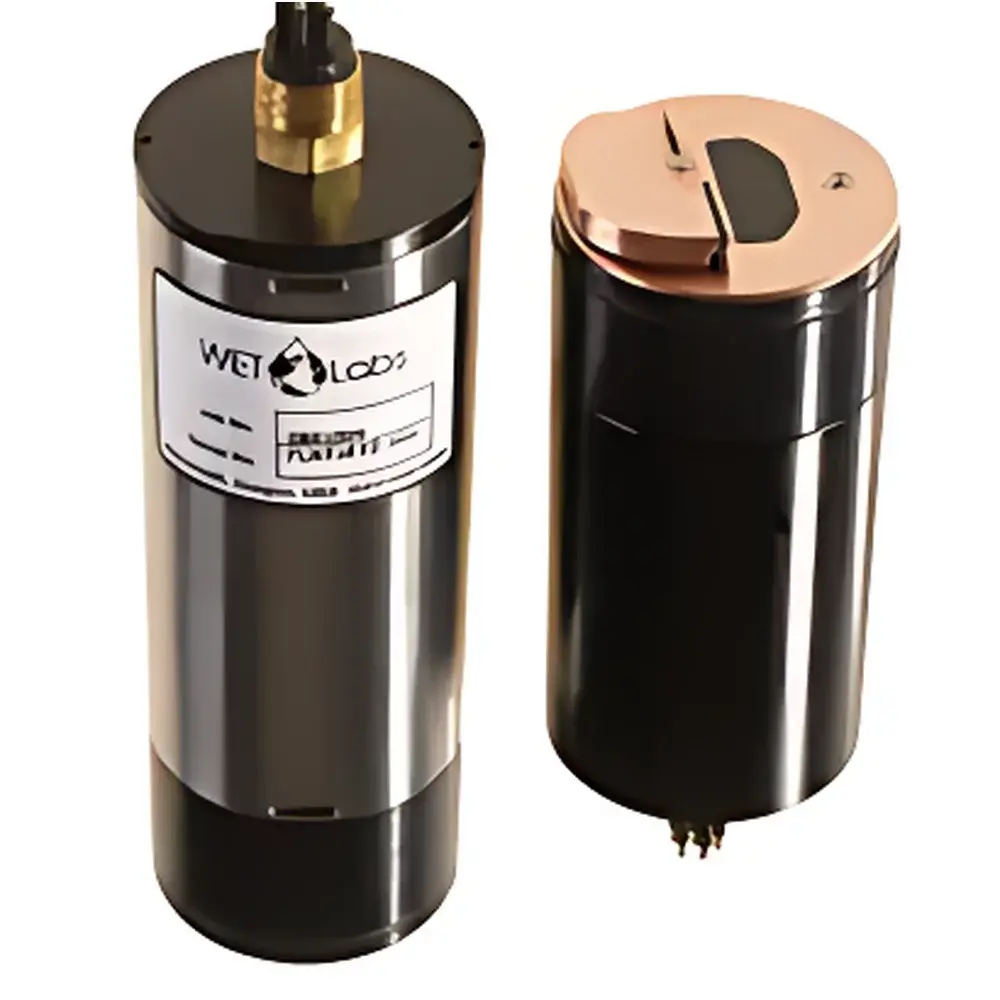
Sea-Bird Scientific ECO Series Fluorometer and Turbidity Sensors
| Brand | Sea-Bird Scientific |
|---|---|
| Origin | Imported |
| Model | ECO Series |
| Optical Excitation/Emission Wavelengths | Chl-a 470/695 nm, CDOM 370/460 nm, Fluorescein 470/530 nm, Rhodamine WT 540/570 nm, Phycoerythrin 540/570 nm, Phycocyanin 630/680 nm |
| Backscatter Wavelengths | 470, 532, 650 nm |
| Chl-a Sensitivity | 0.02 µg/L |
| Chl-a Range | 0–125 µg/L |
| Turbidity Accuracy | ±0.003 NTU (0–10 NTU) to ±0.25 NTU (0–1000 NTU) |
| Backscatter Sensitivity | 0.003 m⁻¹ |
| Backscatter Range | ~0.0024–5 m⁻¹ |
| Digital Resolution | 12–14 bit |
| RS-232 Baud Rate | 19200 |
| Analog Output | 0–5 V |
| Operating Depth | 600 m |
| Temperature Range | 0–30 °C |
| Power Supply | 7–15 VDC |
| Typical Current Draw | 50–60 mA |
| Sleep Current | 140 µA |
| Housing Material | Acetal Copolymer |
| Connector | MCBH6MP |
| Optional Features | Anti-fouling Copper Brush, Internal Battery, Onboard Memory (up to 108,000 samples), Integrated T/P Sensor |
Overview
The Sea-Bird Scientific ECO Series fluorometers and turbidity sensors are high-precision, field-deployable optical instruments engineered for in situ, real-time measurement of fluorescent and scattering properties in aquatic environments. Based on modulated excitation technology, each ECO sensor employs a pulsed LED source operating at 16 Hz—measuring total signal (instrument + ambient light) during illumination and ambient-only signal during dark periods. By digitally subtracting the ambient component, the system achieves robust rejection of solar interference, enabling reliable daytime deployment without optical shielding or mechanical shutters. This principle is foundational to long-term autonomous monitoring in optically complex waters, including coastal zones, estuaries, lakes, reservoirs, rivers, and streams. The ECO platform supports simultaneous quantification of chlorophyll-a (Chl-a), colored dissolved organic matter (CDOM), fluorescent dyes (e.g., Rhodamine WT, fluorescein), phycoerythrin, phycocyanin, and turbidity or spectral backscattering—providing multi-parameter insight into phytoplankton biomass, organic loading, particle dynamics, and water clarity.
Key Features
- Modulated LED excitation with real-time ambient light subtraction for unambiguous daytime operation
- Multi-wavelength fluorescence detection: Chl-a (470/695 nm), CDOM (370/460 nm), fluorescein (470/530 nm), Rhodamine WT (540/570 nm), phycoerythrin & phycocyanin (540/570 nm & 630/680 nm)
- Triple-wavelength backscatter capability (470, 532, 650 nm) for particle size distribution inference and beam attenuation estimation
- High sensitivity: Chl-a detection limit of 0.02 µg/L; turbidity accuracy as tight as ±0.003 NTU in low-range mode
- Rugged acetal copolymer housing rated to 600 m depth; neutrally buoyant in seawater (0.02 kg underwater weight)
- Dual-output architecture: RS-232 serial (19.2 kbaud) and analog 0–5 V, ensuring seamless integration with CTDs, moorings, AUVs, and legacy data acquisition systems
- Low-power design: 50–60 mA active current; 140 µA sleep mode—optimized for battery-powered deployments up to months
- Optional anti-fouling copper brush assembly for extended unattended operation in biofouling-prone environments
- Configurable memory options (up to 108,000 samples) and internal battery support for self-contained profiling or moored time-series applications
Sample Compatibility & Compliance
The ECO Series is validated for use across freshwater, brackish, and marine matrices—including turbid estuarine plumes, eutrophic lakes, oligotrophic open ocean, and glacial runoff. Its optical path geometry and calibration traceability align with ASTM D3857 (Standard Test Method for Chlorophyll a in Water by Fluorometric Measurement) and ISO 10260 (Water quality — Determination of chlorophyll-a — Part 1: In vitro method using acetone extraction). While not intrinsically GLP/GMP-certified, its stable electronics, NIST-traceable factory calibrations, and audit-ready digital logging (with timestamped metadata) support regulatory-grade data collection under US EPA Method 445.0 and EU WFD monitoring protocols. Pressure and temperature compensation routines—when paired with optional integrated sensors—enable correction of fluorescence quenching effects induced by hydrostatic pressure and thermal drift, enhancing inter-comparison validity across vertical profiles.
Software & Data Management
Data acquisition and configuration are supported via Sea-Bird’s SBE Data Processing software suite, which provides instrument setup, calibration coefficient management, linearization, and unit conversion (e.g., raw counts → µg/L Chl-a, m⁻¹ bbp). All models output ASCII-formatted telemetry compatible with Ocean Networks Canada, IOOS, and NOAA NDBC infrastructure. Onboard memory stores time-stamped, high-resolution datasets with configurable sampling intervals (up to 8 Hz for FLNTU variants; 4 Hz for tri-parameter units). Exported files conform to CF-1.7 NetCDF conventions when processed through SBE’s post-acquisition tools—facilitating ingestion into Python (xarray), MATLAB, or ERDDAP-based visualization platforms. For compliance-critical applications, optional firmware enables secure data encryption and electronic audit trails meeting FDA 21 CFR Part 11 requirements for electronic records and signatures.
Applications
- Long-term moored observatories monitoring phytoplankton bloom phenology and sediment resuspension events
- CTD rosette profiling for synoptic assessment of euphotic zone structure and optical closure studies
- AUV and glider payloads requiring low-SWaP, multi-spectral optical sensing
- Real-time wastewater effluent tracking using Rhodamine WT or fluorescein tracers
- CDOM mapping in river plumes to quantify terrestrial carbon export
- Calibration/validation of ocean color satellite algorithms (e.g., MODIS, VIIRS, Sentinel-3 OLCI)
- Ecological risk assessment via combined Chl-a/turbidity ratio analysis for trophic state classification
- Ballast water treatment verification using fluorescent dye decay kinetics
FAQ
What distinguishes the ECO FLNTU from single-parameter fluorometers?
The FLNTU integrates dual optical channels—chlorophyll fluorescence and 700 nm turbidity—in a single compact housing, enabling concurrent correction of quenching artifacts and direct assessment of light-scattering interference.
Can ECO sensors be deployed continuously for over six months?
Yes—when equipped with internal batteries and anti-fouling copper brushes, FLNTUSB and FLNTUS variants have demonstrated >200-day operational stability in temperate coastal deployments, subject to site-specific biofouling pressure.
Is factory recalibration required annually?
Sea-Bird recommends annual verification against secondary standards; full recalibration is advised every 2–3 years or after exposure to extreme pressure cycling or physical impact.
How is backscatter data related to particulate organic carbon (POC)?
While not a direct POC proxy, 470/532/650 nm bbp measurements enable empirical or semi-analytical inversion of particle size distribution and refractive index, supporting POC estimation when coupled with regional regression models.
Do ECO sensors comply with ISO/IEC 17025 for accredited testing labs?
The instruments themselves are not certified under ISO/IEC 17025, but their documented metrological traceability, uncertainty budgets, and calibration certificates meet the technical requirements for inclusion in ISO/IEC 17025-accredited environmental testing workflows.
Related Products







