
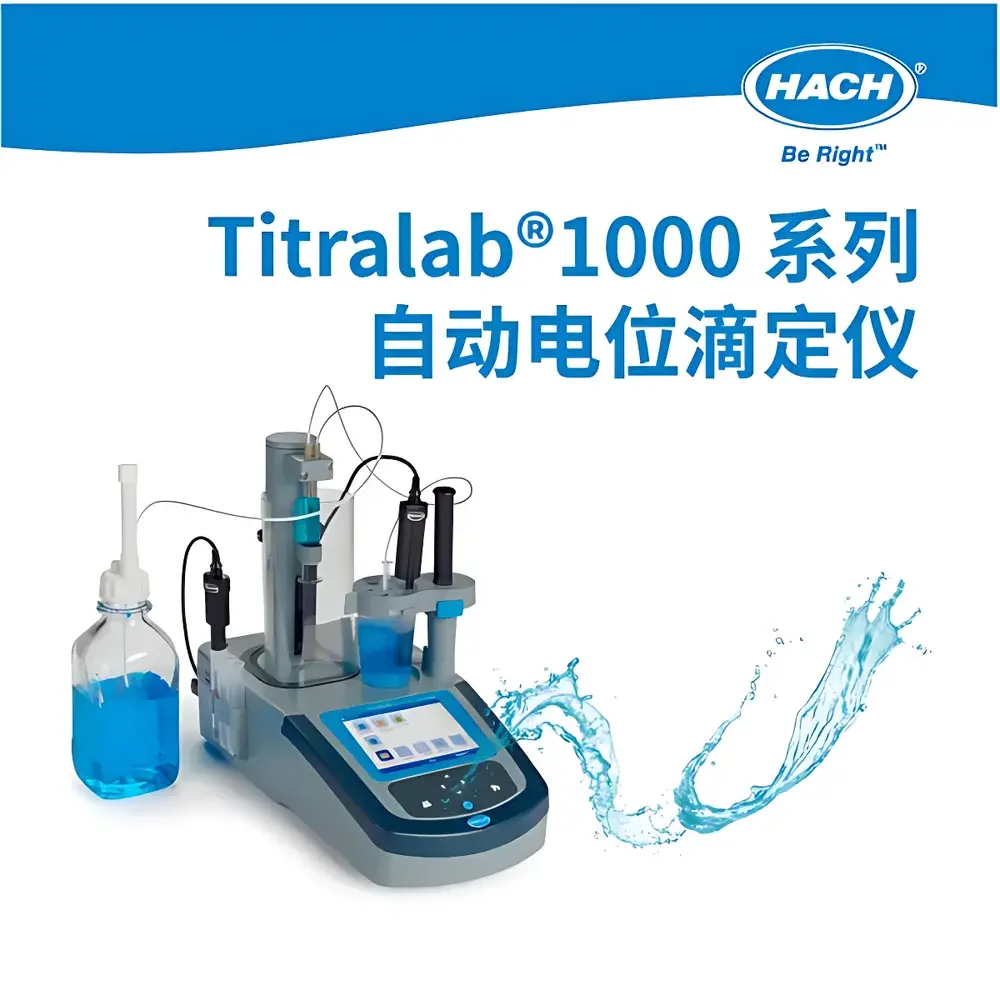
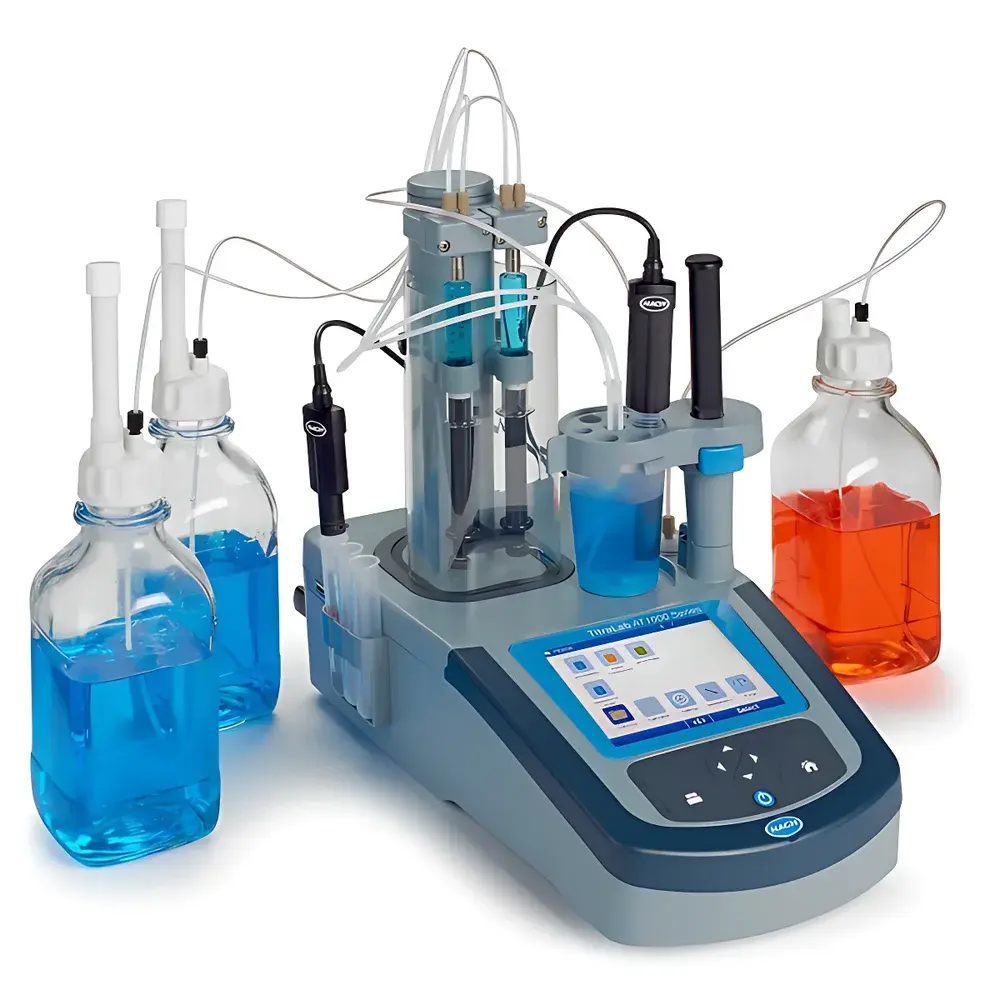
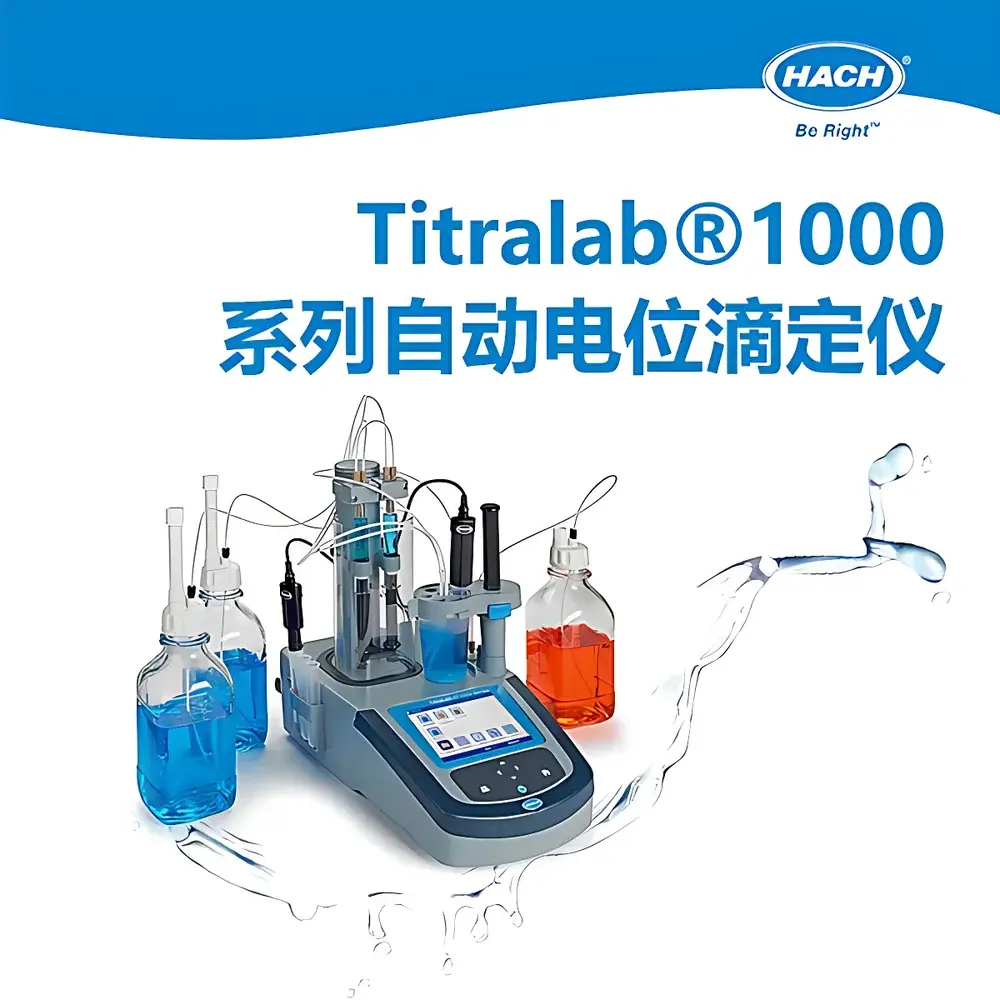
HACH Titralab 1000 Series Automatic Potentiometric Titrator
| Brand | HACH |
|---|---|
| Origin | Imported |
| Manufacturer Type | Manufacturer |
| Model | Titralab 1000 |
| Instrument Type | General-purpose Potentiometric Titrator |
| Application Scope | Dedicated Use |
| pH Measurement Range | 0–14 |
| Burette Resolution | 1/20,000 |
| Titrant Dispensing Precision | ±0.001 mL |
| Display Resolution (pH/mV) | 0.001 pH / 0.1 mV |
| Temperature Range | –10 to +100 °C (0.1 °C resolution) |
| Compliance | GLP, FDA 21 CFR Part 11, ISO/IEC 17025-aligned operation |
Overview
The HACH Titralab 1000 Series Automatic Potentiometric Titrator is a modular, high-precision electrochemical platform engineered for quantitative volumetric analysis across diverse laboratory environments. It operates on the fundamental principle of potentiometric endpoint detection—measuring the potential difference between a reference electrode and an indicator electrode as titrant is incrementally added to the analyte solution. This enables accurate determination of equivalence points in acid-base, redox, precipitation, complexometric, and Karl Fischer (KF) coulometric or volumetric moisture titrations. Designed for reproducibility and traceability, the system integrates precision burette mechanics, real-time potential monitoring, and algorithm-driven endpoint recognition—supporting both classical and advanced titration strategies including dynamic, continuous dynamic, and constant-pH/mV titration modes.
Key Features
- High-resolution burette with 1/20,000 subdivision capability, delivering titrant volumes with ±0.001 mL precision and enabling sub-microliter-level dosing control.
- Large backlit LCD display showing real-time titration curves (E vs. V), derivative plots (dE/dV, d²E/dV²), electrode status, reagent consumption, and active method parameters.
- Multi-mode titration support: endpoint titration (up to 4 endpoints), equivalence point detection via first- or second-derivative analysis, constant-pH/mV titration (TIM854/TIM856 variants), and coulometric KF moisture determination.
- Automated calibration workflows: integrated buffer recognition for pH electrode calibration; scheduled prompts for recalibration intervals; automatic titrant standardization with user-defined protocols.
- Secure multi-level access control: password-protected instrument and PC software interfaces with role-based permissions (operator, supervisor, administrator) aligned with 21 CFR Part 11 audit trail requirements.
- Modular architecture: supports up to two independent burettes (standard); expandable to six via ABU52/ABU62 add-on modules; compatible with automated sample handling systems, analytical balances, barcode scanners, and thermal printers.
Sample Compatibility & Compliance
The Titralab 1000 accommodates aqueous and non-aqueous matrices across a wide pH range (0–14) and temperature span (–10 to +100 °C), making it suitable for samples from aggressive acids and bases to viscous organic solvents and emulsions. Its electrode interface supports glass pH, redox (Pt, Ag/AgCl), ion-selective (e.g., fluoride, chloride), and KF-specific dual-platinum electrodes. All data acquisition, storage, and reporting functions comply with Good Laboratory Practice (GLP) documentation standards. Electronic records include full audit trails—timestamped operator actions, method version history, calibration logs, raw sensor outputs, and manual overrides—with digital signatures available for regulated environments. The system meets functional requirements referenced in ASTM E202, ISO 8587, USP , and EN ISO 14912 for titrimetric moisture and acidity determinations.
Software & Data Management
Titralab Control Software provides a Windows-based interface for method development, execution, and post-run analysis. Predefined methods cover common applications—including ASTM D6304 (KF moisture in petroleum), AOAC 960.12 (acid number in oils), and EPA 160.1 (alkalinity)—and are fully editable. Each method stores electrode configuration, titrant concentration, stirring speed (0–1100 rpm in 50-rpm increments), titration mode logic, and endpoint criteria. Data files (.TIT) retain raw voltage/time series, processed curves, statistical summaries (RSD, confidence intervals), and metadata required for regulatory submissions. Export options include CSV, PDF reports with embedded spectra, and direct integration into LIMS via ODBC or HL7-compliant drivers. All electronic signatures conform to FDA 21 CFR Part 11 Subpart C technical controls.
Applications
The Titralab 1000 serves critical quality control and R&D functions across multiple sectors:
- Pharmaceuticals: Quantification of active pharmaceutical ingredients (APIs), assay of excipients, dissolution testing support, and enzymatic reaction monitoring under constant-pH conditions (e.g., pepsin activity assays).
- Food & Beverage: Determination of titratable acidity (TA), free fatty acids (FFA) in oils, sulfur dioxide in wine, and moisture content in powdered dairy products via KF titration.
- Environmental Testing: Alkalinity, hardness, cyanide, and chloride analysis per EPA and ISO standard methods; wastewater neutralization studies.
- Chemical Manufacturing: Acid/base value verification in catalysts and surfactants; redox titrations for peroxide and hypochlorite concentrations; complexometric EDTA titrations for metal ion quantification.
- Electroplating & Surface Treatment: Bath composition control (e.g., nickel sulfate, copper cyanide), free cyanide monitoring, and accelerator concentration profiling.
FAQ
What types of electrodes are supported by the Titralab 1000?
It accepts all standard DIN/ISO-compatible electrodes—including combination pH, redox, ion-selective, and dual-platinum KF electrodes—with automatic recognition and parameter recall based on stored electrode profiles.
Can the system perform Karl Fischer titration without hardware modification?
Yes—when equipped with a KF reagent module and dual-platinum generator/electrode cell, the Titralab 1000 executes both volumetric and coulometric KF moisture determinations per ASTM D6304 and ISO 760.
Is method validation documentation available for regulated industries?
HACH provides IQ/OQ documentation templates, instrument qualification protocols, and software validation packages compliant with ISO/IEC 17025 and GxP expectations.
How does the constant-pH titration mode function in biological applications?
Using real-time pH feedback, the system dynamically dispenses acid or base to maintain a preset pH setpoint—enabling kinetic studies of pH-dependent enzymes, protein stability assays, and controlled hydrolysis reactions.
What data security measures are implemented for audit readiness?
All user actions generate immutable, time-stamped audit trails; electronic signatures require dual authentication; data encryption and role-based access prevent unauthorized edits or deletions—fully satisfying 21 CFR Part 11 Subpart C requirements.
Related Products






