
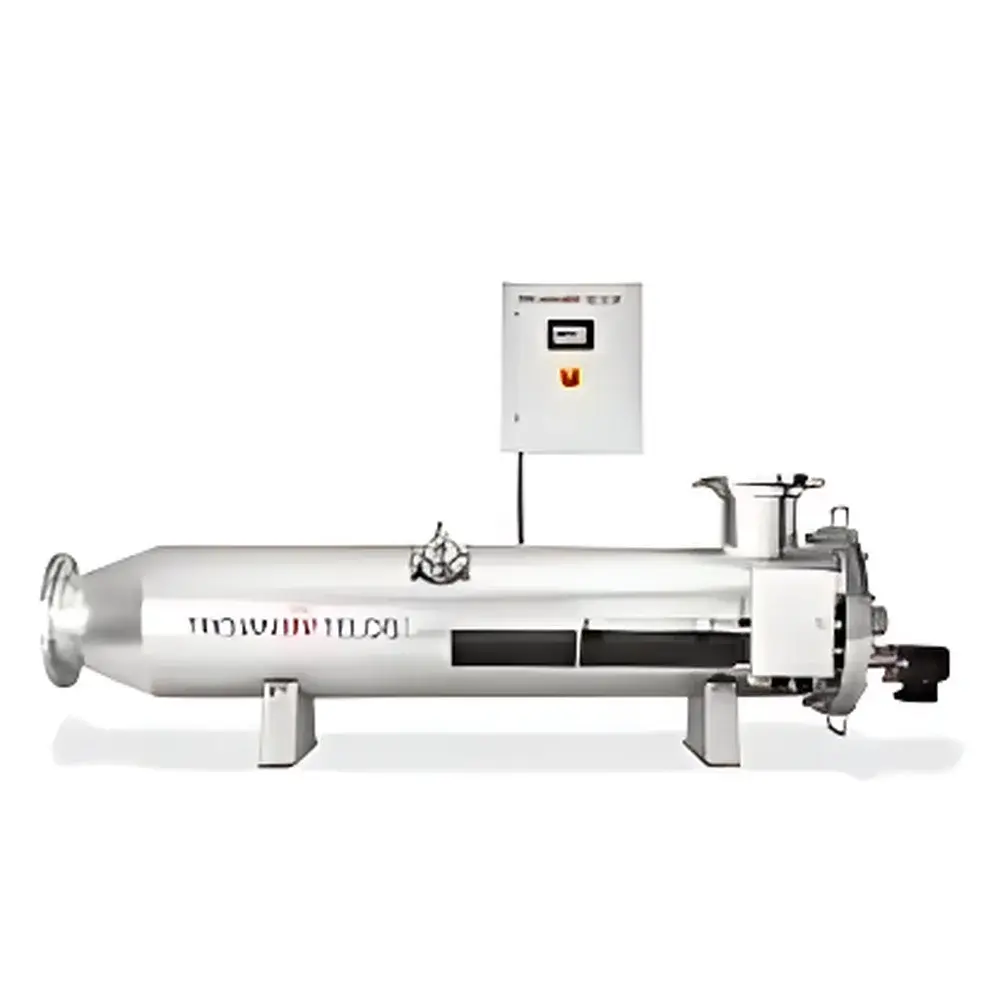
TrojanUV Telos UV Disinfection System
| Brand | Trojan |
|---|---|
| Origin | Imported |
| Manufacturer Type | Authorized Distributor |
| Model | TrojanUVTelos |
| Pricing | Available Upon Request |
Overview
The TrojanUV Telos is an engineered ultraviolet (UV) disinfection system specifically designed for small-community drinking water applications, including booster pump stations and secondary distribution systems. It operates on the principle of germicidal UV-C irradiation (254 nm), inactivating bacteria, viruses, and protozoan pathogens—including Giardia lamblia and Cryptosporidium—by disrupting their DNA/RNA replication capability. Unlike chemical disinfectants, UV treatment introduces no residual byproducts, ensuring compliance with regulatory requirements for primary disinfection without altering water chemistry, taste, or odor. The system integrates Trojan’s proprietary UV Solo Lamp™ technology—a low-pressure, high-output amalgam lamp platform—and the TrojanUV FIN™ flow-field integration design to optimize hydraulic residence time distribution and photon delivery efficiency across the reactor chamber.
Key Features
- UV Solo Lamp™ Technology: Utilizes high-efficiency, long-life amalgam UV lamps delivering stable 254 nm output over extended operational lifetimes (typically ≥12,000 hours), with consistent spectral output across variable ambient temperatures.
- TrojanUV FIN™ Flow Field Integration: A computational fluid dynamics (CFD)-validated internal baffle and flow conditioning architecture that minimizes short-circuiting and ensures uniform UV dose delivery—even under fluctuating flow rates (typical operating range: 10–100 gpm per module).
- Reduced Lamp Count & Energy Efficiency: Achieves target UV dose (e.g., 40 mJ/cm² for Giardia inactivation per US EPA UVDGM) with fewer lamps than conventional systems, resulting in up to 25% lower specific energy consumption (kWh/m³) compared to legacy UV platforms of equivalent capacity.
- Modular Scalability: Designed for plug-and-play expansion; multiple Telos modules can be paralleled to accommodate future demand growth without full-system replacement.
- Low-Maintenance Architecture: Features tool-free quartz sleeve removal, automated wiper mechanisms (optional), and integrated UV intensity sensors with real-time lamp output monitoring and automatic duty-cycle adjustment.
Sample Compatibility & Compliance
The TrojanUV Telos is validated for use with potable water meeting standard municipal pre-treatment criteria: turbidity ≤ 1 NTU, UV transmittance (UVT) ≥ 85% at 254 nm, and total suspended solids (TSS) ≤ 10 mg/L. It complies with NSF/ANSI 55 Class A certification for microbiological reduction and meets the U.S. EPA Ultraviolet Disinfection Guidance Manual (UVDGM) validation protocol requirements. System design supports GLP-compliant operation when integrated with data-logging controllers, and firmware supports audit-trail functionality aligned with FDA 21 CFR Part 11 for electronic records in regulated utilities. Third-party bioassay validation (using MS2 coliphage or Bacillus subtilis spores) is performed per ISO 15858 and DVGW W294 standards.
Software & Data Management
The system interfaces with Trojan’s UV Master™ control platform—a web-enabled supervisory controller supporting Modbus TCP, BACnet/IP, and OPC UA protocols. Real-time parameters—including UV intensity (µW/cm²), flow rate (gpm), lamp status, dose calculation (mJ/cm²), and UVT-derived transmittance correction—are logged at 1-second intervals and stored locally for ≥30 days. Historical datasets export to CSV or integrate directly into SCADA or CMMS platforms. Alarm management includes configurable thresholds for low-dose events, lamp failure, sensor drift, and flow excursions—with email/SMS notifications via SMTP or MQTT. All configuration changes are timestamped and user-attributed to support regulatory traceability.
Applications
- Small municipal water systems serving populations under 10,000 residents
- Booster pumping stations requiring point-of-entry (POE) disinfection prior to distribution loop re-injection
- Secondary treatment facilities integrating UV as a final barrier after filtration
- Remote or off-grid communities utilizing solar-hybrid power systems—optimized low-power draw enables compatibility with renewable energy sources
- Emergency response deployments where rapid installation, minimal footprint (<2.5 m² per 50 gpm module), and chemical-free operation are critical
FAQ
What is the minimum required UV transmittance (UVT) for reliable operation?
The system is rated for continuous operation at UVT ≥ 85% at 254 nm; performance modeling and dose verification are recommended for waters with UVT between 75–85% using Trojan’s UVCalc™ software.
Does the Telos system require pre-filtration?
Yes—mechanical filtration to ≤ 5 µm is required upstream to prevent quartz sleeve fouling and ensure optical clarity; coagulation/flocculation may be needed for high-humic or iron-rich source waters.
How often must UV lamps be replaced?
Lamp replacement is scheduled every 12,000 operating hours or annually—whichever occurs first—as defined by NSF/ANSI 55 and Trojan’s maintenance protocol.
Is remote monitoring supported out of the box?
Yes—standard Ethernet connectivity and UV Master™ firmware include secure HTTPS access, role-based user accounts, and encrypted data transmission compliant with NIST SP 800-53 controls.
Can the system be validated for Cryptosporidium inactivation under state primacy programs?
Yes—validation reports per UVDGM Appendix B, including third-party bioassay testing and hydraulic residence time distribution (RTD) analysis, are provided upon commissioning.
Related Products







