
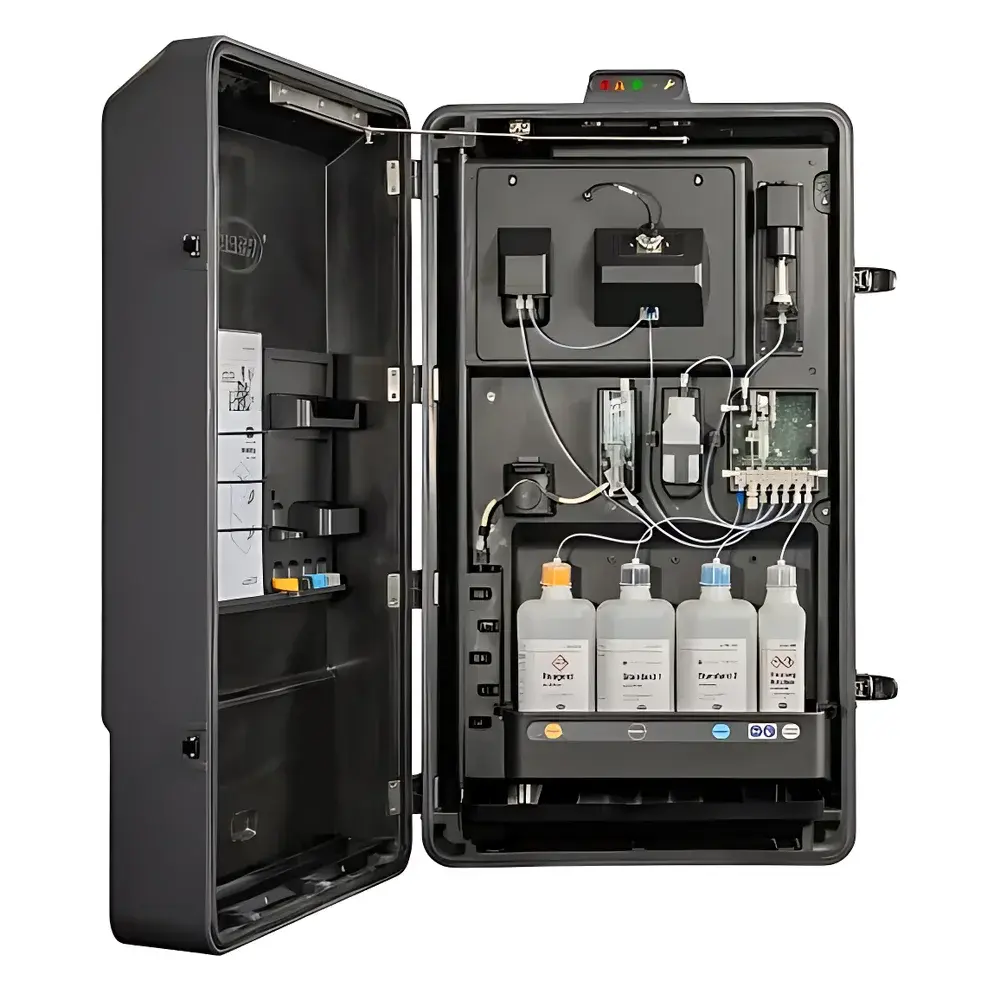
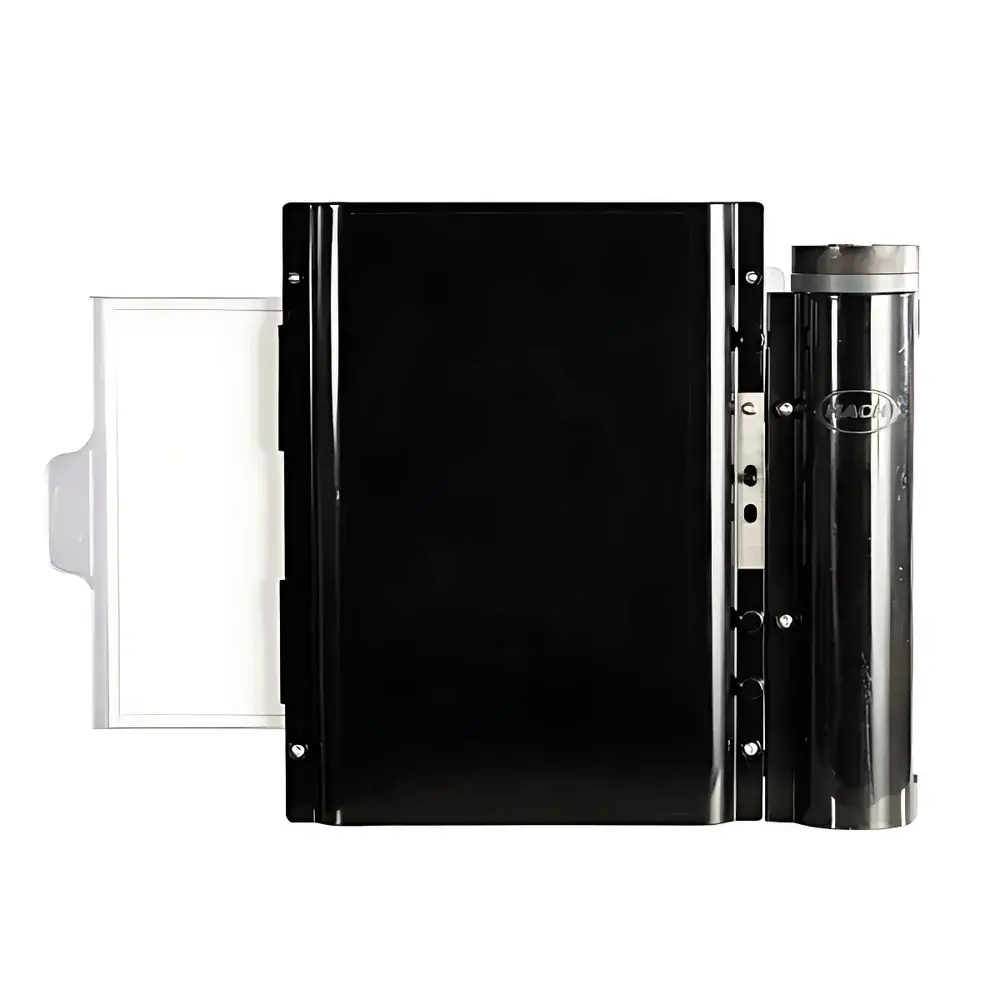
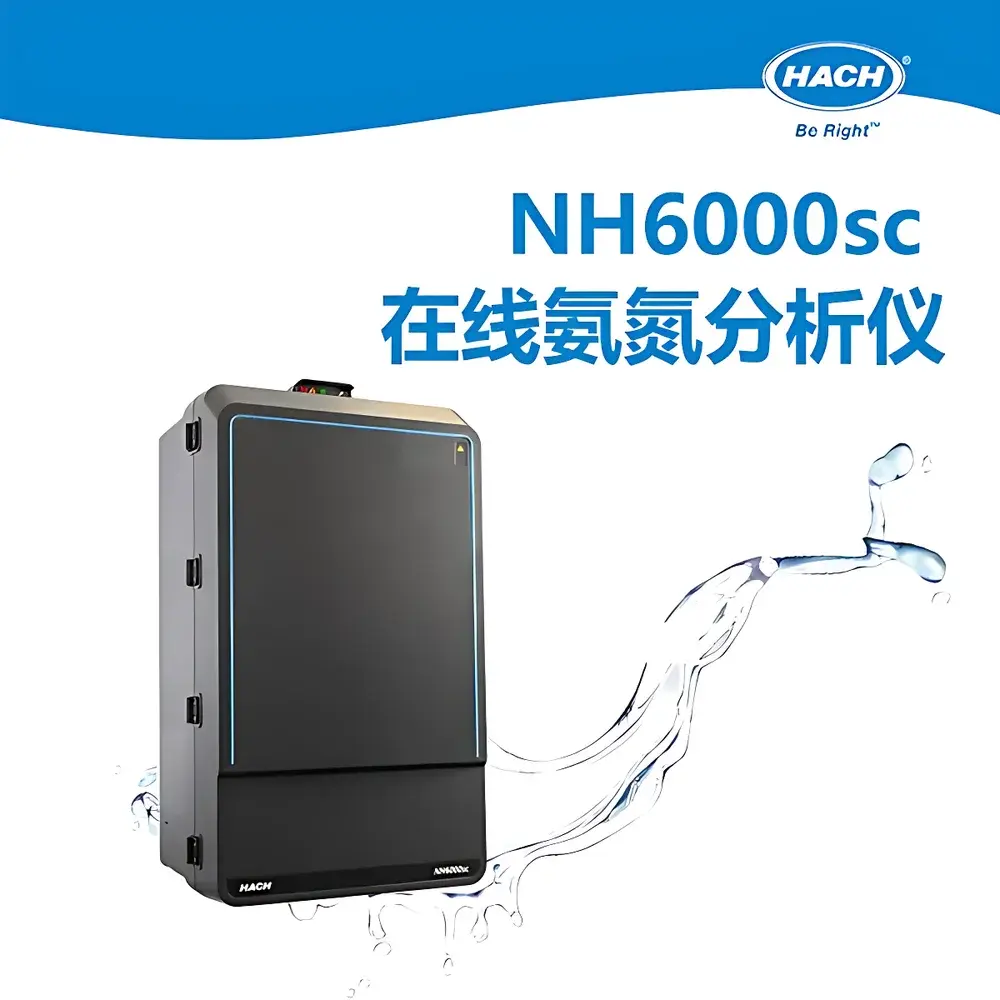
Hach NH6000sc Online Ammonia Nitrogen Analyzer
| Brand | Hach |
|---|---|
| Origin | Imported |
| Manufacturer | Hach Company |
| Model | NH6000sc |
| Instrument Type | Online Analyzer |
| Measurement Principle | Gas-Sensing Electrode (GSE) |
| Measurement Range | 0.02–5.0 mg/L NH₄–N (standard range), extendable to 10–1000 mg/L NH₄–N via range selection |
| Accuracy | ≤1 mg/L: ±0.02 mg/L + 3% of reading |
| >1 mg/L | ±0.02 mg/L + 5% of reading |
| Detection Limit | 0.02 mg/L NH₄–N |
| Response Time | <5 minutes (for concentrations >0.2 mg/L) |
| Measurement Interval | User-selectable (5, 10, 15, 20, or 30 min) |
| Sample Flow Rate | 1.0–20.0 L/h |
| Operating Temperature | –20 to 45 °C |
| Enclosure Rating | IP55 / NEMA 3R |
| Power Supply | 115 VAC or 230 VAC |
| Weight | ~45 kg |
| Dimensions | 575 × 991 × 425 mm |
Overview
The Hach NH6000sc Online Ammonia Nitrogen Analyzer is an industrial-grade, continuous-monitoring instrument engineered for precise, interference-resistant quantification of ammonium-nitrogen (NH4–N) in aqueous matrices. It employs gas-sensing electrode (GSE) technology—a selective electrochemical detection method in which ammonium ions in the sample are converted to gaseous ammonia (NH3) under controlled alkaline conditions. The NH3 diffuses selectively through a hydrophobic gas-permeable membrane and is detected by a pH-sensitive electrode immersed in an internal electrolyte solution. This principle eliminates direct contact between the electrode and the sample matrix, thereby minimizing fouling, drift, and cross-sensitivity to common interferents such as potassium, sodium, calcium, and chloride—unlike conventional ion-selective electrode (ISE) systems. Designed for deployment in demanding environmental and process water applications, the NH6000sc delivers stable, low-maintenance operation with measurement intervals configurable from 5 to 30 minutes and response times under 5 minutes for concentrations above 0.2 mg/L.
Key Features
- Gas-sensing electrode (GSE) technology ensures high specificity for NH4–N with minimal interference from ionic strength, turbidity, or redox-active species.
- Four programmable measurement ranges (0.02–5.0, 0.05–20, 1–100, and 10–1000 mg/L NH4–N) enable seamless adaptation across source water, drinking water, wastewater influent/effluent, and industrial process streams.
- Integrated predictive diagnostics and automated maintenance routines—including auto-calibration, auto-verification, and auto-cleaning cycles—reduce operator dependency and support GLP-compliant operational records.
- Modular filtration compatibility with FX610 (standard) and FX620 (heavy-duty) filter systems ensures consistent sample conditioning (<0.45 µm filtration), improved air purge efficiency, and real-time flow monitoring.
- Ruggedized PUR 66 UV-stabilized enclosure rated IP55/NEMA 3R supports unsheltered outdoor installation in ambient temperatures from –20 to 45 °C and up to 95% relative humidity (non-condensing).
- Low-maintenance architecture enables biannual servicing—reducing reagent replacement, electrode conditioning, and mechanical cleaning to just two scheduled interventions per year.
Sample Compatibility & Compliance
The NH6000sc accepts raw or pre-filtered water samples within a pH range of 5–9 and tolerates chloride concentrations up to 1000 mg/L Cl–. For optimal performance, incoming sample streams must be pre-conditioned using ultrafiltration (e.g., FX6x0 series) or equivalent sub-0.45 µm filtration. Sample pressure must not exceed 2.5 bar (36.3 psi), and flow rates should be maintained between 1.0 and 20.0 L/h. The analyzer complies with key international standards governing environmental instrumentation, including ISO 5667-3 (water sampling), ASTM D1426 (ammonia nitrogen test methods), and EN 25667-3. Its digital interface and audit-trail-capable controller integration align with data integrity requirements under FDA 21 CFR Part 11 when paired with validated SC-series controllers and appropriate software configuration.
Software & Data Management
The NH6000sc operates exclusively with Hach’s SC digital controller platform (sold separately), enabling centralized configuration, real-time diagnostics, historical trend logging, and alarm management via Modbus RTU/TCP or HART communication protocols. All calibration events, verification checks, cleaning cycles, and error logs are time-stamped and stored locally on the SC controller with optional cloud synchronization via Hach’s Asset Insight™ platform. Raw measurement data—including mV output, temperature-compensated NH4–N concentration, and diagnostic flags—is exported in CSV or OPC UA format for integration into SCADA, LIMS, or MES systems. Audit trails meet GLP/GMP traceability expectations, supporting regulatory submissions and third-party validation processes.
Applications
- Drinking water treatment: Real-time monitoring of finished water and distribution system entry points to ensure compliance with WHO and EPA maximum contaminant levels (MCLs) for ammonia.
- Wastewater treatment: Process control at nitrification/denitrification basins, effluent discharge compliance verification, and biological nutrient removal (BNR) optimization.
- Surface and groundwater surveillance: Early warning detection in rivers, reservoirs, and aquifer recharge zones impacted by agricultural runoff or septic leakage.
- Industrial process water: Monitoring boiler feedwater, cooling tower make-up, and semiconductor ultrapure water loops where trace ammonia compromises system integrity.
- Regulatory reporting: Automated generation of certified data packages aligned with national discharge permits (e.g., U.S. NPDES, EU Urban Wastewater Treatment Directive).
FAQ
What measurement principle does the NH6000sc use, and how does it differ from ISE-based analyzers?
The NH6000sc utilizes gas-sensing electrode (GSE) technology, where ammonium is converted to gaseous NH3, selectively diffusing across a membrane for potentiometric detection. Unlike ISE methods, GSE avoids direct sample-electrode contact, significantly reducing sensitivity to ionic strength variations, electrode poisoning, and chloride interference.
Can the NH6000sc operate without external filtration?
No. Continuous operation requires upstream filtration to ≤0.45 µm (e.g., FX610/FX620). Unfiltered samples risk membrane fouling and measurement drift due to particulate accumulation.
Is the analyzer suitable for seawater or high-salinity applications?
It is not recommended for salinities exceeding 1000 mg/L Cl–. While the GSE design improves tolerance over ISE, prolonged exposure to marine or brackish water may accelerate membrane degradation and require more frequent maintenance.
How often does the GSE sensor require replacement?
Under typical freshwater conditions and biannual maintenance, the GSE sensor demonstrates ≥18 months of functional service life. Replacement intervals depend on sample matrix aggressiveness and operating temperature.
Does the NH6000sc support remote firmware updates and configuration changes?
Yes—when connected to an SC4500 or SC200 controller with Ethernet or cellular telemetry, firmware updates and parameter adjustments can be performed remotely via Hach’s secure web interface or Asset Insight™ cloud portal.
Related Products







