
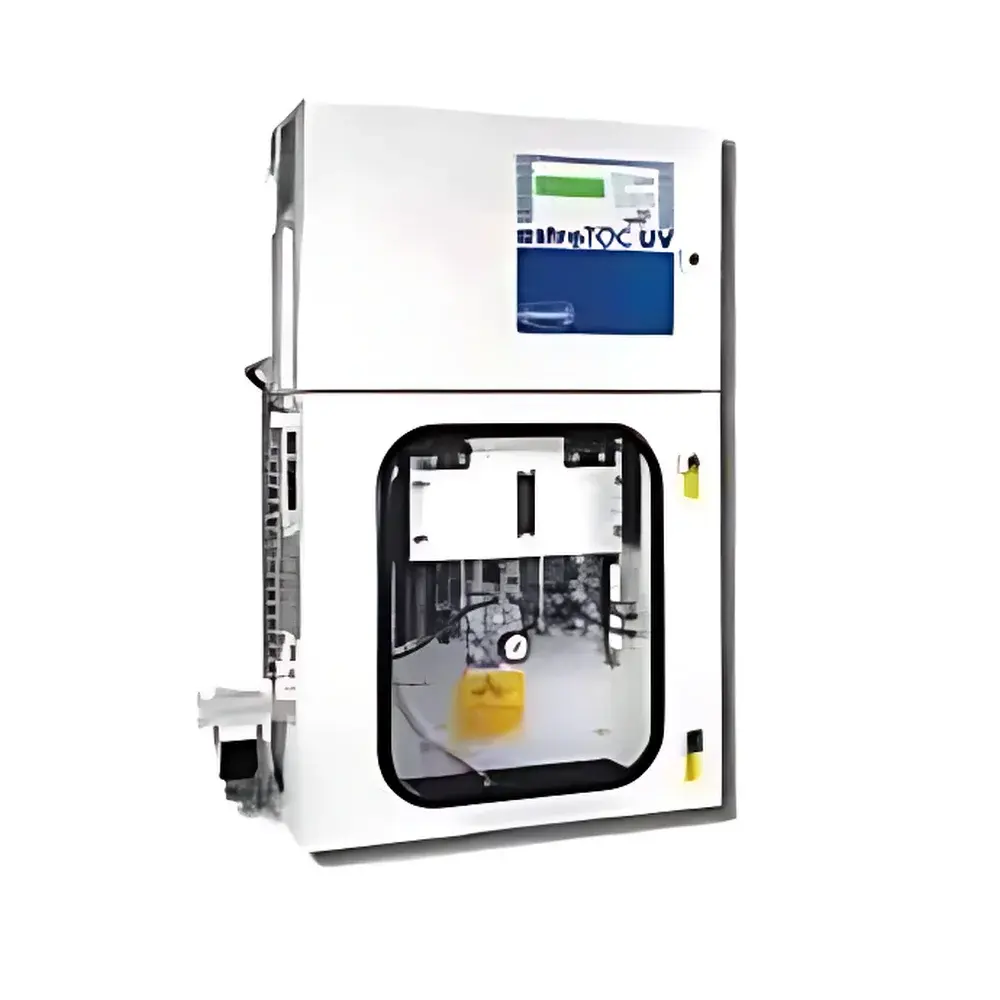
HACH Astro TOC UV TURBO Online Total Organic Carbon Analyzer
| Brand | HACH |
|---|---|
| Origin | Imported |
| Manufacturer Type | Manufacturer |
| Instrument Type | Online TOC Analyzer |
| Model | Astro TOC UV TURBO |
| Measurement Principle | UV-Persulfate Oxidation + NDIR Detection |
| Oxidation Method | Dual-stage oxidation (acidic sparging for inorganic carbon removal followed by 185/254 nm UV photolysis with persulfate) |
| Measurement Range | 0–2.000, 0–5.000, 0–10.000, 0–25.000, 0–50.000 mg/L as C |
| Detection Limit | ≤5 µg/L (at 25°C, 0–5000 µg/L range) |
| Response Time | T₉₀ ≤ 5 min |
| Repeatability | < ±2% RSD (at ≥100 µg/L) |
| Sample Flow Rate | 25–200 mL/min |
| Sample Temperature Range | 2–70°C |
| Operating Ambient Temperature | 5–40°C |
| Inlet Pressure | 0.15–6 bar |
| Enclosure Rating | IP66 / NEMA 4 |
| Certifications | CE, UL 61010-1, CSA C22.2 No. 61010-1 |
| Dimensions (H×W×D) | 981 × 675 × 220 mm |
| Weight | 54 kg |
| Power Supply | 115/230 VAC, 50/60 Hz |
| Analog Outputs | Two isolated 4–20 mA outputs (user-configurable scaling) |
| Digital Communication | RS232/RS485 (Modbus RTU or CSV format) |
| Alarm Functions | Five configurable alarms (TOC concentration, system fault, maintenance due, flow loss, pressure deviation) |
| Carrier Gas | CO₂-free air or nitrogen (2.8–6.2 bar) |
Overview
The HACH Astro TOC UV TURBO is a high-performance online total organic carbon (TOC) analyzer engineered for continuous, real-time monitoring of ultra-pure water streams in critical industrial applications—including power plant condensate return loops, semiconductor ultrapure water (UPW) systems, and petrochemical process water networks. It employs a validated dual-stage oxidation methodology: first, acidification and sparging to remove inorganic carbon (TIC), followed by advanced UV/persulfate oxidation (185 nm + 254 nm lamps with sodium persulfate catalyst) to quantitatively convert non-purgeable organic carbon (NPOC) into CO₂. The liberated CO₂ is then phase-separated from the aqueous matrix via a proprietary hydrophobic membrane-based water vapor separator and delivered to a thermally stabilized non-dispersive infrared (NDIR) detector. This architecture ensures stoichiometric oxidation efficiency exceeding 99% across the full dynamic range and eliminates interferences from volatile organics, chlorinated compounds, or oxidation by-products—critical for trace-level TOC quantification in sub-ppb matrices.
Key Features
- Sub-5 µg/L detection limit optimized for condensate reuse compliance—meets ASTM D5997 and ISO 8245 requirements for low-concentration TOC validation.
- UV-TURBO oxidation module delivers consistent >99% oxidation efficiency without catalyst replenishment or lamp replacement for ≥12 months under typical operating conditions.
- Integrated self-diagnostic suite continuously monitors UV lamp intensity, reagent delivery accuracy, gas flow stability, and NDIR baseline drift—triggering maintenance alerts prior to performance deviation.
- Automated daily cleaning cycle using high-purity water and controlled backflush pressure prevents biofilm accumulation and carbon carryover between samples.
- Rugged IP66/NEMA 4 enclosure enables direct installation in harsh utility corridors, turbine halls, or outdoor skids without climate-controlled shelters.
- Configurable 4–20 mA analog outputs support integration with DCS, PLC, or SCADA systems; Modbus RTU over RS485 allows bidirectional parameter read/write and event logging.
Sample Compatibility & Compliance
The Astro TOC UV TURBO accepts liquid samples with conductivity ≤1 µS/cm and silica ≤50 µg/L—typical of steam-cycle condensate, boiler feedwater, and UPW loop returns. It operates reliably across pH 5.0–8.5 and tolerates transient particulate loadings up to 1 µm without filter clogging, thanks to its dual-stage particulate trap and laminar-flow sample path design. Regulatory alignment includes full traceability per FDA 21 CFR Part 11 (audit trail, electronic signature, data integrity controls when paired with HACH Insight software), GLP/GMP-ready operation with IQ/OQ documentation packages, and conformity with EN 61000-6-2 (EMC immunity) and EN 61000-6-4 (EMC emission) standards.
Software & Data Management
Data acquisition and instrument control are managed via HACH Insight™ web-based platform (accessible via secure HTTPS on local network). The system records raw NDIR absorbance, oxidation efficiency metrics, calibration history, alarm timestamps, and diagnostic logs with time-stamped digital signatures. All data exports comply with ASTM E2500-22 for analytical instrument qualification, supporting automated report generation in PDF/CSV formats. Optional cloud synchronization enables remote fleet monitoring, predictive maintenance scheduling, and trend analysis across multiple analyzers—fully compliant with ISA-95 Level 2 MES integration protocols.
Applications
- Real-time TOC surveillance in nuclear and fossil-fuel power plant condensate polishing systems to prevent organic-induced corrosion in steam generators.
- Monitoring of reclaimed condensate in chemical and refinery processes where hydrocarbon breakthrough must be detected at <10 µg/L.
- Final quality verification in pharmaceutical purified water (PW) and water for injection (WFI) distribution loops per USP and EP 2.2.44.
- Early-warning detection of heat exchanger tube leakage (e.g., lube oil ingress) in closed-loop cooling systems.
- Validation of membrane integrity in reverse osmosis and electrodeionization (EDI) units serving semiconductor fab UPW plants.
FAQ
What oxidation method does the Astro TOC UV TURBO use, and why is it suitable for condensate analysis?
It combines acid sparging for TIC removal with UV/persulfate oxidation—providing complete, interference-free conversion of refractory organics (e.g., acetates, glycols, amines) commonly found in turbine condensate.
Does the analyzer require carrier gas, and what purity specifications apply?
Yes—CO₂-free air or nitrogen (≤0.1 ppm CO₂) at 2.8–6.2 bar is required for NDIR reference and sample gas transport; onboard gas purifiers maintain specification over 6-month intervals.
How is calibration verified during unattended operation?
A dual-point verification sequence runs automatically every 24 hours using certified KHP and sucrose standards; results are logged with uncertainty estimates per ISO/IEC 17025.
Can the instrument operate in environments with high ambient humidity or vibration?
Yes—the IP66-rated chassis, shock-mounted optical bench, and convection-cooled electronics ensure stable operation in turbine hall environments per IEC 60068-2-6 (vibration) and IEC 60068-2-30 (humidity cycling).
Is the system compatible with third-party LIMS or historian platforms?
Yes—via Modbus TCP/IP gateway or OPC UA adapter; all process variables, diagnostics, and alarm states map to standard tag structures aligned with ISA-88/ISA-95 naming conventions.
Related Products







