
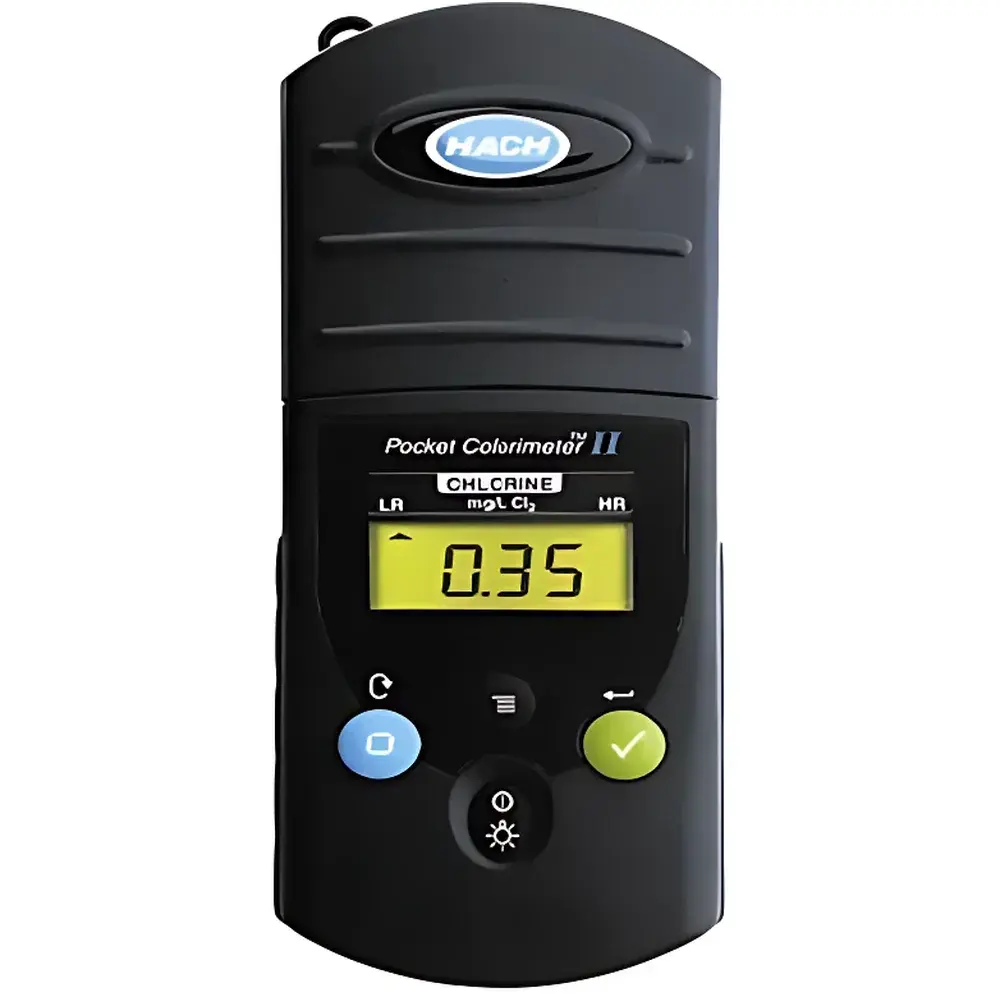
Hach PCII Single-Parameter Water Quality Analyzer
| Brand | Hach |
|---|---|
| Origin | Imported |
| Manufacturer Type | Manufacturer |
| Model | PCII |
| Instrument Type | Laboratory Water Quality Analyzer |
| Measurable Parameters | Multiple (Single-Parameter Operation Mode) |
| Wavelength | Model-Dependent |
| Photometric Range | 0–2.5 ABS |
| Power Supply | AAA Alkaline Batteries (4×) |
| Weight | 230 g |
| Operating Environment | 10–50 °C, 0–90% RH (non-condensing) |
| IP Rating | IP67 (submersible up to 0.9 m for 30 min) |
| Data Storage | 10 recent measurements with timestamp |
| Display | Backlit LCD with battery level indicator |
| Calibration | Factory-calibrated against standardized methods (e.g., APHA, ASTM, ISO) |
Overview
The Hach PCII Single-Parameter Water Quality Analyzer is a compact, field-deployable photometric instrument engineered for rapid, reliable quantification of individual water quality parameters in both laboratory and on-site environments. Based on fixed-wavelength absorbance photometry—principally utilizing pre-programmed, method-specific calibration curves aligned with internationally recognized standard procedures (including APHA Standard Methods, ASTM D1293, ISO 7027, and EPA-approved colorimetric protocols)—the PCII delivers traceable, reproducible results without requiring user-developed calibrations. Its optical architecture employs high-stability LED light sources matched to narrow-band interference filters, minimizing spectral interference and ensuring consistent pathlength-independent measurement across varying sample turbidity or matrix complexity. Designed as a dedicated single-parameter platform, each PCII unit is configured at manufacture for one specific analyte (e.g., chlorine, nitrate, phosphate, iron, or copper), eliminating cross-parameter interference and optimizing signal-to-noise ratio for that target species.
Key Features
- Portable form factor: Weighing only 230 g, the PCII is optimized for handheld operation during field surveys, plant walk-throughs, or mobile lab deployments.
- Robust environmental sealing: Rated IP67, the instrument withstands immersion in freshwater up to 0.9 meters for 30 minutes—enabling safe use near open channels, wastewater collection points, or stormwater outfalls.
- Integrated data management: Stores the last 10 measurements with automatic timestamping; data can be reviewed directly on-device without external software or connectivity.
- Enhanced readability: Backlit monochrome LCD display ensures legibility under low-light conditions (e.g., manholes, dim laboratories, or nighttime sampling); real-time battery status icon prevents unexpected power loss during critical measurements.
- Method-embedded firmware: Each unit ships with factory-loaded calibration curves validated per Hach’s internal QA/QC protocols and traceable to NIST-traceable reference standards—eliminating manual curve generation and reducing operator-dependent error.
- Low-power architecture: Operates on four standard AAA alkaline batteries with typical service life exceeding 2,000 measurements per set, supporting extended unattended operation in remote locations.
Sample Compatibility & Compliance
The PCII is compatible with aqueous samples meeting standard drinking water, wastewater, and surface water matrix specifications. It accepts samples in standard 10-mm square or round cuvettes (10 mL volume), including Hach’s proprietary TNTplus vials and reusable glass cells. All measurement methods comply with applicable regulatory frameworks: chlorine assays conform to APHA 4500-Cl G (DPD method); phosphate analysis follows ISO 6878; nitrate determinations align with ASTM D3867. The instrument supports GLP-compliant workflows through its immutable measurement log and absence of editable calibration coefficients—ensuring audit-ready documentation for laboratories operating under ISO/IEC 17025, EPA Contract Lab Program (CLP), or state-certified testing requirements.
Software & Data Management
The PCII operates as a standalone photometer with no embedded Bluetooth, USB, or wireless interface. Data export is manual: users record values from the display or transcribe timestamps and results into LIMS or paper-based logbooks. This design intentionally avoids digital connectivity to maintain electromagnetic compatibility in industrial settings and eliminate cybersecurity vulnerabilities associated with networked instrumentation. Firmware updates are not field-serviceable; recalibration or method reconfiguration requires return to Hach-authorized service centers—ensuring metrological integrity remains under controlled, documented conditions compliant with ISO 17025 clause 6.4.3 (Equipment Verification).
Applications
- Drinking water distribution system monitoring: Rapid verification of residual disinfectant (free/total chlorine) at storage tanks, booster stations, and endpoint taps.
- Wastewater treatment process control: Spot-checking orthophosphate in effluent streams prior to discharge compliance reporting.
- Environmental field screening: On-site assessment of nitrate contamination in agricultural runoff or groundwater wells.
- Educational laboratories: Teaching fundamental colorimetric principles, Beer-Lambert law validation, and method-specific interferences (e.g., chloride masking in cyanide assays).
- Regulatory inspection support: Providing immediate, defensible results during health department or EPA field audits where portable, method-validated instruments are mandated.
FAQ
Is the PCII compliant with US EPA drinking water regulations?
Yes—when used with Hach-certified reagents and approved test methods (e.g., Method 10069 for chlorine), the PCII satisfies performance criteria outlined in 40 CFR Part 141 for field verification of disinfectant residuals.
Can multiple parameters be measured on a single PCII unit?
No—the PCII is a dedicated single-parameter platform; each unit is hardware- and firmware-configured for one analyte only. Multi-parameter capability requires separate units or migration to Hach’s DR series spectrophotometers.
Does the PCII support GLP audit trails?
While it lacks electronic audit logging, its immutable 10-entry memory, fixed calibration, and method-locked firmware meet minimum GLP expectations for non-networked field instruments per FDA Guidance for Industry (2003) and OECD Principles on GLP.
What is the recommended recalibration interval?
Hach recommends annual verification against certified reference standards; full recalibration is performed only by authorized service centers using traceable photometric reference materials (NIST SRM 2034).
Are rechargeable batteries supported?
No—only disposable AAA alkaline batteries are specified to guarantee stable voltage output across the instrument’s operational temperature range and avoid drift induced by variable discharge profiles.
Related Products







