
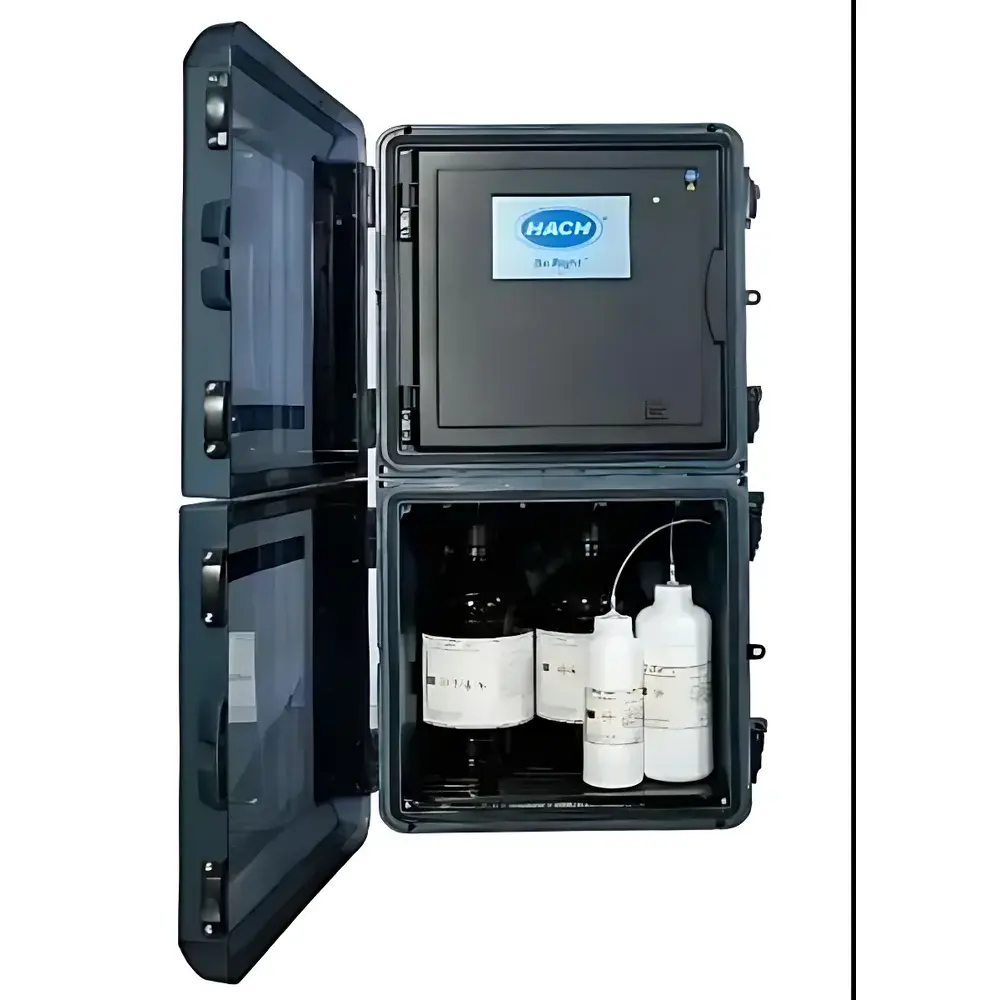
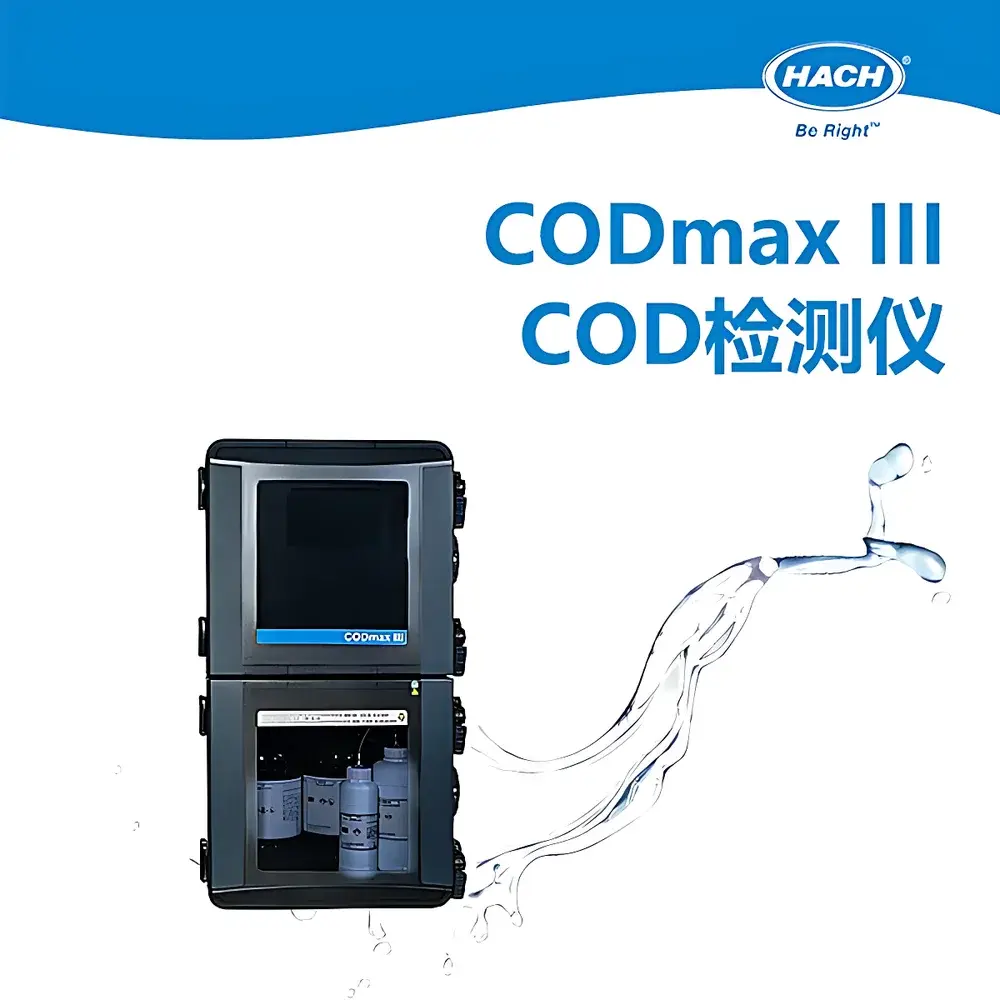
HACH CODmaxIII Online COD Analyzer (Dichromate Method)
| Brand | HACH |
|---|---|
| Origin | Imported |
| Manufacturer Type | Manufacturer |
| Model | CODmaxIII |
| Price | Upon Request |
Overview
The HACH CODmaxIII Online COD Analyzer is a fully automated, laboratory-grade instrument engineered for continuous, regulatory-compliant chemical oxygen demand (COD) monitoring in wastewater discharge streams. It implements the standardized dichromate oxidation method—specifically aligned with U.S. EPA Method 410.4 and Chinese national standard HJ 377-2019—wherein water samples undergo high-temperature digestion (165 °C, 20 min) in acidic medium with potassium dichromate as the oxidant, followed by photometric quantification of the reduced Cr3+ at 600 nm. Designed for compliance with HJ 35X-2019 series standards—including HJ 353 (installation), HJ 354 (acceptance), HJ 355 (operation), and HJ 356 (data validity)—the CODmaxIII delivers trace-level accuracy down to 10 mg/L COD, making it especially suited for municipal effluent monitoring where concentrations frequently fall below 30 mg/L (e.g., Class I-A discharge per GB 18918-2002). Its robust architecture eliminates manual intervention while maintaining metrological equivalence to reference lab methods (HJ 828-2017).
Key Features
- Regulatory-compliant dichromate digestion system operating at 165 °C for 20 minutes, ensuring full oxidation of refractory organics
- Multi-stage optical metering system enabling precise low-range quantification (10–5000 mg/L COD) with enhanced photometric stability
- Integrated standard solution verification (SSV) function—performs automated 24-hour interval checks using certified reference materials (e.g., 20, 75, and 100 mg/L COD standards) with real-time deviation reporting
- Auto-calibration triggered upon SSV failure or scheduled intervals (configurable up to 7 days), meeting HJ 35X-2019 mandatory requirements
- HACH Prognosys predictive diagnostics and Diagnose self-diagnostic suite—monitors critical subsystems (pump wear, heater performance, optical path integrity) and issues maintenance alerts prior to functional degradation
- Chloride tolerance up to 5000 mg/L Cl−, minimizing interference in saline or industrial-influenced wastewater
- Anti-fouling measurement protocol—optimized fluidic sequencing and thermal purging reduce fouling on sampling lines, metering cells, and digestion chambers; field data show no required cleaning of metering tubing over 3-month continuous operation
Sample Compatibility & Compliance
The CODmaxIII accepts raw or filtered wastewater samples from municipal effluents, industrial discharges, and combined sewer overflows without pre-dilution within its native range. It complies with ISO/IEC 17025:2017 principles for measurement uncertainty management and supports audit-ready documentation per GLP and GMP frameworks. All calibration, verification, and maintenance events are timestamped and logged with user ID attribution—fully compatible with FDA 21 CFR Part 11 electronic record and signature requirements when deployed with HACH SCADA-integrated data servers. Instrument validation protocols align with ASTM D1252 (Parts A & B) and EN 15337-2 for online water quality analyzers.
Software & Data Management
The embedded firmware supports Modbus TCP/IP, Profibus DP, and 4–20 mA analog output for seamless integration into plant DCS/SCADA systems. HACH Insight™ web-based platform provides remote configuration, real-time trend visualization, alarm management (with configurable thresholds for SSV error, calibration drift, and digester timeout), and automated report generation (daily/weekly/monthly compliance summaries). All measurement data—including raw absorbance values, temperature logs, reagent consumption counters, and diagnostic flags—are stored locally for ≥90 days and exportable in CSV or PDF formats compliant with HJ 356-2019 data archiving mandates.
Applications
- Municipal wastewater treatment plant final effluent monitoring (e.g., Class I-A discharge per GB 18918-2002)
- Industrial park centralized wastewater discharge portals requiring HJ 35X-2019 conformance
- Environmental monitoring stations performing source tracking and load allocation studies
- Pre-treatment verification at industrial influent points subject to local discharge permits
- Research facilities validating advanced oxidation or membrane bioreactor performance via high-frequency COD trending
FAQ
Does the CODmaxIII meet HJ 35X-2019 requirements for automatic standard verification and auto-calibration?
Yes. It performs scheduled standard solution verification every 24 hours and initiates automatic recalibration if verification results exceed ±10% tolerance—fully satisfying HJ 354-2019 Section 6.2.2 and HJ 355-2019 Section 5.3.2.
What is the lowest detectable COD concentration with documented accuracy?
The instrument maintains ≤10% relative standard deviation at 10 mg/L COD under routine operational conditions, verified against HJ 828-2017 reference measurements.
How does the anti-fouling mode extend maintenance intervals?
By modulating flow velocity, introducing periodic thermal flush cycles during idle periods, and optimizing reagent-to-sample ratio, the system minimizes precipitate adhesion in metering capillaries and digestion reactors—reducing required cleaning frequency by >80% compared to prior-generation models.
Can the CODmaxIII operate reliably in high-chloride wastewater?
Yes. Its digestion chemistry incorporates mercury sulfate masking agents and algorithmic chloride correction, enabling stable operation up to 5000 mg/L chloride without manual interference or dilution.
Is remote firmware update and diagnostic support available?
Yes. Over-the-air updates and secure remote troubleshooting are supported via HACH’s authorized service portal, with role-based access control and encrypted data transmission compliant with IEC 62443-3-3 cybersecurity standards.






