
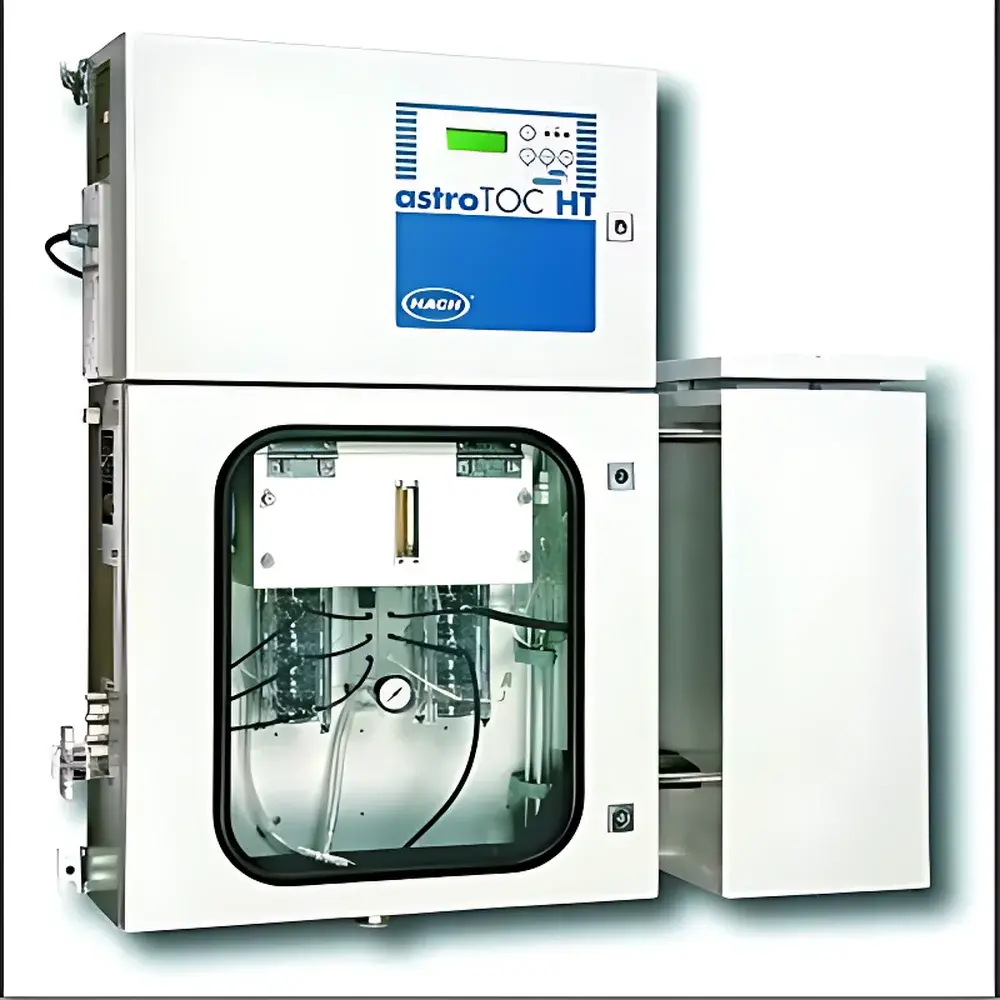
HACH AstroTOC™ HT Online Total Organic Carbon Analyzer
| Brand | HACH |
|---|---|
| Origin | Imported |
| Manufacturer Type | Manufacturer |
| Instrument Type | Online TOC Analyzer |
| Model | AstroTOC™ HT |
| Oxidation Method | High-Temperature Catalytic Combustion (Pt-catalyzed, 680 °C) |
| Measurement Range | 0–25 mg/L to 0–20,000 mg/L TOC |
| Accuracy | ±5% of reading (≤1000 mg/L, undiluted, 25 °C) |
| Detection Limit | <0.1 mg/L (at 0–25 mg/L range, 25 °C) |
| Repeatability | ±5% of reading (≤1000 mg/L) or ±2% (2000–20,000 mg/L), undiluted, 25 °C |
| Response Time (T₉₀) | <8 minutes |
| Sample Flow Rate | 20–200 mL/min |
| Sample Temperature Range | 2–70 °C |
| Operating Ambient Temperature | 5–40 °C |
| Inlet Pressure | 0.15–6 bar |
| Power Supply | 115/230 VAC, 50/60 Hz, max. 1500 W |
| Enclosure Rating | IP54 / NEMA 12 |
| Dimensions (H×W×D) | 983 × 973 × 244 mm |
| Weight | 97 kg |
| Certifications | CE, UL 61010-1, CSA C22.2 No. 61010-1 |
| Carrier Gas | CO₂-free air or nitrogen, 2.8–6.2 bar |
Overview
The HACH AstroTOC™ HT Online Total Organic Carbon Analyzer is an industrial-grade, high-temperature catalytic combustion (HTCC) system engineered for continuous, real-time TOC monitoring in demanding wastewater and process water streams. It employs a patented large-volume combustion furnace operating at 680 °C with a high-surface-area platinum catalyst to achieve complete oxidation of refractory organic compounds—including humic substances, polymers, and chlorinated organics—without chemical oxidants or UV lamps. Unlike persulfate-based or low-temperature combustion analyzers, the AstroTOC™ HT delivers robust performance across wide concentration ranges (0–25 mg/L to 0–20,000 mg/L TOC) while maintaining trace-level sensitivity (<0.1 mg/L LOD) and minimizing maintenance intervals. Its design prioritizes operational resilience in harsh environments—such as chemical manufacturing, pharmaceutical effluent treatment, power plant blowdown, and semiconductor ultrapure water recirculation—where particulate load, temperature fluctuation, and variable pH are common.
Key Features
- High-Temperature Catalytic Combustion (HTCC) System: A proprietary 680 °C furnace with extended residence time and optimized Pt-catalyst geometry ensures >99% oxidation efficiency for diverse organic matrices, including non-volatile and thermally stable compounds.
- Large-Volume Combustion Chamber: Reduces coking and fouling risk by accommodating particulate-laden or viscous samples; extends service intervals between maintenance cycles without compromising accuracy.
- Integrated Acidification & TIC Removal: Automated two-step acid-purge sequence eliminates inorganic carbon interference prior to combustion, eliminating need for separate sparging modules or manual calibration adjustments.
- Non-Dispersive Infrared (NDIR) Detection: Dual-beam NDIR sensor provides linear, drift-stable CO₂ quantification with high signal-to-noise ratio across full dynamic range—no photometric drift or lamp replacement required.
- Active Sample Cooling Loop: Maintains consistent sample temperature entering the oxidation chamber independent of ambient or inlet water fluctuations—critical for reproducible combustion kinetics and measurement stability.
- Comprehensive Self-Diagnostic Architecture: Monitors critical subsystems—including carrier gas pressure, furnace temperature ramp rate, NDIR baseline stability, and valve actuation timing—and initiates protective shutdown if out-of-spec conditions are detected.
Sample Compatibility & Compliance
The AstroTOC™ HT accepts raw, unfiltered industrial wastewater with suspended solids up to 100 mg/L and operates reliably across pH 2–12. Its 1/4″ OD stainless steel fluidic path resists corrosion from halogenated solvents, acids, and caustic cleaners. The analyzer complies with international regulatory frameworks governing environmental monitoring and process validation: it meets ASTM D7573 (Standard Test Method for Total Organic Carbon in Water by High Temperature Catalytic Oxidation), EPA Method 415.1, and Standard Methods 5310B. Its dual 4–20 mA analog outputs and MODBUS RTU (RS485) interface support integration into DCS/SCADA systems compliant with ISA-88 and ISA-95. For regulated industries, audit-trail-capable data logging (via optional HACH DataStream™ software) supports 21 CFR Part 11 compliance when deployed with electronic signature and user access control configurations.
Software & Data Management
The AstroTOC™ HT includes embedded firmware with configurable alarm logic (five independent SPDT relays), auto-ranging capability, and programmable output mapping (TOC concentration, system status, or fault codes). Optional HACH DataStream™ software enables remote configuration, trend analysis, event-driven report generation, and secure export in CSV or PDF formats. All calibration events, diagnostic logs, and alarm triggers are timestamped and stored locally with 30-day circular memory. When connected to HACH’s IntelliLink™ cloud platform, users gain role-based web access to real-time dashboards, predictive maintenance alerts, and historical data correlation with co-located parameters (e.g., conductivity, pH, flow).
Applications
- Continuous TOC monitoring in chemical plant wastewater discharge streams prior to municipal sewer release
- Pharmaceutical facility clean-in-place (CIP) rinse water verification per USP and EP 2.2.44
- Power generation cycle chemistry control—monitoring condensate polishers and feedwater TOC excursions
- Electronics industry ultrapure water (UPW) loop surveillance to detect organic leachates from ion exchange resins or piping
- Food & beverage processing line validation—ensuring cleaning agent removal before product contact
- Environmental compliance reporting under EU Urban Wastewater Treatment Directive (91/271/EEC) and U.S. Clean Water Act NPDES permits
FAQ
Does the AstroTOC™ HT require carrier gas conditioning or purification modules?
No—its internal pressure-regulated gas manifold accepts standard CO₂-free compressed air or nitrogen (2.8–6.2 bar) without external scrubbers or moisture traps.
Can the instrument operate unattended for extended periods?
Yes—designed for 7×24 operation with automatic daily zero/span checks, self-diagnostic routines, and configurable alarm escalation via relay or MODBUS.
Is the system compatible with hazardous area classifications?
The base unit is rated IP54/NEMA 12 for general indoor industrial use; explosion-proof enclosures (Class I, Div 1) are available as factory-installed options.
How is calibration verified in-line?
Certified potassium hydrogen phthalate (KHP) or sucrose standards can be introduced via the dedicated calibration port; verification results are logged with metadata including date, operator ID, and deviation from nominal value.
What maintenance tasks are required on a quarterly basis?
Routine inspection of the quartz combustion tube integrity, NDIR optical window cleanliness, and Pt-catalyst visual assessment—no catalyst replacement is needed under normal operation for ≥18 months.







