
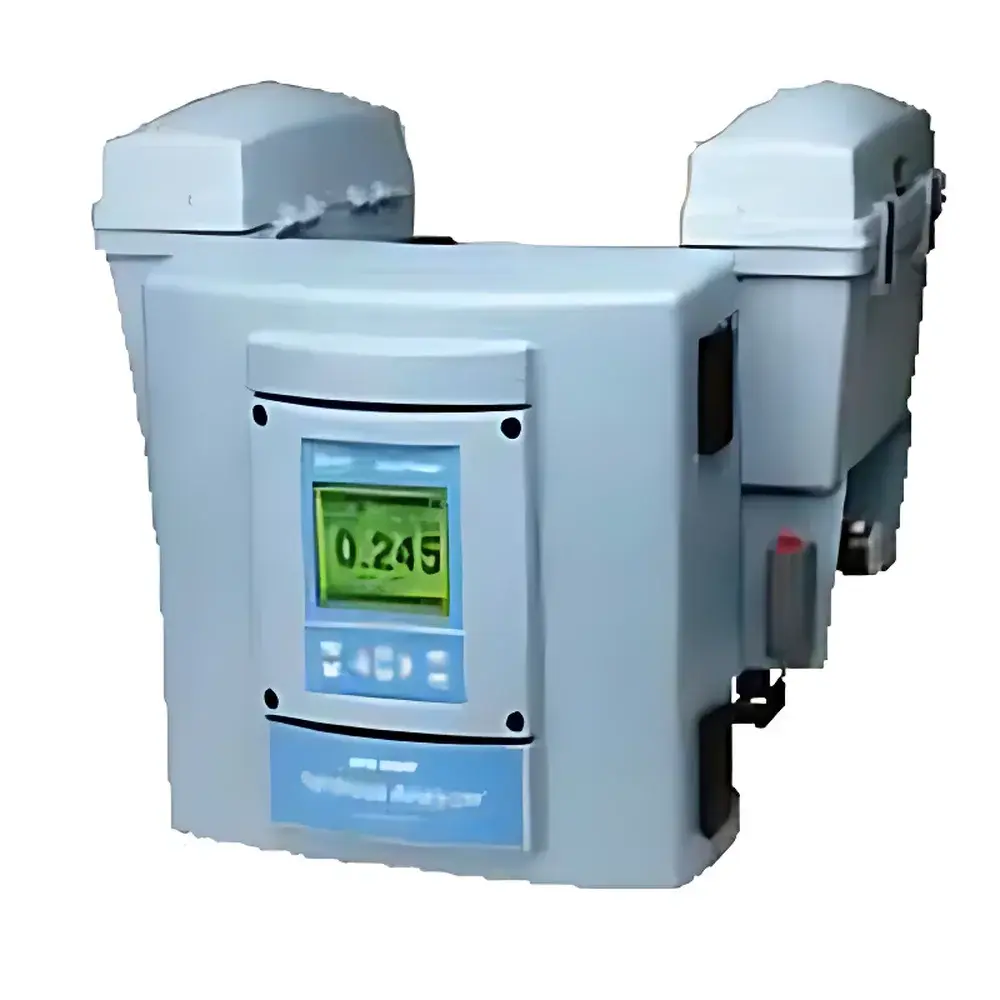
HACH APA6000 Online Hardness Analyzer
| Brand | HACH |
|---|---|
| Model | APA6000 |
| Measurement Principle | Colorimetric EDTA Complexation (USEPA-Approved Method) |
| Low-Range Range | 0.05–10 mg/L as CaCO₃ |
| High-Range Range | 10–1000 mg/L as CaCO₃ |
| Accuracy (Low) | ±5% or ±0.05 mg/L as CaCO₃, whichever is greater |
| Accuracy (High) | ±5% or ±2 mg/L as CaCO₃, whichever is greater |
| Repeatability (Low) | ±3% or ±0.03 mg/L as CaCO₃ |
| Repeatability (High) | ±5% or ±2 mg/L as CaCO₃ |
| T90 Response Time (Low) | ≤5 min |
| T90 Response Time (High) | ≤17 min |
| Cycle Time (Low) | 4 min |
| Cycle Time (High) | 8.2 min |
| Sample Temp. | 5–50 °C |
| Sample Flow Rate | 100–2000 mL/min |
| Inlet Pressure | 0.03–2.04 bar |
| Drain Fitting | 3/4″ NPT |
| Analog Outputs | Dual 4–20 mA (isolated, configurable for hardness or status) |
| Alarm Outputs | Two SPDT relays |
| Certifications | NRTL Listed (UL/CSA), CE Marked |
| Power Supply | 95–240 VAC, 50/60 Hz ±2 Hz |
| Data Storage | 30-day internal logging with timestamped values, trend plotting, and export via serial interface |
Overview
The HACH APA6000 Online Hardness Analyzer is an industrial-grade, fully automated water quality monitoring system engineered for continuous, unattended measurement of total hardness—expressed as calcium carbonate (CaCO₃)—in real time. It employs a validated colorimetric method based on ethylenediaminetetraacetic acid (EDTA) complexation, compliant with U.S. Environmental Protection Agency (USEPA) Method 130.1 for low-range applications. The analyzer operates across two dynamic ranges: a low-range configuration (0.05–10 mg/L CaCO₃) optimized for softened water, boiler feedwater, and ultrapure process streams; and a high-range configuration (10–1000 mg/L CaCO₃) suited for cooling tower makeup, surface water, and municipal distribution systems. Its core architecture integrates precision fluidics, thermally stabilized reaction chambers, and dual-channel capability—enabling simultaneous, independent analysis of two sample streams without cross-contamination.
Key Features
- Fully autonomous operation: automatic reagent dosing, sample aspiration, reaction chamber cleaning, and zero/span calibration—requiring no manual intervention for up to 30 consecutive days.
- Air-insulated thermal management system maintains consistent reaction temperature (±0.5 °C) across ambient variations from 5–50 °C, ensuring stoichiometric accuracy in EDTA–Ca²⁺/Mg²⁺ chelation.
- Minimal reagent and sample consumption per cycle (<15 mL reagent, <50 mL sample), reducing operational cost and eliminating carryover or memory effects between measurements.
- Dual 4–20 mA analog outputs support integration with DCS, SCADA, or PLC systems; each output is independently assignable to hardness value, system status, or diagnostic flag.
- Two programmable SPDT relay outputs provide fail-safe alarm signaling for out-of-range conditions, maintenance alerts, or calibration overdue events.
- Robust mechanical design with NPT-threaded wetted components (3/4″ drain, pressure-rated inlet) ensures compatibility with standard industrial water piping infrastructure.
Sample Compatibility & Compliance
The APA6000 accepts raw, filtered, or clarified aqueous samples within specified physical constraints: inlet pressure 0.03–2.04 bar, flow rate 100–2000 mL/min, and temperature 5–50 °C. It is compatible with potable water, treated wastewater effluent, industrial cooling water, and desalinated feed streams—provided turbidity remains below 5 NTU and suspended solids are non-abrasive. The analyzer meets NRTL safety certification requirements (UL 61010-1, CSA C22.2 No. 61010-1) and carries CE marking for EMC and LVD directives. While not inherently 21 CFR Part 11 compliant, its data logging architecture supports audit-ready traceability when deployed with external validated software platforms adhering to GLP/GMP principles. The low-range method is formally recognized under USEPA Method 130.1; high-range performance aligns with ISO 6059:2022 (Water quality — Determination of hardness — Titrimetric method) for comparative validation.
Software & Data Management
Onboard firmware provides local data storage for 30 days of timestamped hardness readings (minimum 1440 entries/day at 4-min cycle), including raw absorbance, calculated concentration, reagent batch ID, and diagnostic logs. Data export is supported via RS-232 serial interface using ASCII-based Modbus RTU protocol. Internal visualization includes real-time trend graphs, historical comparison overlays, and pass/fail threshold highlighting. Configuration and diagnostics are accessible through a secure web interface (HTTPS) or terminal emulation—supporting password-protected user roles (Operator, Technician, Administrator). All parameter changes, calibration events, and alarm triggers are automatically logged with user ID and timestamp, enabling compliance with internal QA procedures and third-party audit requirements.
Applications
- Monitoring softener breakthrough in ion exchange systems to optimize regeneration cycles and reduce salt consumption.
- Controlling antiscalant dosing in reverse osmosis (RO) pretreatment by providing real-time hardness feedback to PID controllers.
- Ensuring boiler feedwater quality compliance (ASME B31.1, ASTM D1066) through continuous surveillance of Ca²⁺/Mg²⁺ ingress.
- Validating hardness removal efficiency in lime-soda softening plants and membrane filtration facilities.
- Supporting regulatory reporting for surface water intakes under NPDES permits where hardness serves as a surrogate indicator for scaling potential.
- Facilitating predictive maintenance of heat exchangers and condensers in HVAC and power generation facilities.
FAQ
Does the APA6000 require daily operator intervention?
No. Once commissioned and calibrated, the system operates autonomously for up to 30 days—including reagent replenishment, self-cleaning cycles, and automatic calibration—without manual servicing.
Can it measure hardness in seawater or brackish water?
Not recommended. High chloride and sodium concentrations interfere with EDTA complexation kinetics and may accelerate corrosion of internal fluidic components. Use is restricted to freshwater matrices with TDS < 2000 mg/L.
Is remote firmware update supported?
Yes—via secure HTTPS connection using signed firmware packages. Updates preserve all configuration settings and historical logs unless explicitly reset.
How is method verification performed during routine QA?
The analyzer supports bracketing with certified reference materials (CRMs) traceable to NIST SRM 1643e (Hardness Standard). A three-point verification (low/mid/high) is recommended weekly for critical applications.
What maintenance tasks are required beyond reagent replacement?
Annual inspection of peristaltic pump tubing, optical window cleaning, and verification of relay contact resistance per manufacturer’s Preventive Maintenance Schedule (PMS-APA6000 Rev. D).







