
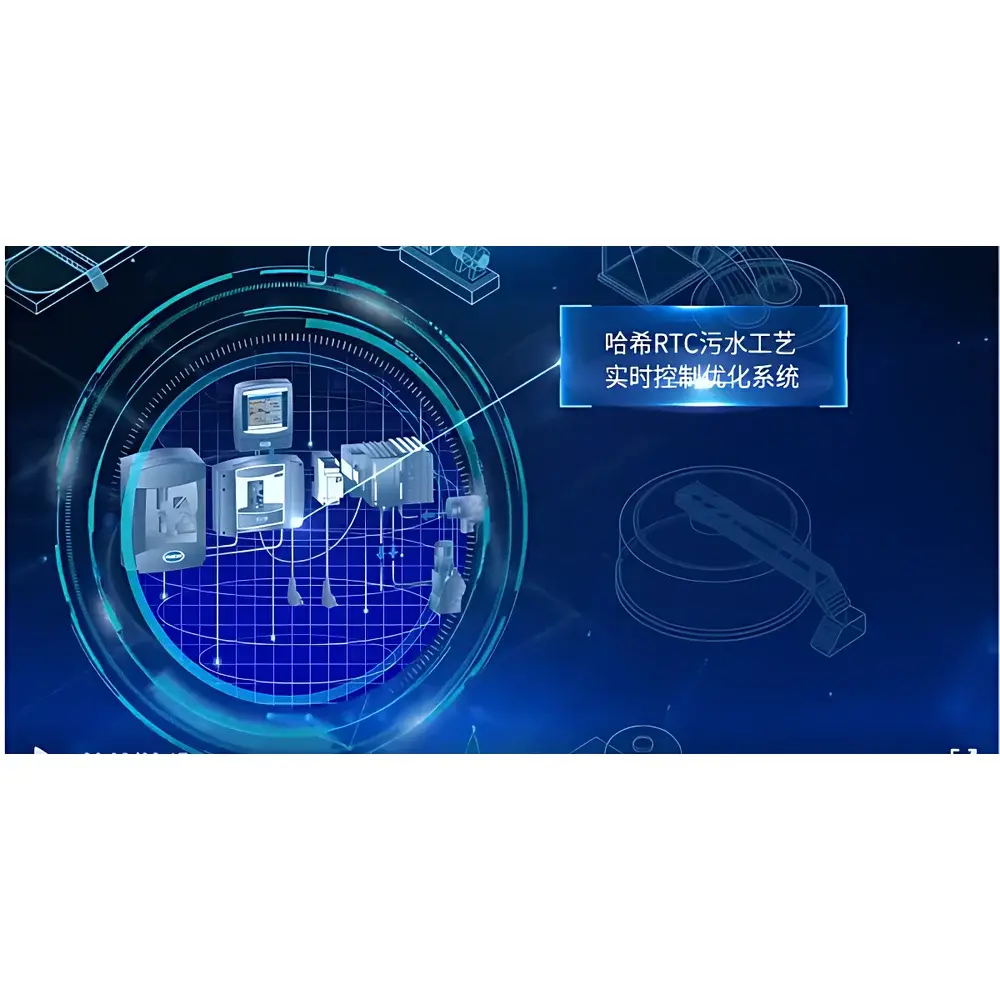
HACH RTC Wastewater Treatment Real-Time Control System
| Brand | HACH |
|---|---|
| Origin | Imported |
| Manufacturer | HACH Company |
| Model | RTC |
| Pricing | Available Upon Request |
Overview
The HACH RTC Wastewater Treatment Real-Time Control System is an advanced, model-based process optimization platform engineered for municipal and industrial wastewater treatment plants. Built upon HACH’s portfolio of certified online analyzers—including ammonium, nitrate, phosphate, dissolved oxygen, pH, ORP, turbidity, and flow sensors—the RTC system implements closed-loop, dynamic control logic grounded in first-principles process modeling and adaptive mathematical algorithms. Unlike conventional SCADA-based monitoring or fixed-setpoint controllers, RTC continuously interprets real-time multivariate sensor data to adjust actuator commands (e.g., blower speed, return activated sludge rate, chemical dosing pumps) in response to hydraulic and organic load fluctuations. This enables compliant effluent quality under variable influent conditions while minimizing energy consumption, chemical usage, and operational labor.
Key Features
- Real-time adaptive control architecture integrating dynamic biokinetic and hydraulics models calibrated to site-specific plant configuration and historical performance data
- Seamless integration with HACH’s ISO/IEC 17025-accredited online instrumentation—ensuring traceable, metrologically sound input signals
- Modular software design supporting phased deployment: from single-unit optimization (e.g., aeration basin control) to full-plant coordinated control
- Embedded fault detection and diagnostics (FDD) engine that identifies sensor drift, actuator saturation, or model mismatch and triggers automated alerts or graceful degradation modes
- Robust cybersecurity framework compliant with IEC 62443-3-3 Level 2 requirements, including role-based access control, encrypted communications (TLS 1.2+), and audit logging
- Pre-validated control logic modules aligned with widely adopted regulatory frameworks—including EPA’s Clean Water Act compliance benchmarks and EU Urban Wastewater Treatment Directive (91/271/EEC) reporting thresholds
Sample Compatibility & Compliance
The RTC system does not perform direct sample analysis; rather, it functions as a supervisory control layer dependent on validated input from upstream online analyzers. All integrated HACH sensors comply with relevant international standards, including ISO 7027 (turbidity), ISO 5814 (dissolved oxygen), EN 27888 (pH), and ASTM D1293 (pH in water). The system architecture supports data integrity requirements under FDA 21 CFR Part 11 when deployed in regulated environments (e.g., pharmaceutical wastewater pretreatment), providing electronic signatures, audit trails, and data retention policies configurable per GLP/GMP protocols. RTC-generated operational reports meet ISO 14064-1 greenhouse gas accounting criteria for energy-related emissions tracking.
Software & Data Management
RTC operates on a Linux-based industrial server platform with redundant storage and hot-swappable power supplies. Its web-native interface—accessible via secure HTTPS—provides real-time dashboards, historical trend analysis, and customizable KPI visualization (e.g., specific energy consumption kWh/kg BOD removed, nitrification efficiency %, compliance margin vs. permit limits). All control decisions are timestamped, version-controlled, and archived with SHA-256 hash verification. Data export supports CSV, OPC UA, and MQTT protocols for enterprise-level integration with CMMS (e.g., IBM Maximo), ERP systems (e.g., SAP), or cloud analytics platforms. Software updates undergo rigorous regression testing and are delivered through digitally signed firmware packages with rollback capability.
Applications
- Optimization of nitrogen removal in activated sludge processes via dynamic DO and nitrate setpoint modulation
- Energy-efficient aeration control across oxidation ditches, MBRs, and SBR configurations
- Phosphorus removal enhancement through intelligent coagulant dosing synchronized with real-time orthophosphate measurements
- Stormwater-influenced flow balancing using predictive inflow forecasting and wet-weather storage coordination
- Regulatory compliance assurance for NPDES permits, particularly for ammonia, total nitrogen, and TSS discharge limits
- Supporting ISO 50001-certified energy management systems through quantifiable energy savings reporting
FAQ
What hardware infrastructure is required to deploy RTC?
RTC requires a dedicated industrial server (minimum 8 GB RAM, 256 GB SSD, dual NIC), redundant UPS, and network connectivity to existing PLCs, DCS, and HACH online analyzers via Modbus TCP, Profibus DP, or OPC UA.
Can RTC be retrofitted into legacy wastewater plants?
Yes—RTC is designed for brownfield integration. It interfaces with most major PLC brands (Siemens, Rockwell, Schneider) without requiring replacement of field instrumentation or primary control systems.
Is model calibration performed onsite or remotely?
Initial model parameterization uses historical SCADA data; final tuning is conducted onsite by HACH-certified process engineers during commissioning, with optional remote support via secure VNC session.
Does RTC support third-party sensors?
RTC accepts analog (4–20 mA) and digital (Modbus, HART) inputs from non-HACH devices, though full performance validation and warranty coverage apply only to HACH-specified instrument configurations.
How frequently is the control model updated?
The core biokinetic model remains static post-commissioning; however, adaptive learning parameters (e.g., decay coefficients, yield factors) are recalculated hourly using recursive least squares estimation based on real-time residuals.



