
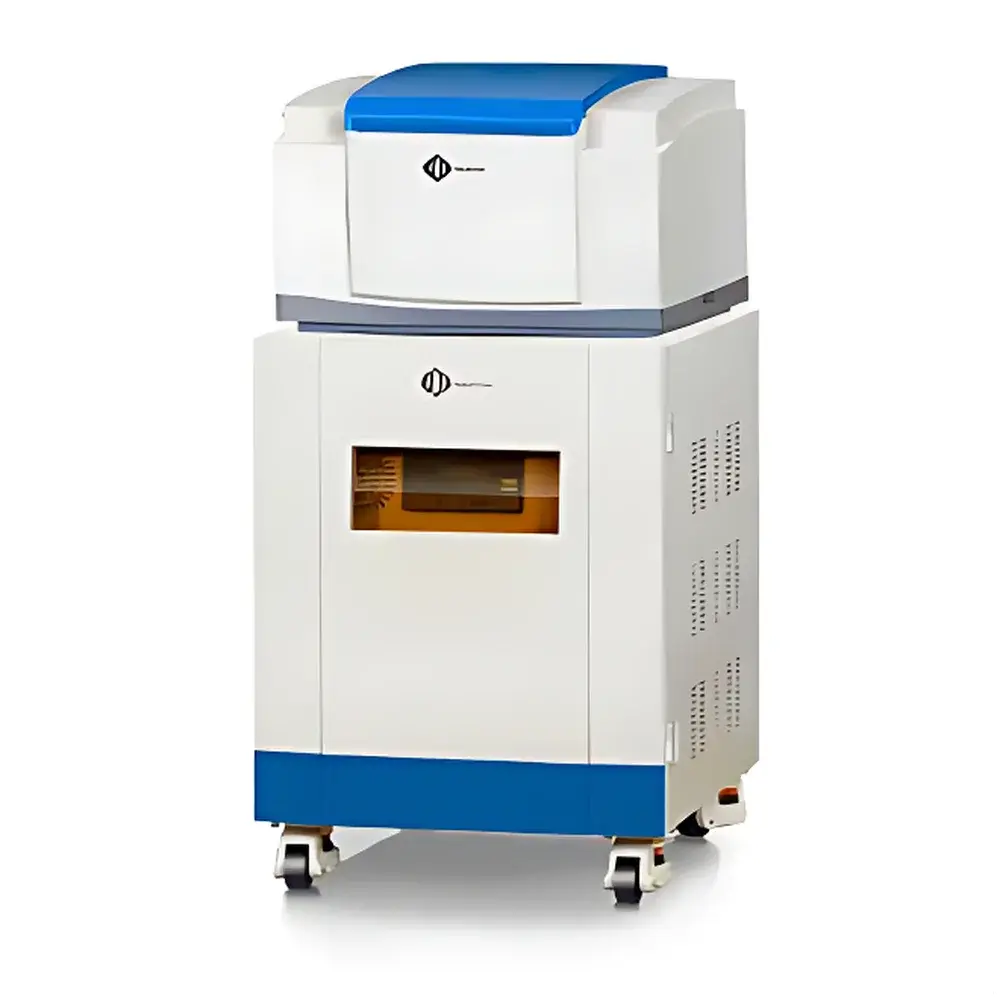
NIUMAG PQ001-1 Benchtop Low-Field NMR Oil Content Analyzer for Seeds
| Brand | NIUMAG |
|---|---|
| Origin | Jiangsu, China |
| Manufacturer Type | Authorized Distributor |
| Country of Origin | China |
| Model | PQ001-1 |
| Pricing | Upon Request |
| Magnet Type | Permanent Magnet |
| Magnetic Field Strength | 0.5 ± 0.08 T |
| Larmor Frequency | 21.3 MHz |
| Probe Coil Diameter | 25 mm |
Overview
The NIUMAG PQ001-1 is a compact, benchtop low-field nuclear magnetic resonance (LF-NMR) analyzer engineered specifically for rapid, non-destructive quantification of oil and moisture content in intact seeds. Operating at a fixed Larmor frequency of 21.3 MHz—corresponding to a static magnetic field of 0.5 ± 0.08 T—the instrument leverages the transverse relaxation behavior (T₂ decay) of hydrogen protons in triglyceride and water molecules to differentiate and quantify oil and water phases without chemical extraction or sample destruction. Unlike conventional gravimetric or solvent-based methods, this system requires no homogenization, drying, or hazardous reagents, making it suitable for routine quality control in seed processing facilities and high-throughput research laboratories. Its one-box modular architecture integrates magnet, probe, RF electronics, and control unit into a single stabilized platform, enabling deployment in industrial environments with moderate electromagnetic noise. First commercialized in 2008, the PQ001-1 has been validated across agricultural R&D, breeding programs, and regulatory compliance workflows where speed, reproducibility, and operator safety are critical.
Key Features
- Non-invasive, non-destructive analysis: Enables repeated measurements on the same seed batch or even individual whole seeds (e.g., peanut, soybean, sunflower, rapeseed, sesame, corn, cottonseed) without physical alteration.
- High measurement throughput: Typical analysis time per sample is under 3 minutes—including automatic shimming, frequency tuning, and T₂ acquisition—supporting >100 samples per 8-hour shift.
- Self-locking frequency stabilization: Patented auto-tuning algorithm eliminates manual lock-in procedures; maintains resonance stability despite ambient temperature drift or minor mechanical vibration.
- 25 mm diameter RF probe optimized for heterogeneous seed matrices: Accommodates whole seeds up to 20 mm in longest dimension; supports both bulk sample cups (5–15 g) and custom holders for single-seed positioning.
- Robust electromagnetic interference (EMI) tolerance: Operates reliably near motors, inverters, or other industrial equipment without shielding enclosures.
- Modular configuration flexibility: Optional firmware modules support moisture distribution profiling, solid-fat-content (SFC)-like phase analysis, and multi-component T₂ spectral deconvolution for bound vs. free water discrimination.
Sample Compatibility & Compliance
The PQ001-1 is validated for intact and ground seeds including Arachis hypogaea (peanut), Glycine max (soybean), Zea mays (corn), Brassica napus (rapeseed), Sesamum indicum (sesame), Helianthus annuus (sunflower), Gossypium hirsutum (cottonseed), and Aleurites fordii (tung nut). It complies with ISO 10565:1993 (oilseed—determination of oil and moisture content—reference method using NMR), and supports method validation per AOAC Official Method 999.05 (NMR determination of oil in oilseeds). While not FDA 21 CFR Part 11–certified out-of-the-box, audit-ready data export (CSV, XML) and full electronic log retention enable integration into GLP/GMP-compliant QA systems when deployed with controlled access protocols and documented SOPs.
Software & Data Management
The embedded Windows-based software provides guided workflow navigation, real-time T₂ decay visualization, and automated calibration curve generation using certified reference standards. All raw FID data, processed T₂ spectra, and quantitative reports (oil % w/w, moisture % w/w, T₂₁/T₂₂ ratio) are timestamped and stored locally or exported via USB 2.0 to external drives. Batch reporting supports customizable templates compliant with internal QC documentation requirements. Audit trail functionality records user login, parameter changes, and result exports—enabling traceability required for ISO/IEC 17025 accreditation. No cloud dependency; all computation occurs on-device to ensure data sovereignty and network isolation.
Applications
- Routine oil content screening in seed cleaning, conditioning, and crushing facilities to optimize oil extraction yield.
- Breeding program phenotyping: High-throughput assessment of oil accumulation kinetics across generations of oilseed crops.
- Moisture phase analysis: Discrimination of free water (T₂ > 100 ms) from immobilized/bound water (T₂ < 20 ms) to inform drying protocol design and storage stability prediction.
- Method equivalence studies: Direct comparison against AOAC 920.39 (Soxhlet) or ISO 659 (petroleum ether extraction) for regulatory submission packages.
- Process validation: Monitoring oil loss during thermal treatment, extrusion, or enzymatic hydrolysis without interrupting production lines.
FAQ
How does the PQ001-1 differentiate oil from water signals?
It exploits differences in proton mobility: triglyceride protons exhibit shorter T₂ relaxation times (~10–50 ms) than bulk water protons (~100–1000 ms); multi-exponential T₂ decay fitting separates these components quantitatively.
Can it measure oil content in roasted or heat-treated seeds?
Yes—provided the sample remains physically stable inside the probe; thermal denaturation does not alter hydrogen density or relaxation mechanisms significantly.
Is calibration required for each seed species?
A single universal calibration is insufficient; species-specific calibration curves must be built using at least 15 reference samples with known oil content (e.g., via validated Soxhlet or GC-FID), then stored as selectable assay profiles.
What maintenance is required beyond routine cleaning?
No cryogens or consumables; annual verification of field homogeneity (shim map) and RF coil Q-factor is recommended using NIUMAG’s service toolkit.
Does it comply with international seed trade standards?
Data generated meets the technical acceptability criteria of ISTA Handbook Section 10 (Oil Content Determination) when validated per local regulatory guidance and supported by documented uncertainty budgets.
Related Products





