
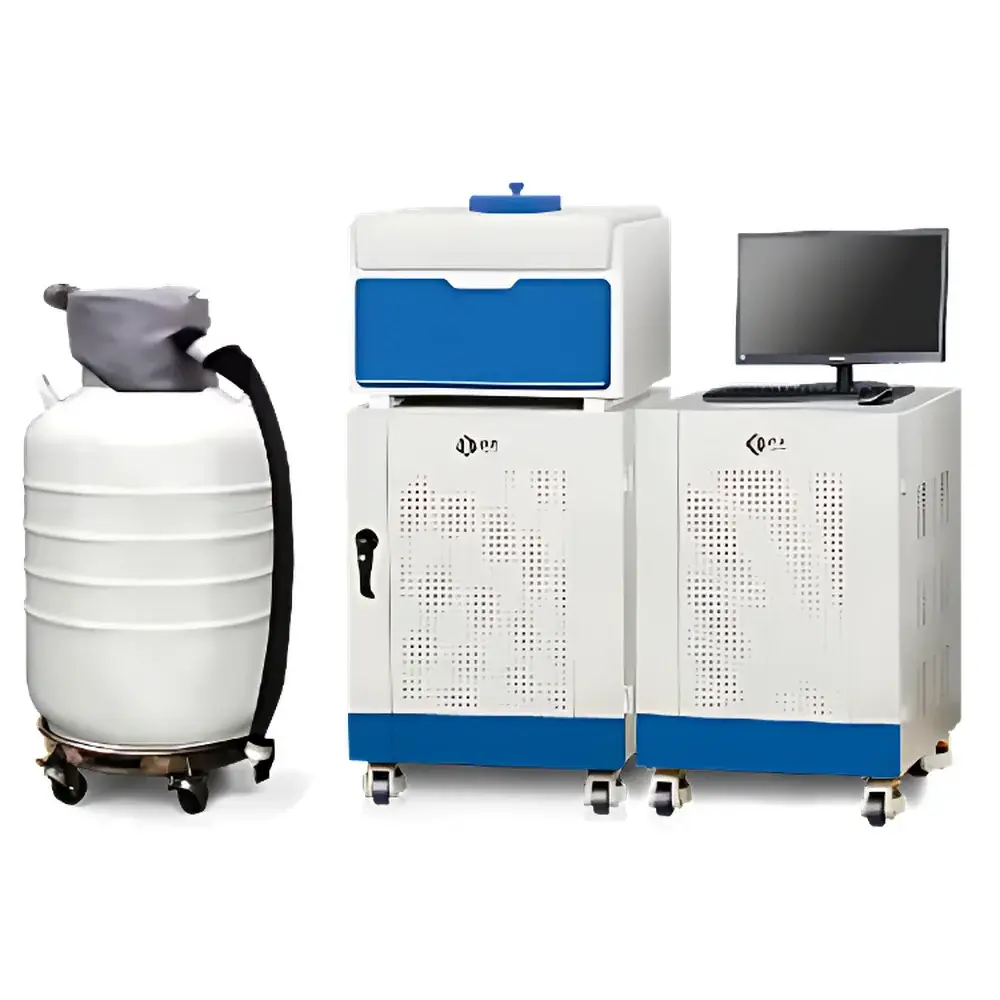
NIUMAG NMRC12 Low-Field Nuclear Magnetic Resonance Nanopore Analyzer
| Brand | NIUMAG |
|---|---|
| Origin | Shanghai, China |
| Manufacturer Type | Authorized Distributor |
| Country of Origin | China |
| Model | NMRC12 |
| Quotation | Available upon Request |
| Magnetic Field Strength | 0.3 ± 0.05 T |
| Temperature Control Range | −30 °C to ambient, stability ±0.1 °C |
| Sample Dimensions | Cylindrical, Ø8 mm × H10 mm |
| Effective Pore Size Range | 4–1400 nm (using OMCTS as saturating fluid) |
| Method Principle | NMR Cryoporometry (NMRC) |
Overview
The NIUMAG NMRC12 Low-Field Nuclear Magnetic Resonance Nanopore Analyzer is an engineered solution for quantitative characterization of pore size distribution in heterogeneous porous solids using NMR cryoporometry (NMRC). Unlike gas adsorption techniques, NMRC relies on the depression of freezing point of a confined liquid—typically octamethylcyclotetrasiloxane (OMCTS)—within nanopores, where thermodynamic constraints shift the solid–liquid phase transition temperature inversely with pore diameter. By acquiring temperature-resolved 1H NMR signal intensity during controlled cooling and warming cycles, the instrument reconstructs differential pore volume vs. pore radius distributions with high physical fidelity. Operating at a stable 0.3 T field, the system delivers robust signal-to-noise performance optimized for routine laboratory use in geoscience, materials science, and industrial R&D environments. Its low-field architecture eliminates the need for cryogenic magnets or superconducting infrastructure, reducing operational complexity and total cost of ownership.
Key Features
- Integrated high-stability temperature control module with ±0.1 °C precision across −30 °C to ambient range, enabling reproducible thermal ramping protocols essential for NMRC quantification.
- Dedicated low-field permanent magnet system (0.3 ± 0.05 T) designed for long-term field homogeneity and minimal drift—critical for multi-cycle thermal NMR experiments.
- Optimized RF probe geometry accommodating standard cylindrical samples (Ø8 mm × 10 mm), ensuring uniform excitation and reception across typical rock core, wood, and ceramic specimens.
- Non-destructive, solvent-free analysis—no vacuum systems, no nitrogen or helium consumption, and zero sample preparation beyond saturation with OMCTS.
- Compliance-ready architecture supporting audit trails, user access levels, and electronic signature functionality aligned with GLP and GMP documentation requirements.
Sample Compatibility & Compliance
The NMRC12 accommodates a broad class of rigid and semi-rigid porous media, including sedimentary rock cores (sandstone, shale, carbonate), fired ceramics, catalyst supports, bio-based foams, and hygroscopic natural materials such as timber and plant tissues. Samples must be fully saturated with OMCTS—a non-polar, low-melting-point liquid with well-characterized surface interactions and negligible chemical reactivity toward siliceous or carbonaceous matrices. The technique is inherently insensitive to surface chemistry artifacts common in gas adsorption (e.g., micropore filling hysteresis, functional group interference), making it especially suitable for water-wet or chemically heterogeneous systems. NMRC data generation adheres to principles outlined in ISO 15901-3 (2016) for mercury intrusion and cryoporometric pore analysis, and supports traceable calibration against NIST-traceable reference standards.
Software & Data Management
The proprietary NMRC Analysis Suite provides full workflow automation—from thermal protocol definition and real-time FID acquisition to baseline-corrected melting curve deconvolution and pore size distribution derivation via Gibbs–Thomson transformation. All raw time-domain data (FIDs), processed spectra, and derived distributions are stored in HDF5 format with embedded metadata (temperature, pulse sequence, coil loading, operator ID). Software supports 21 CFR Part 11-compliant electronic records: role-based login, immutable audit logs, and configurable report templates exportable to PDF or CSV. Batch processing mode enables comparative analysis across sample sets, while spectral overlay tools facilitate identification of multimodal pore populations and inter-sample heterogeneity.
Applications
- Geoscience & Petroleum Engineering: Quantitative evaluation of pore throat connectivity, clay-bound water content, and kerogen-hosted nanoporosity in unconventional reservoir rocks.
- Materials Science: Validation of pore architecture in templated mesoporous silica, MOFs, and aerogels under native hydration states.
- Forestry & Biomaterials: In-situ assessment of cell wall porosity and bound-water mobility in hardwoods, softwoods, and engineered biocomposites.
- Building Materials: Monitoring pore evolution during cement hydration, carbonation, or freeze–thaw cycling without drying artifacts.
- Quality Control: Routine batch verification of pore uniformity in filtration membranes, battery electrode coatings, and pharmaceutical excipients.
FAQ
How does NMRC differ from nitrogen physisorption (BET/BJH)?
NMRC measures pore size based on thermodynamic confinement effects in saturated pores, avoiding assumptions about adsorption layer thickness or pore geometry. It directly resolves pore volumes across the 4–1400 nm range without requiring Kruk–Jaroniec–Sayari (KJS) corrections or slit/cylinder model selection.
Can NMRC analyze wet or partially saturated samples?
Yes—NMRC requires only full saturation with OMCTS; residual moisture or aqueous phases do not interfere, provided they are immiscible and do not displace the saturant.
Is calibration required before each measurement?
A single temperature calibration using a reference standard (e.g., pure OMCTS) is performed during system qualification; subsequent runs rely on internal Pt100 sensor validation with automated drift compensation.
What safety certifications does the NMRC12 hold?
The instrument complies with IEC 61010-1:2010 for electrical safety and IEC 61326-1:2013 for EMC; CE marking is affixed for EU market deployment.
Can NMRC data be integrated into LIMS or ELN platforms?
Yes—the software exposes RESTful API endpoints for structured data export and supports direct integration with major laboratory informatics systems via ASTM E1578-compliant metadata schemas.



