
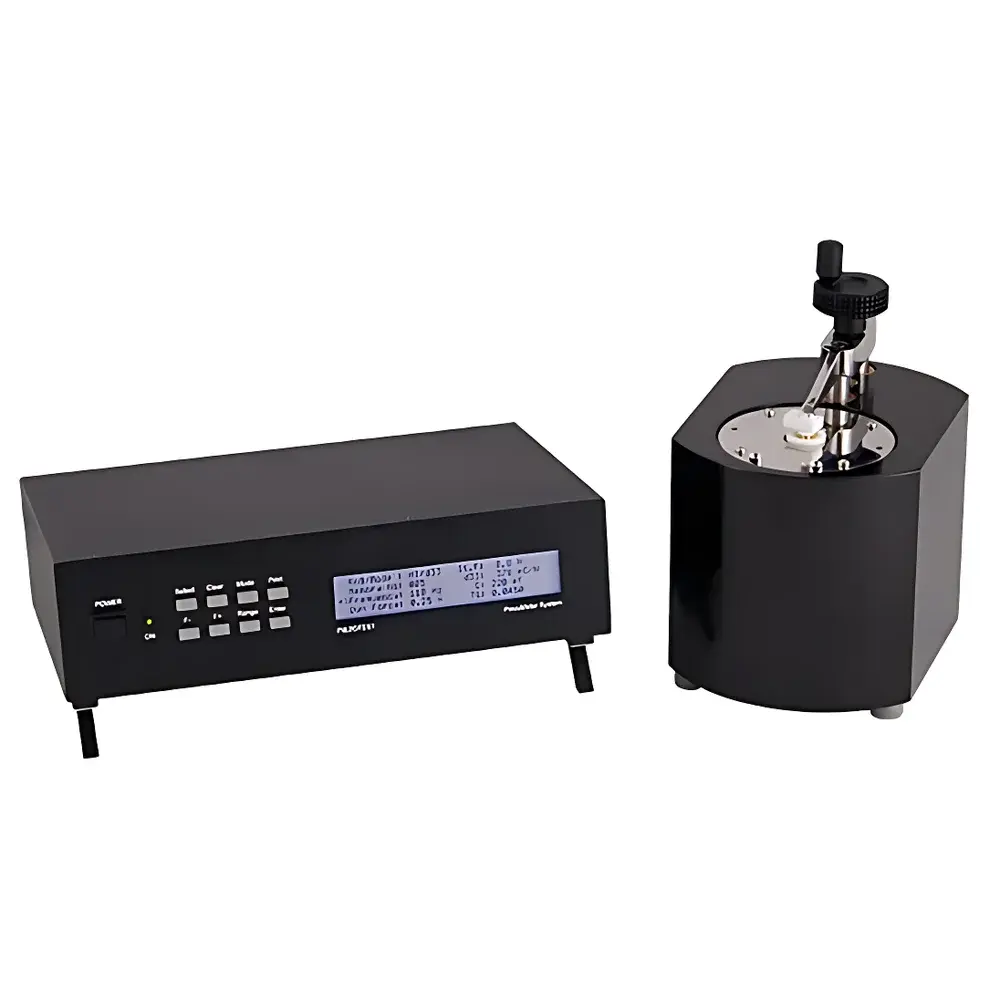
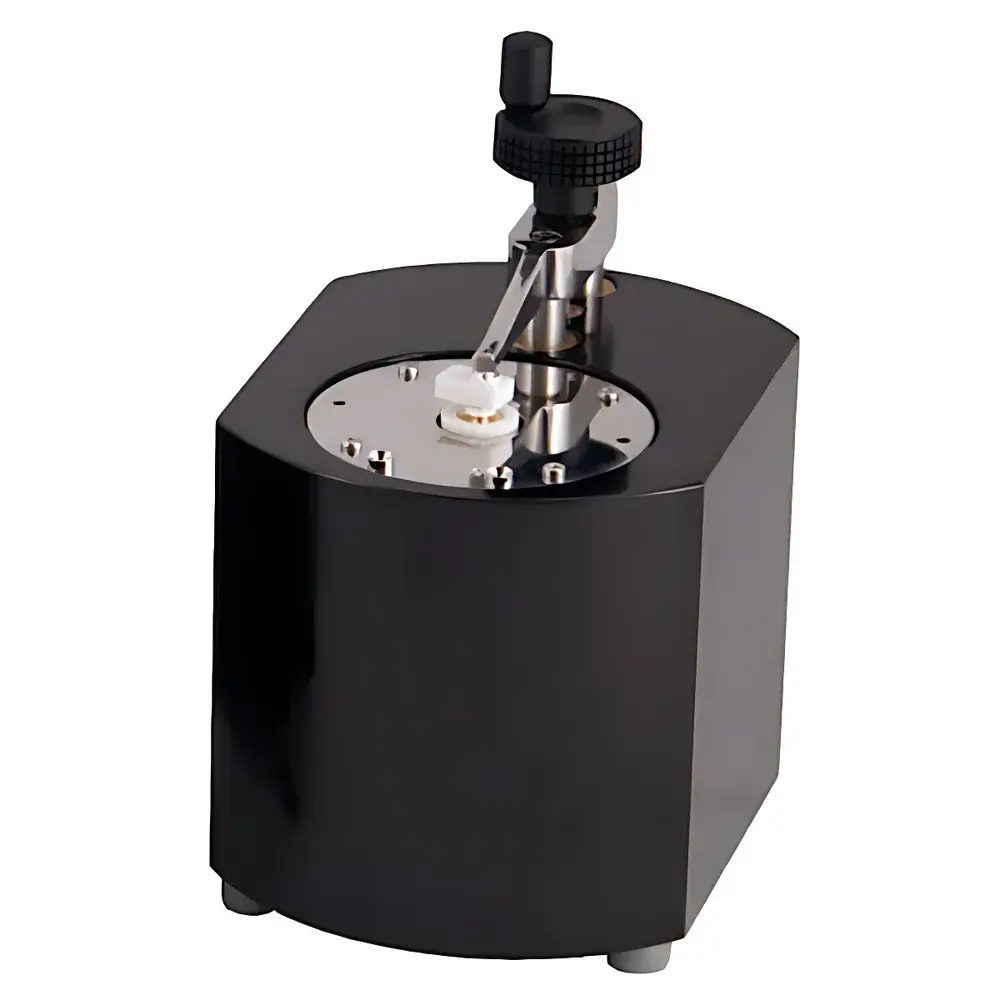
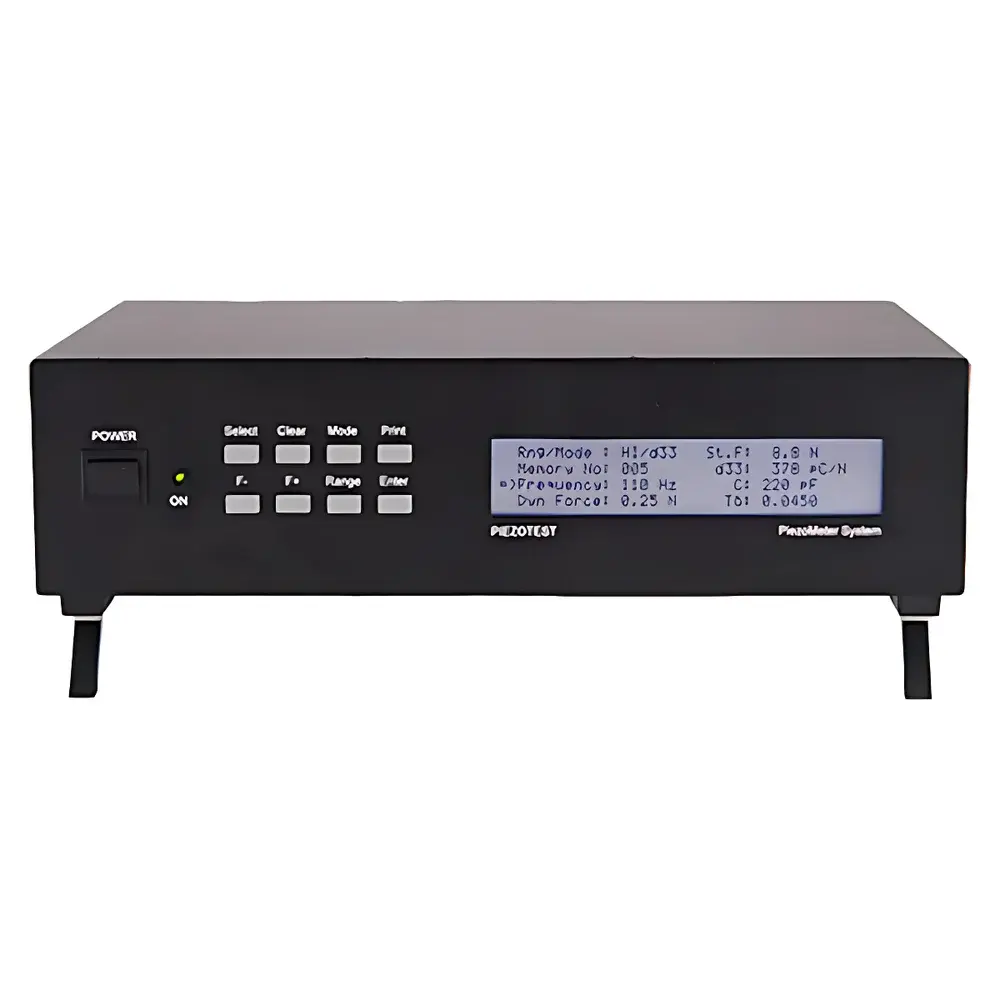
Piezotest PM300 Precision Piezoelectric Coefficient Tester
| Brand | Piezotest |
|---|---|
| Origin | Singapore |
| Model | PM300 |
| d₃₃ Range | 0–10,000 pC/N |
| Resolution | 0.01 pC/N (lowest range) |
| Adjustable Static Force | 0–10 N |
| Dynamic Force | 0.05–0.5 N |
| Test Frequency | 30–300 Hz (1 Hz step, calibrated at 110 Hz) |
| Capacitance Measurement | 10 pF–0.1 µF |
| Loss Tangent (tan δ) | 0.0000–0.2000 |
| Max Sample Dimensions | Ø136 mm × 50 mm (polarization direction) |
| Max Sample Weight | 1 kg |
| Compliance | ASTM D790, IEC 62047-18, ISO 6722 (referenced for piezoelectric characterization) |
Overview
The Piezotest PM300 Precision Piezoelectric Coefficient Tester is a laboratory-grade instrument engineered for quantitative electromechanical characterization of piezoelectric materials under controlled quasi-static and dynamic loading conditions. It operates on the direct piezoelectric effect principle—measuring charge displacement (in picocoulombs) per unit applied mechanical stress (in newtons)—to determine key piezoelectric coefficients including d₃₃, d₃₁, and d₁₅. The system employs a dual-force actuation architecture: a precision-adjustable static pre-load (0–10 N) ensures optimal mechanical contact and polarization alignment, while a superimposed sinusoidal dynamic force (0.05–0.5 N, 30–300 Hz) enables frequency-resolved response acquisition. Calibration is traceable to NIST-traceable reference standards via built-in 110 Hz excitation, supporting compliance with international testing protocols such as IEC 62047-18 (Micro-electromechanical systems — Part 18: Piezoelectric property measurement methods) and ASTM D790 (flexural properties of plastics, adapted for ceramic and thin-film bending-mode validation).
Key Features
- Four selectable d₃₃ measurement ranges (0–10, 1–100, 10–1000, 100–10,000 pC/N), each optimized for resolution and linearity—down to 0.01 pC/N in the lowest range
- Integrated polarization direction identification module, enabling rapid verification of crystallographic orientation prior to measurement
- Simultaneous acquisition of d₃₃, d₃₁, d₁₅ (with optional adapters), capacitance (C), and dielectric loss tangent (tan δ)
- Derived parameter calculation engine: automatically computes g-coefficients (g₃₃, g₃₁, g₁₅), relative permittivity (εT₃₃), and coupling factors (k₃₃, k₃₁) using standardized IEEE/IEC definitions
- Dual-control operation: real-time test execution and result visualization via dedicated front-panel controller or PC-based software interface
- Modular hardware design supports field-upgradable functionality—including optional d₃₁ and d₁₅ test kits, digital force feedback display, and over-load warning indicators
Sample Compatibility & Compliance
The PM300 accommodates a broad spectrum of piezoelectric specimens: sintered PZT and PLZT ceramics (discs, plates, rings), sol-gel and sputtered thin films (on Si, glass, or flexible substrates), PVDF and copolymer films (thickness ≥5 µm), and emerging relaxor-ferroelectric single crystals (e.g., PMN-PT). Maximum sample dimensions are Ø136 mm × 50 mm (along polarization axis); maximum mass is 1 kg. All mechanical and electrical interfaces comply with IEC 61000-4 electromagnetic compatibility standards. Data integrity meets GLP/GMP documentation requirements: audit trails, user access control, and electronic signature support are implemented in firmware and validated software versions. Instrument calibration procedures align with ISO/IEC 17025 guidelines for testing laboratories.
Software & Data Management
The proprietary PiezoSoft v4.x platform provides full instrument control, real-time waveform monitoring, and post-processing analytics. It supports automated multi-point mapping across sample surfaces, batch processing of up to 99 samples per session, and export of raw time-series data (CSV, HDF5) for third-party analysis (MATLAB, Python, Origin). Software includes built-in uncertainty propagation modules compliant with GUM (Guide to the Expression of Uncertainty in Measurement) principles. Electronic records adhere to FDA 21 CFR Part 11 requirements when configured with password-protected user roles, timestamped audit logs, and non-erasable result archives. Firmware updates are delivered via secure HTTPS channel with cryptographic signature verification.
Applications
The PM300 serves critical R&D and QA/QC functions across multiple sectors: development of high-sensitivity acoustic transducers (naval sonar arrays, medical ultrasound probes), qualification of energy-harvesting composites for IoT sensor nodes, reliability screening of MEMS piezoelectric actuators (inkjet printheads, adaptive optics), and metrology of ferroelectric domain-engineered thin films for non-volatile memory applications. Its low-noise charge amplification and adaptive gain switching make it particularly suitable for characterizing low-d₃₃ materials (<10 pC/N), such as lead-free KNN-based ceramics and bio-piezoelectric polymers—where conventional testers lack sufficient sensitivity and dynamic range.
FAQ
What standards does the PM300 comply with for piezoelectric coefficient measurement?
The system implements measurement methodologies aligned with IEC 62047-18, ASTM D790 (for flexural d₃₁), and ISO 6722 (for polymer film evaluation), with traceable calibration at 110 Hz.
Can the PM300 measure d₃₁ and d₁₅ coefficients without external accessories?
No—d₃₁ and d₁₅ measurements require separately ordered mechanical adapters (PM300-D31-KIT and PM300-D15-KIT), which reconfigure the force application geometry and electrode configuration.
Is the 0.01 pC/N resolution achievable across the entire 0–10,000 pC/N range?
Resolution is range-dependent: 0.01 pC/N applies only in the 0–10 pC/N range; higher ranges use coarser resolution steps (0.1, 1, or 10 pC/N) to maintain signal-to-noise ratio and full-scale accuracy.
Does the system support temperature-controlled measurements?
The base PM300 model operates at ambient temperature (15–30 °C, <60% RH). Integration with external environmental chambers (e.g., Linkam LTS420) is supported via analog I/O triggers and software API, though thermal calibration is user-performed.
How is traceability maintained for factory calibration?
Each unit ships with a NIST-traceable calibration certificate covering d₃₃, capacitance, and force sensors, valid for 12 months. Re-calibration services are available through Piezotest’s Singapore service center or authorized regional partners.
Related Products



