
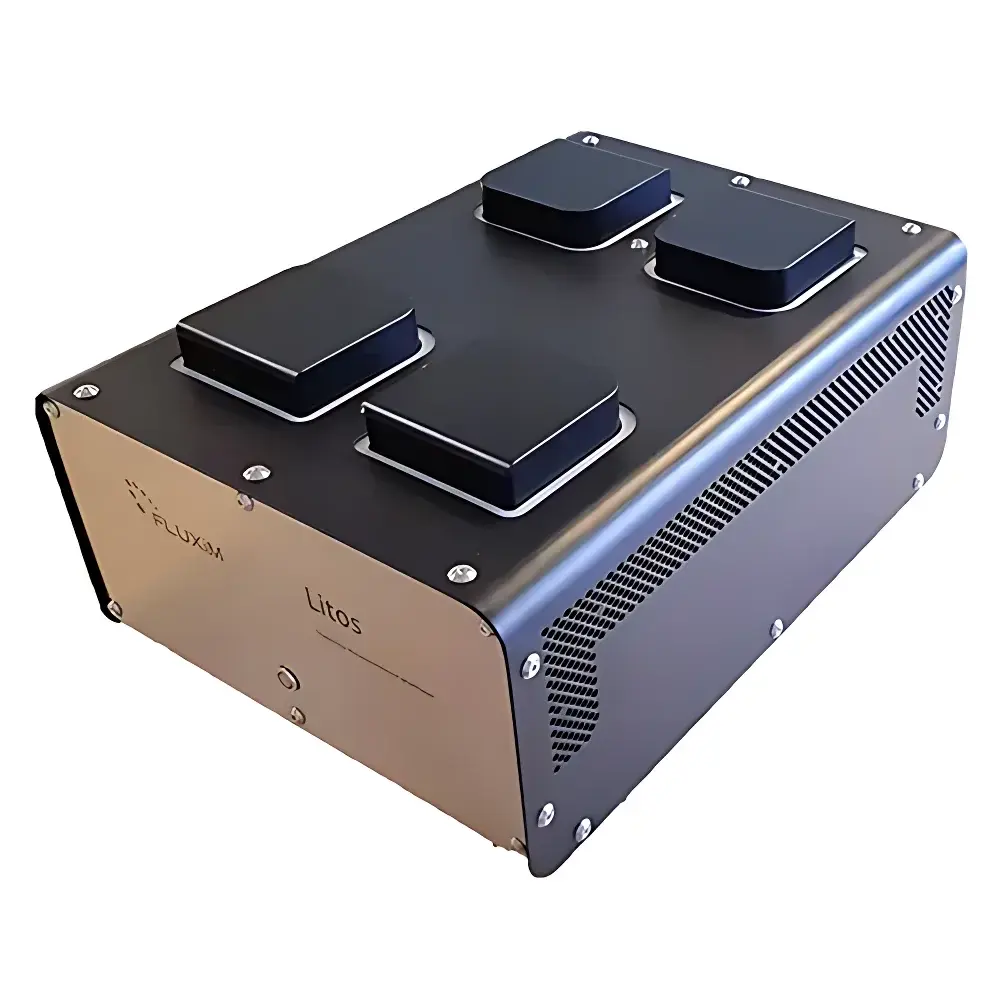
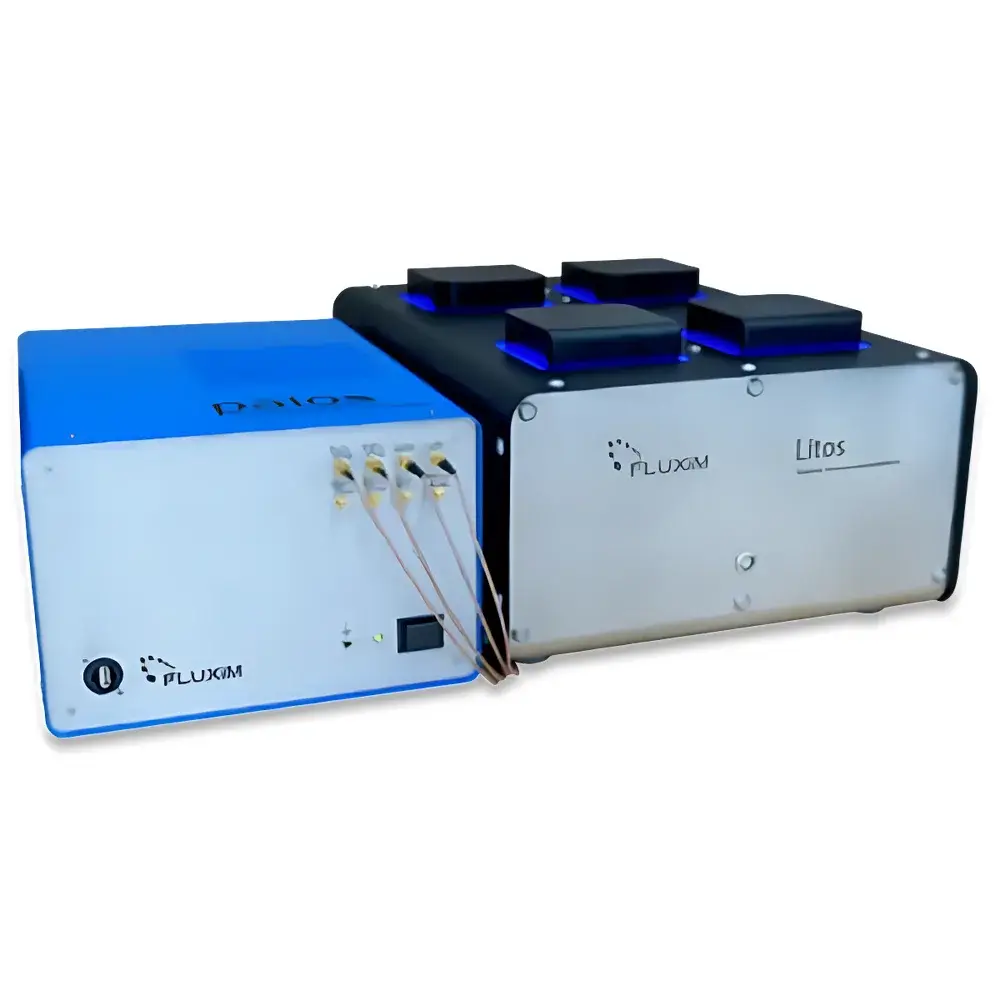
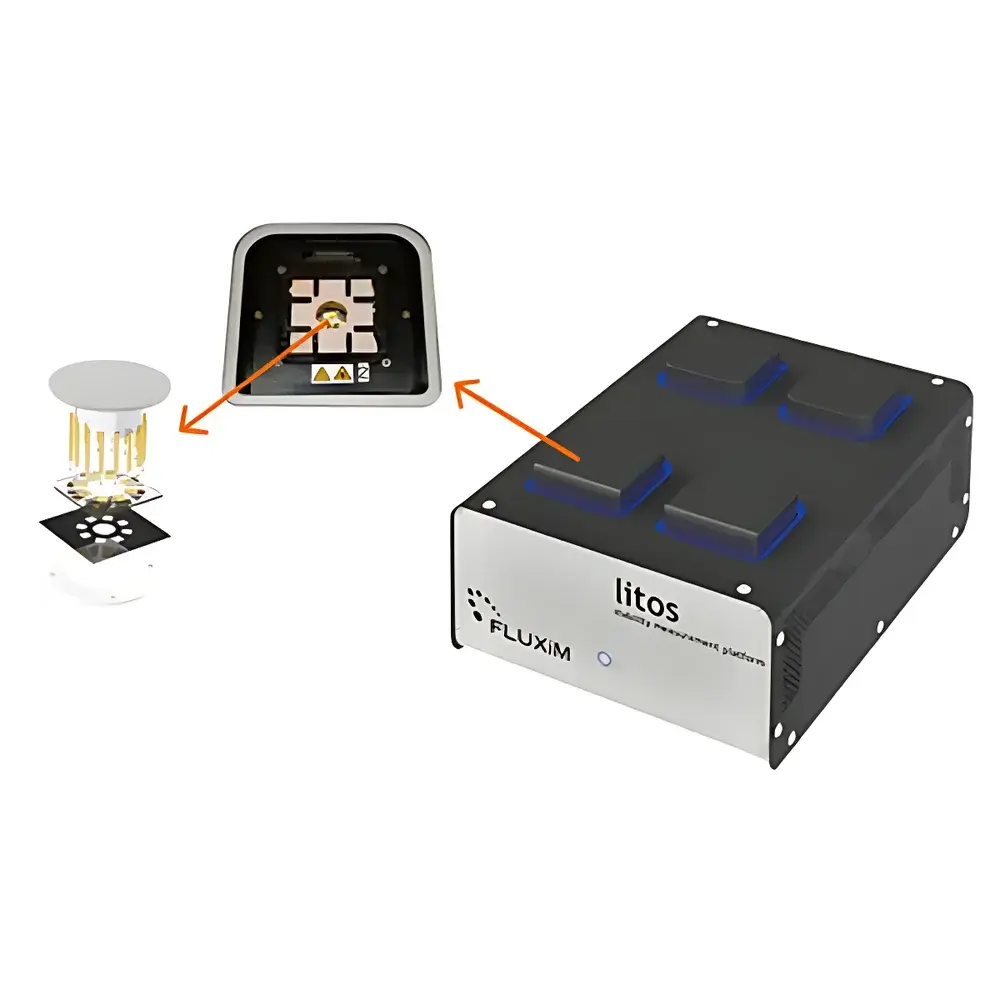
LITOS Multi-Channel OLED Stability Testing System
| Brand | Fluxim |
|---|---|
| Origin | Switzerland |
| Model | LITOS |
| Channel Capacity | 16–32 parallel channels |
| Environmental Chambers | 4 independent, sealed chambers with individual temperature/humidity/light control |
| Temperature Range | 0–125 °C |
| Voltage Range | −10 V to +10 V |
| Current Range | ±20 mA per channel |
| Sample Size Support | up to 2-inch substrates |
| Compliance | ISOS protocols (ISOS-L-1, ISOS-L-2, ISOS-O-1, ISOS-D-1) |
| Optional In Situ Spectroscopy | UV-VIS absorption (PV mode) or electroluminescence (OLED mode) |
| Integrated PAIOS Transient Platform Support | J-V, CELIV, DLTS, TPV, TPC, TEL, IMPS/IMVS, IS/CV |
| Automation | Full script-driven operation with timestamped data logging and real-time curve generation |
Overview
The LITOS Multi-Channel OLED Stability Testing System is a modular, research-grade platform engineered for high-throughput, accelerated stability assessment of optoelectronic thin-film devices under rigorously controlled environmental stressors. Designed and manufactured in Switzerland by Fluxim AG, the system operates on a dual-mode architecture—supporting both OLED emissive device characterization and photovoltaic (PV) device evaluation—including organic photovoltaics (OPV), perovskite solar cells (PSC), quantum dot solar cells (QDSC), and hybrid organic-inorganic absorbers. Its core measurement principle combines precision electrical biasing (constant current/voltage modes), calibrated optical excitation (white LED + UV LED arrays), and synchronized environmental conditioning across four independently regulated sealed chambers. Each chamber accommodates up to eight device substrates (maximum 2-inch format), enabling up to 32 parallel test channels. The system integrates seamlessly with the PAIOS transient analysis platform to extend functionality beyond steady-state aging into dynamic carrier kinetics—such as charge extraction (CELIV), trap density profiling (DLTS), transient photovoltage (TPV), and intensity-modulated photocurrent spectroscopy (IMPS)—all while maintaining full thermal and illumination control.
Key Features
- Four fully isolated environmental chambers with independent regulation of temperature (0–125 °C), relative humidity (5–95% RH, optional), and broadband illumination (1–10 sun equivalent, white + UV LED sources)
- Modular configuration supporting OLED mode (top/bottom emission compatibility, electroluminescence monitoring, luminance decay tracking) and PV mode (MPP tracking, J-V hysteresis analysis, in situ UV-VIS absorption)
- 16–32 parallel measurement channels with programmable bias control (−10 V to +10 V, ±20 mA per channel) and auto-ranging current sensing
- Native integration with PAIOS transient instrumentation for time-resolved characterization including TPV, TPC, TEL, IMPS/IMVS, impedance spectroscopy (IS), and capacitance-voltage (CV) profiling
- Compliance-ready architecture: configurable test sequences aligned with ISOS-L-1 (light soaking), ISOS-L-2 (light+temperature), ISOS-O-1 (operational stability), and ISOS-D-1 (dark storage) protocols
- Script-based automation via Python API and native GUI; all measurements timestamped with metadata (T, RH, irradiance, bias history) and exported in HDF5 or CSV format
Sample Compatibility & Compliance
The LITOS system accommodates rigid and flexible substrates up to 2 inches in diameter, including ITO/PEDOT:PSS/active layer/metal stacks typical of OLEDs and inverted/regular PSC architectures. It supports both bottom-emitting and top-emitting OLED configurations through optimized optical path design and non-invasive contact probing. For PV testing, MPP tracking is implemented using incremental conductance algorithms with sub-second update rates, ensuring accurate power degradation quantification under variable illumination. All hardware and software modules are designed to meet GLP-aligned documentation standards, supporting audit trails, electronic signatures, and version-controlled test protocols—critical for regulatory submissions under FDA 21 CFR Part 11 or ISO/IEC 17025-accredited laboratories. Environmental chamber calibration certificates (traceable to NIST or METAS standards) are available upon request.
Software & Data Management
The LITOS Control Suite provides a unified interface for experiment definition, real-time monitoring, and post-processing. Users define multi-step stress profiles—including ramped temperature cycles, pulsed illumination sequences, and bias polarity switching—with conditional triggers (e.g., “pause if luminance drops below 80% of initial value”). Raw data streams (voltage, current, photodiode signal, spectrometer frames) are stored in hierarchical HDF5 files containing embedded metadata (channel ID, chamber ID, timestamp, environmental setpoints). Built-in analysis modules compute T80, T50, activation energy (via Arrhenius fitting), and degradation rate coefficients. Export options include publication-ready SVG/PDF plots, batch statistical summaries (ANOVA, Weibull lifetime modeling), and direct import into MATLAB, Python (via h5py), or OriginLab. Audit logs record all user actions, parameter changes, and system events with SHA-256 hashing for integrity verification.
Applications
- Accelerated operational lifetime testing of OLED emitters under ISOS-O-1 and ISOS-L-2 conditions
- Photochemical degradation kinetics of perovskite LEDs (PeLEDs) and QD-LEDs under controlled UV exposure
- Light-soaking stability assessment of OPV and PSC devices per ISOS-L-1 protocol
- Correlation of transient photocarrier dynamics (from PAIOS) with long-term degradation pathways
- Humidity-induced interfacial delamination studies in encapsulated flexible OLEDs
- Multi-stress screening (thermal + light + bias) for reliability qualification of next-generation emissive displays
FAQ
Does the LITOS system support in situ electroluminescence spectral monitoring during OLED aging?
Yes—when equipped with an optional fiber-coupled spectrometer module, the system captures time-resolved EL spectra (350–1000 nm, 0.5 nm resolution) at user-defined intervals without interrupting bias or environmental conditions.
Can the same hardware platform be reconfigured between OLED and PV testing modes?
Yes—the core chamber, bias electronics, and environmental controls are shared; only optical components (e.g., integrating sphere vs. collimated beam path) and software modules differ between modes.
Is remote operation supported for unattended long-term experiments?
Yes—the system includes secure SSH access, RESTful API endpoints, and watchdog-triggered email/SMS alerts for critical events (e.g., chamber overtemperature, power loss recovery).
What level of temperature uniformity is achieved across a single chamber?
Typical spatial uniformity is ±0.5 °C at 60 °C and ±1.2 °C at 120 °C, verified with calibrated PT100 sensor arrays placed at nine positions within the chamber volume.
Are calibration services and traceable documentation available for regulatory compliance?
Fluxim provides optional annual calibration packages with ISO/IEC 17025-accredited certificates for temperature, irradiance, and current measurement subsystems, including uncertainty budgets and drift analysis reports.




